
Of all of the modern war lessons that have emerged from more than four years of war in Ukraine, the rapid rise of weaponized drone technology and the necessary race to develop systems to counter them has arguably received the most attention—and the most resourcing by militaries around the world seeking to address it. Notable examples like fiber-optic drones, which are impervious to electronic warfare countermeasures, and Ukraine’s Operation Spiderweb, which used hidden drones to attack Russian strategic airfields, have exposed vulnerabilities to military forces operating from static, easy to identify locations.
For US forces, the lessons learned vicariously through the war in Ukraine are being reinforced by the combat operations in the Middle East they are now engaged in. The threat of weaponized drones is quickly shifting from academic to existential for units deployed within range of Iranian and Iranian-aligned militia groups’ one-way attack and first-person-view drones in the Middle East. Despite a major push by the US armed services into counterdrone improvement, a simple, low-tech solution is being overlooked: the antidrone net.
In 2016, the Modern War Institute published an article by Major John Spencer titled “The Most Effective Weapon On The Modern Battlefield Is Concrete.” In it, John explored the role that concrete played during operations in Iraq and Afghanistan, specifically emphasizing its importance in the 2008 Battle of Sadr City. The article sets itself apart from other analyses of battlefield problems, not by exploring the exquisite solutions the US military habitually looks to, but by focusing on an easily overlooked piece of passive military equipment—concrete. His article points the spotlight on an almost mundane thing while also acknowledging the planning nuance and scale required to effectively use concrete as a “weapon.” Employing concrete barriers to disrupt the flow of weapons and protect civilian populations is a simple solution even if it is not an easy one to implement. Through the active work of thousands of soldiers over repeated deployments, the Army learned how to employ concrete at scale and with mission level specificity to counter the rise of improvised explosive devices. If we could counter that threat with a simple solution, why not seek to do the same for drones?
The Logic of Passive Defenses
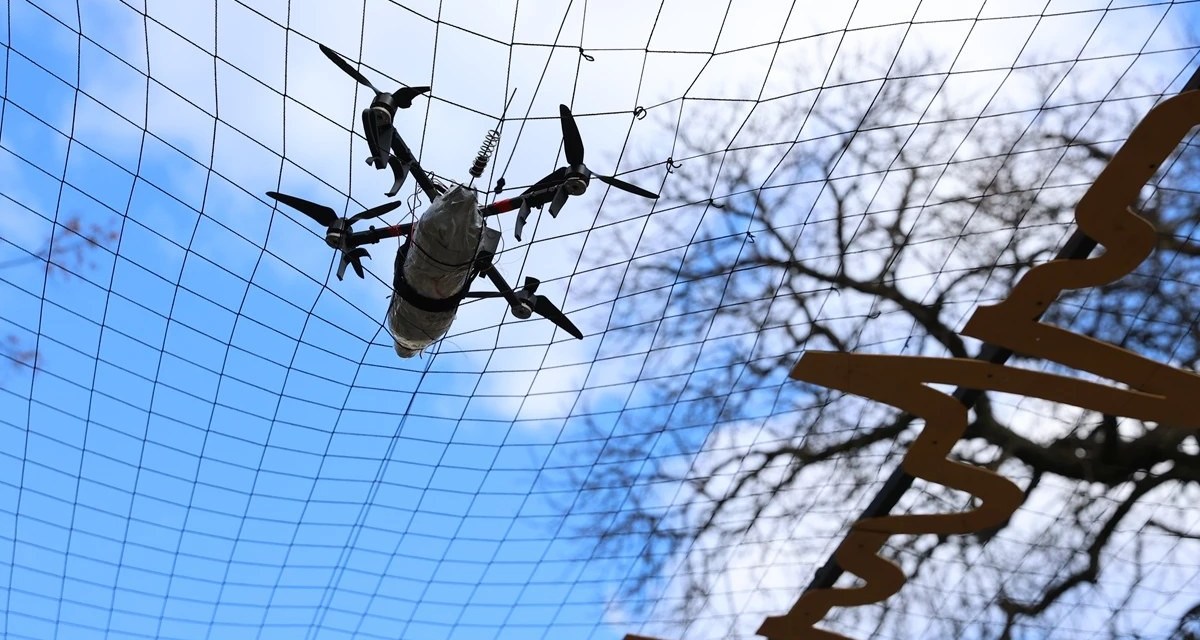
As a first order of business, it is necessary to establish the fact that antidrone nets work. This should not be up for debate, but I encourage those who are unfamiliar with the utility of antidrone nets to review an in-depth tactical analysis of antidrone nets by the UK defense blogger Think Defence and read about their current application in Ukraine from articles by United 24 Media and NPR. Antidrone nets—like concrete barriers—are effective passive defenses for two reasons. First, they prevent the explosive payload of an attack drone from hitting its desired target. Second, antidrone nets deny freedom of movement to attack first-person-view drones, which rely on maneuverability and access to locate and attack the best available target. Direct comparisons can be made to concrete: It provided a physical barrier to improvised explosive device payloads, and the strategic emplacement of concrete barriers denied freedom of maneuver of vehicle-borne explosives to position alongside US forces. In fact, the Department of Defense recently recommended the use of antidrone nets to protect critical US infrastructure.
Given the imminent threats US military bases face in the Middle East from drones—to include fiber-optic first-person-view drones—antidrone nets are a low-cost, proven drone defense method that should be incorporated into counterdrone planning. Two recent examples of drone attacks against US bases in Iraq serve as an example for the benefit of antidrone nets.
In March, the Islamic Resistance in Iraq—an umbrella network of Iranian-backed militant groups—released video footage of an attack against a US AN/MPQ-64 Radar and a UH-60 Blackhawk using first-person view drones. In both cases, the exposed military equipment lacked any type of overhead protection. These attacks are not isolated incidents, and as the United States increases its force presence in the Middle East, it is a guarantee that there will be an increase in the amount of personnel and equipment that is vulnerable to similar attacks.
What to Do
In order to effectively incorporate antidrone netting into the US military’s layered defense planning, we can look to two key lessons from the successful weaponization of concrete to counter the threat of improvised explosive devices. The first is that improving one’s passive defenses is an investment—in time, money, manpower, and special equipment. The second is that innovative passive defense adoption, whether concrete or antidrone nets, often begins with improvisation, which later leads to standardization and scaled solutions.
John’s article highlights the important fact that concrete didn’t spontaneously appear in the areas it was needed. It required dedication of work details to install the concrete, it required contracting support to purchase and ship the concrete, and it required dedication of engineering vehicles to transport and install the concrete. In short, it needed investment. Likewise, our bases will not spontaneously grow antidrone net protection. Unit leaders must invest their manpower, logisticians, and organic assets into proactively procuring, installing, and maintaining antidrone nets to protect their positions. A unit that does not currently have a solution for purchase, movement, installation, and maintenance of antidrone netting is like a unit in 2008 planning to occupy bases without concrete barriers.
By the time concrete was employed to disrupt the threat of improvised explosive devices in 2008, John—a company commander during the Battle of Sadr City—and his peers knew the difference between Jersey, Alaska, Texas, and Colorado barriers. They knew exactly how many twelve-foot T-walls a brigade could install in one period of darkness (~122). This was the result of standardization brought from years of improvisational application of concrete as a passive defense. Currently, the US military is still in the improvisational phase of antidrone net defenses. We need to quickly develop standardized tactics, techniques, and procedures to address fundamental questions: What antidrone netting is suitable for group 1, group 2, and group 3 drones? How much time does it take to set up antidrone netting for a patrol base, vehicle, or fire base? How many shipping containers are necessary to deploy a brigade’s worth of antidrone netting equipment? What national stock numbers or commercial off-the-shelf equipment is available for units to procure and ensure they have the necessary netting, support poles, and anchors required for antidrone defenses? What effect do different antidrone netting solutions have on existing electronic warfare equipment like radar systems, aviation platforms, and active counterdrone systems?
While tactical units experimenting at the tactical edge and in combat training centers develop answers to these questions, the US defense industrial base can help with the dual challenges of innovation and scale. Innovations in the form of lighter weight, stronger material, and other characteristics will steadily improve the antidrone netting available to US units. And scale in the form of enterprise-level accessibility to standardized deployable kits, military specifications for antidrone netting, and introduction of antidrone netting into the Defense Logistics Agency catalog will speed unit’s ability to get the netting they need, where they need it, more quickly and efficiently.

Drones are a reality of modern warfare, and the United States has yet to develop a perfect solution to this threat. While we continue to invest in the development and rapid fielding of counterdrone equipment that leverages cutting-edge science in electronic warfare and kinetic solutions, we must also make use of low-tech solutions that are immediately available to increase the survivability of our warfighters and equipment. Antidrone nets should be an integral part of a layered defensive plan that incorporates both active and passive measures. As the US Army’s experience with concrete in Iraq shows, even low-tech solutions can have disproportionately high levels of life-saving significance. That experience also shows that low-tech solutions still require an investment in time and resources to be maximally effective. Now is the time to make that investment in such a critical component of a layered defense system to counter the large—and inevitably growing—threat posed by enemy drones.
Major William Mayne is a Special Forces officer currently assigned to US Army Special Operations Command. He recently completed two years as a company commander in 7th Special Forces Group (Airborne) and has operational experience in Central Europe, Panama, and Afghanistan.
The views expressed are those of the author and do not reflect the official position of the United States Military Academy, Department of the Army, or Department of Defense.
Image credit: Lviv Regional Military Administration