
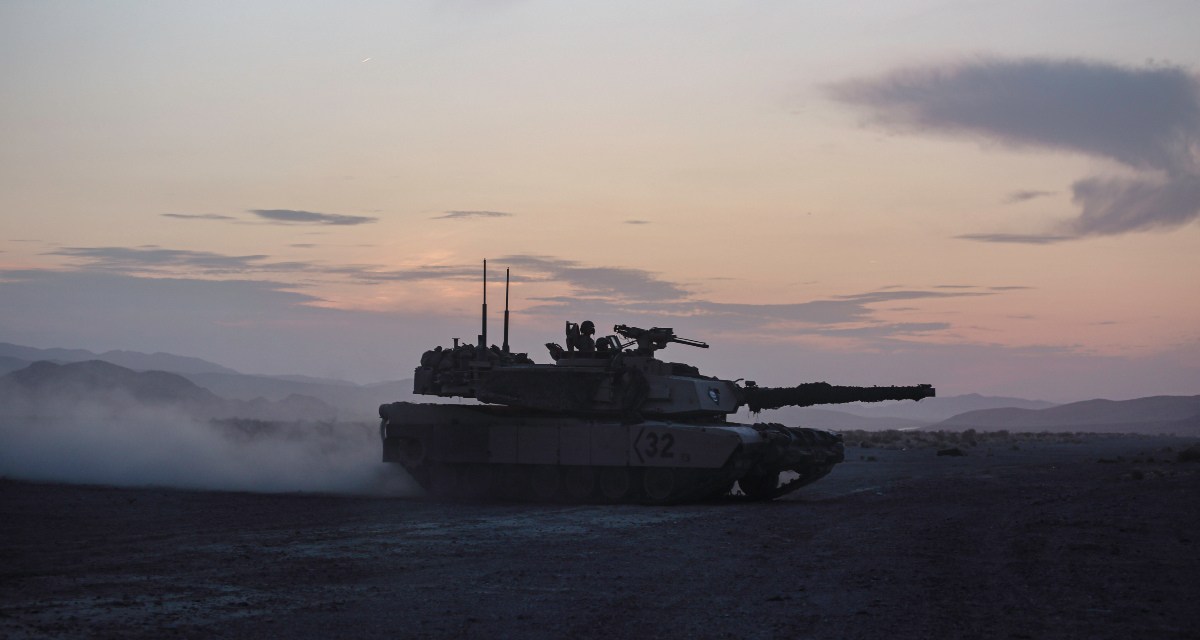
For the past several years, scholars and practitioners have vigorously debated the utility of armored formations on an increasingly lethal modern battlefield characterized by a proliferation of sensors, precision long-range fires, and integrated command and control networks. Recent campaigns—including the 2006 Hezbollah-Israeli War, the 2017 Battle for Mosul, the 2020 Second Nagorno-Karabakh War, and the 2023 Ukrainian counteroffensive against the Surovikin Line—appear to support claims that maneuver warfare is no longer viable. Commentary and debate, ranging from superficial, media-driven reactions to deeply researched analysis, between casual observers, scholars, and practitioners, continue unabated.
It is true that armor and combined arms maneuver face significant challenges in the contemporary operating environment. Yet, while these challenges are formidable, they are not insurmountable. To overcome them, armored and cavalry warfighters must develop new concepts, train and organize differently, and prepare to integrate new capabilities into new combined arms formations. However, the fundamental role and value proposition of armor remains unchanged. Armor—when operating as part of joint, combined arms team—possesses the means to survive dense adversary reconnaissance-strike complexes, rupture the enemy’s prepared defenses, and continue an unrelenting advance into the enemy’s vulnerable rear area. There is no formation better suited to these tasks than US Army armored formations. The Army’s armor branch is driving the transformation of our combined arms formations to meet the current and future challenges of modern warfare, but armor’s viability will rest on maintaining the momentum of that transformation.
The Challenges of Modern Combined Arms Maneuver and Enduring Value of Armor
At least two challenges—one old and one new—contribute to the positional nature of warfare in the modern era. The first of these is an inherent function of large-scale combat operations against a peer adversary, the scope and scale of which limit offensive maneuver. Operational planners have historically sought out the gap, seam, or assailable flank that allows friendly forces to penetrate the enemy’s prepared defenses. However, peer adversaries can field ground armies with enough combat power to man continuous defensive positions, in sufficient depth, to necessitate costly offensive operations to penetrate those prepared defenses. The risk of culmination prior to exploitation of successful penetrations is real. Even if the attacker is successful in penetrating prepared defensive positions, defending commanders race to consolidate their surviving forces and reposition reserves to establish subsequent defensive positions, thereby restoring the integrity of their defensive lines.
Air-ground coordination has been an integral part of overcoming this first set of challenges. Control of the air has allowed ground forces to concentrate and penetrate prepared defenses without fear of punishment by enemy air strikes. It also protects the immense logistical tail that, if targeted successfully by enemy air strikes, could halt forward momentum, force early culmination, and leave armored spearheads stranded. Enabled by close air support and interdiction, armored combined arms formations can break through and break out. Such air-ground integration has enabled spectacular battlefield victories throughout modern military history: the German invasion of France, the Israeli defeat of the Egyptians in the 1973 Yom Kippur War, and the US-led coalition’s success in Operation Desert Storm. However, while US and allied militaries have long enjoyed unrivaled control of the air, our adversaries are increasingly able to contest the air domain and bypass our air-control capabilities, threatening the viability of maneuver in future wars.
This represents a new, second challenge: The integration of pervasive sensors and long-range precision fires into a reconnaissance-strike complex frustrates the ability of the attacker to achieve surprise, concentrate forces, and build and maintain the tempo necessary to exploit success. In recent years, our adversaries have established robust integrated air and missile defense systems to contest the air domain and deny US and allied air forces the ability to contribute to operations in the land domain. Without the benefit of close air support and air interdiction, penetrating adversary defenses and fixing and isolating reserves becomes exceedingly challenging. Cheap drones, loitering munitions, and precision-guided missiles now allow enemy forces to bypass Western advantages in the air and provide them the historical contribution of airpower: sensing and striking. This fusion of pervasive surveillance and long-range precision fires—called reconnaissance-strike tactics—further frustrates friendly ground commanders’ ability to conduct maneuver. As a result, a new, contested dimension of the battlefield has emerged, in which the future viability of combined arms maneuver will be determined: the air-ground littoral.
The contested nature of the air-ground littoral and the effectiveness of adversary reconnaissance-strike complexes once again challenge the ability of armored formations to achieve surprise, concentrate forces, and maintain tempo. The dense sensor-to-shooter kill webs formed by the integration of both sense- and strike-capable drones, offensive and defensive electronic warfare, and long-range precision fires has extended the killing ground through which attackers must transit. This exacerbates the historic challenge for attackers attempting to penetrate well-prepared defensive positions comprised of countermobility obstacles and lethal antitank direct fires. While these challenges are formidable, they are not insurmountable. The unique capabilities of combined arms armored formations provide the most viable means of breaking through prepared defenses, seizing and holding ground, and, under the right conditions, restoring maneuver to the contemporary battlefield.
Many observers overlook an important fact: Enemy reconnaissance-strike complexes and their ability to contest the air-ground littoral are neither monolithic nor arrayed uniformly throughout the battlespace. Unevenness of capability across the front line creates opportunities for offensive maneuver, as the success of Ukrainian counteroffensives in Kharkiv and Kursk in 2022 and 2024 can attest. Thus, creating and exploiting positions of relative advantage—the core idea behind maneuver warfare—remains viable. US military leaders should not abandon maneuver and resign themselves to assuming a positional or attritional mindset simply because the conditions of the modern battlefield make it challenging. The conditions of modern warfare encourage positional warfare, but do not dictate it.
Armor’s historic battlefield role remains central to joint success. Armored formations penetrate prepared defenses, seize and hold ground, and dislocate enemy formations. Armor’s protected firepower and mobility enable ground commanders to threaten broad sections of the enemy’s defensive line and to rapidly deliver a powerful combined arms blow when and where opportunities arise. That same protection, mobility, and firepower in exploitation allows ground commanders to transform tactical success into an operational position of advantage. Exploitation into the enemy’s support area, where many of the capabilities of the reconnaissance-strike complex reside, allow ground commanders to knock down the pillars on which the enemy’s means for contesting the air-ground littoral rest. There simply is no organization within the United States military better suited to navigate the no-man’s land formed by the enemy’s reconnaissance-strike complex and to rapidly penetrate the enemy’s prepared defenses than the armored brigade combat team. And there are no organizations better suited to exploit those penetrations and achieve an operational position of advantage against enemy ground forces than the US Army armored division and armored corps.
Four Conditions Necessary for Successful Maneuver: Reconnaissance, Masking, Suppression, and Isolation
Maneuver by armored formations is viable, but only under the right conditions. Achieving local dominance in the air-ground littoral is of paramount importance before armored formations are committed to the fight. New concepts for achieving this include the creation of “zones of proximal dominance” or “reduced enemy drone activity/opportunity areas” and are worth examination. Recently, Ukrainian forces experimented with approaches that offer the potential to restore maneuver through the application of combined arms in a seven-phase approach. Any proposed solution will require combined arms. Before penetration, seizure of terrain, and dislocation of enemy formations can occur, commanders must establish conditions for maneuver through reconnaissance, masking, suppression, and isolation. Identifying vulnerabilities across the tactical and operational depth of enemy defenses requires augmenting traditional reconnaissance with sensing drones and electronic warfare support. Integrating loitering munitions, strike drones, electronic warfare, and artillery blinds the enemy’s sensor network, masking friendly forces and securing surprise. These combined joint fires suppress enemy strike assets and isolate their formations, preventing them from massing effects during breakout operations. Simultaneously, layered electronic warfare, air defense, and counterdrone capabilities shield the formation to prevent culmination. Ultimately, transforming how the armor force thinks, organizes, trains, and equips to execute this modern combined arms approach must be our central priority.
Armor’s Transformation in Progress
Armor, as part of the combined arms team, must develop the capability to dominate the air-ground littoral to penetrate no-man’s land and prepared defensive positions of a peer adversary. Today’s armored brigade combat team, armored division, and armored corps cannot combine yesterday’s arms to solve the problems posed by tomorrow’s battlefield. We must develop new concepts for fighting, organizing, training, and equipping the armored formations that can combine the arms of the future to achieve dominance in the air-ground littoral.
Senior armor leaders are at the forefront of this intellectual effort, publishing concepts that address the challenges of the contemporary battlefield. For example, the 1st Cavalry Division’s wave-based, all-arms approach describes how armored divisions can achieve a temporary window of dominance in the air-ground littoral. This concept integrates detection, precision strike, and suppression with layered protection to enable the penetration and exploitation of enemy defenses, aligning closely with the way in which the Ukrainian forces are actively experimenting.
Under the Army’s “transformation in contact” initiative, several armor formations are experimenting with new drone, counterdrone, air defense, and command-and-control capabilities at home station and the National Training Center. In October 2025, 2nd Brigade, 1st Cavalry Division experimented with organizational design changes to increase the fighting capability of the armored brigade combat team. This included a multifunctional reconnaissance-strike troop, heavy cavalry troops, and armored strike troops and sections. These redesigned formations were fielded new capabilities, to include drones, loitering munitions, and counterdrone and electronic warfare capabilities. In May 2026, 2nd Brigade, 3rd Infantry Division experimented with a significantly different organizational design to sense and strike out to forty kilometers. Observations and lessons learned from these rotations serve as the basis for ongoing dialogue and collaboration across the armor community. Experimentation will continue well into next year, as future armor rotations at the National Training Center offer opportunities to build on lessons learned.
Transformation extends beyond designated transformation-in-contact brigades. The US Army Armor School and III Corps have partnered on the Armored Transformation and Standardization Initiative to drive action across the entire armor force. For instance, the 4th Infantry Division is leading efforts to increase our formation survivability, informing the development of Training Circular (TC) 3-90.10, Brigade Combat Team Cover, Concealment, and Camouflage. The 1st Infantry Division is leading the development of unmanned aircraft system training standards, contributing to the publication of Army Techniques Publication 3-90.51, Tactical Employment of Small Unmanned Aircraft System [sUAS], TC 3-20.32-111, Training: sUAS Operator, Group 1 and 2, and TC 3-20.32-113, Gunnery: sUAS Crew. The 1st Armored Division is establishing counterdrone training standards for the armor force. And the 1st Cavalry Division is leading the development of the armor strike platoon manual.
On the institutional side, the Armor School is adapting initial entry training and professional military education. New functional training, such as the Robotics Master Trainer Course and the Robotics and Autonomous Systems Tactics Leader Course, are being implemented to train a new generation of 19-series operators, master trainers, and leaders.
Despite the recent success of these efforts, the transformation of the armor branch and our combined arms formations are far from over—much work remains. Experimentation with unmanned aircraft has not yet reached the scope and scale of employment observed by combatants in recent conflicts around the globe. Our armored formations remain vulnerable to unmanned aircraft, loitering munitions, and drone swarms until the Army’s recent investments in short-range air defense battalions and counterdrone capabilities bear fruit. Greater investment in and integration of electronic warfare remains an urgent priority. The US Army’s armor community understands these challenges and are pressing the attack to address them. The armor branch must continue to rethink how ground forces fight, organize, train, and equip the armored combined arms formations of the future. Leaders recognize that the branch cannot be myopically focused on maneuver warfare, it must be attuned to the evolving conditions of the modern battlefield, and it must maintain transformative momentum to prepare for future wars.
A Call to Action
However, understanding of how the armor branch is driving change is not shared by all within the ranks. Without this knowledge, junior armor leaders and soldiers worry about how they are going to survive, fight, and win with what exists in unit motor pools today. Continuous transformation of the branch requires ownership by leaders at all levels. Rigorous, battle-focused training, championing armor’s role in a joint, combined arms fight, and aggressive sharing of lessons learned across the force will accelerate our transformation, but only if those leading it are well-informed.
Senior leaders should prioritize leader professional development programs that create greater shared awareness for how armor is transforming and their units’ role within it. The Armored Transformation and Standardization Initiative and Armored Brigade Combat Team Warfighters’ Forum are platforms for achieving this. Our junior leaders must better understand the Transformation taking place if they are to lead and contribute to it.
Junior leaders also have a crucial role to play in armor’s continued transformation. To remain relevant on the modern battlefield, they must be both readers and writers. Junior leaders must write to share their experiences and insights in experimentation. Write for the Modern War Institute. Write for Military Review and the Center of Army Lessons Learned. Armor’s continuous transformation will be incomplete if it is exclusively driven from the top-down. The US Army armor branch does not operate on a preordained vision of the future; instead, it encourages experimentation, intellectual curiosity, and rigorous debate. Leaders at all levels must challenge the status quo and established doctrine to shape new concepts and refine tactics, techniques, and procedures. By putting pen to paper and engaging in the professional forums, practitioners and juniors leaders inject hard-won experience into the institutional bloodstream. Junior leaders of the armor branch—lieutenants, captains, and noncommissioned officers—must lead this charge from the front. Waiting for doctrine to catch up to the realities on the ground risks descent into irrelevance. Units, leaders, and the armor branch are driving transformation to prepare for tomorrow’s challenges, but more work remains, and the future of the armor branch will be written by the armored warfighters and cavalrymen who actively shape it.
Lieutenant Colonel Alan Hastings is an armor officer and currently serves as the squadron commander for 3rd Squadron, 16th Cavalry Regiment at Fort Benning, Georgia. His previous assignments include maneuver observer-coach trainer at the Mission Command Training Program in Fort Leavenworth, Kansas, and squadron operations officer and executive officer of 5th Squadron, 4th Cavalry Regiment at Fort Riley, Kansas.
Major James Casey is an armor officer currently serving as the executive officer for 1st Battalion, 635th Armored Regiment of the Kansas National Guard. He has served previously as a tank company commander, tank company executive officer, and tank platoon leader.
Captain Elijah Leroux is an armor officer, currently attending the Harding Fellowship Program at the University of Kansas. He has served previously as a tank company commander and tank platoon leader.
The views expressed are those of the authors and do not reflect the official position of the United States Military Academy, Department of the Army, or Department of Defense.
Image credit: Spc. William Vu, US Army