The Army has new operational warfighting guidance. General Christopher LaNeve’s How the Army Fights organizes landpower around four interdependent elements that enable operational maneuver: convergence, strike, close battle, and endurance. Although principally concerned with how expeditionary landpower can achieve strategic objectives, this framework has profound implications for maritime campaigns. Nowhere is this more apparent than in the contested zones of the northwestern Pacific, where the US military and its allies face an adversary capable of contesting American access through integrated missile networks, maritime surveillance, electronic warfare, amphibious assault, and increasingly sophisticated networks of unmanned systems. For the Army, this will require employing landpower to increasingly enable naval freedom of action while denying adversary aggression. In that context, the Army’s ability to seize and control terrain, employ fires across domains, integrate multidomain effects, and sustain distributed operations can transform archipelago and littoral networks into fortified positions of operational advantage.
As General LaNeve’s guidance describes it, this requires the Army to employ the operational elements to “maximize our capabilities and formations to create operational maneuver” and “connect battlefield action to campaign outcomes.” This includes heavily investing in capabilities to execute land-based sea denial in contested spaces. Echoing the remarkable success of the Ukrainian Army in defeating the Russian Navy in the Black Sea, the Army should develop fortified positions, disperse mobile formations, array multidomain fires, prepare amphibious assault forces, and project survivable logistics in order to dominate forward positions. Rather than competing with the Navy or Marine Corps for maritime agency, America’s landpower institution can enable these services to deploy into theater, maneuver against threat vulnerabilities, and reconstitute for prolonged operations.
Convergence: Integrating Landpower into Maritime Warfare
Convergence represents the deliberate synchronization of capabilities across domains to create and exploit positions of operational advantage. In How the Army Fights, Army leadership directs that theater armies and corps execute convergence by integrating sensors, command networks, long-range fires, cyberspace operations, and electromagnetic effects to shape opportunity and disrupt adversary systems across expansive horizons. Applied to the Pacific theater, this concept positions the Army as an essential contributor to joint maritime operations by providing long-rage fires, counterfires, forward logistics, and continuous engagement. The resulting requirement is not simply to increase the number of available weapons, but to create cascading dilemmas that undermine the adversary’s ability to position, influence, and fight at depth.
These ideas offer specific application to China’s subversion and aggression in the Pacific region. Relying on its dramatic military modernization of recent years, Beijing’s strategy increasingly leverages integrated reconnaissance-strike networks to identify and track, and in case of armed conflict, disrupt and destroy American-led forces during approach. These systems combine space-based capabilities, unmanned aircraft, coastal radars, electronic surveillance, ballistic missiles, and warships into sophisticated antiaccess and area-denial architectures. However, US Army forces positioned along the first island chain could contest these networks through distributed sensing, multidomain attack, multifaceted deception, and survivable fires. By degrading adversary targeting capabilities, Army forces provide staying power and create opportunity for joint forces to position, maneuver, and win in critical littoral zones.
The Army’s commitment to enabling convergence also depends upon a network of mutually beneficial relationships with regional partners that remain critical to American success in the region. Factors such as access to operationally critical positions, established communications infrastructure, and interoperable targeting networks cannot be improvised after hostilities begin. They require proactive development to expand preconflict coalition capabilities with legitimate and credible implementation. Through the maturation of forward presence, multinational exercises, and redundant theater access, Army headquarters can integrate coalition forces into a cohesive regional effort to assure access and deny aggression. This network would strengthen deterrence by demonstrating that any attack would confront coordinated multinational resistance rather than isolated American forces.
Strike: Projecting Land Fires into Maritime Domains
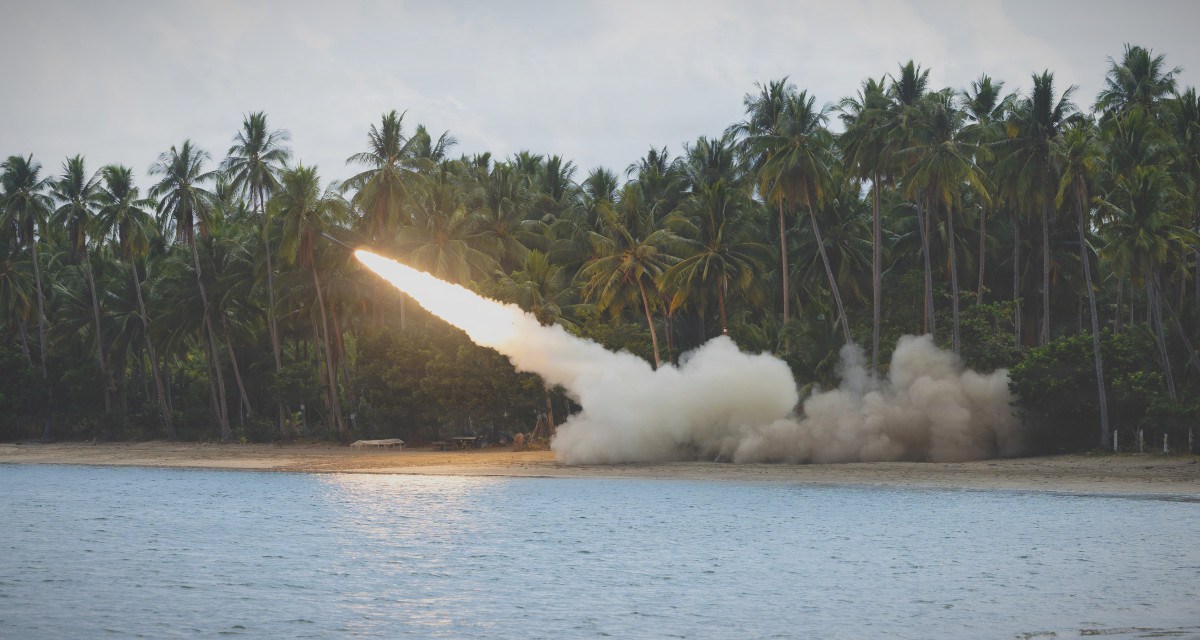
Strike is the second operational element of landpower and is designed to employ lethal and nonlethal effects at extended ranges to degrade and destroy adversary systems. The Army’s energetic modernization of long-range precision fires—with magazine depth and survivability that naval and air services cannon match—creates novel opportunities to control, contest, and deny movement across archipelago and littoral zones along the first island chain. By incorporating emerging technologies that are transforming target acquisition and strike potential, ground forces can exploit new opportunities to interdict maritime targets and destroy command-and-control infrastructure. This will allow Army forces, as part of joint teams, to impose severe costs on adversary efforts to execute naval maneuver, project amphibious assault, and maintain forward positions.
Unmanned systems are playing a critical role in modernizing the Army’s ability to apply multidomain strike at distance in concert with the changing character of warfare. Reconnaissance drones, loitering platforms, and one-way attack systems are increasingly complementing, and sometimes supplanting, more expensive long-range missile systems by providing persistent observation and an ability to negotiate systemic attrition and concentrate for effect. While previously seen by some as the province of other services, the Army’s focused investment in air, surface, and even subsurface drone technologies will vastly expand threat detection distances and support joint efforts to apply sea control with selective area denial.
The effectiveness of these capabilities depends on balancing lethality and survivability to ensure operational endurance. Mobile launchers must disperse rapidly, exploit concealment, and frequently reposition to avoid adversary counterstrikes. The construction of fortified positions, hardened shelters, and perhaps most importantly, credible deception, decoy, and dummy schemes will complement mobility, preserve critical assets, and complicate enemy targeting. Together, investments in both mobile dispersion and fortified strongpoints create resilient forward positions capable of enduring sustained attack and seizing initiative at scale. This would enable naval fleet commanders to maneuver carrier strike groups and support Marine amphibious assault in vulnerable zones. Ground force strike thus becomes a critical operational enabler that expands joint freedom of action in high-threat environments.
Close Battle: Seizing Maritime Positions of Advantage
Close battle remains the decisive element of landpower because physical control of terrain ultimately determines whether military gains can be exploited and preserved. How the Army Fights emphasizes the timeless reality that precision fires cannot independently seize and hold territory, regardless of their destructive potential. This principle is especially relevant in the Pacific, where strategically important islands, ports, airfields, and maritime chokepoints connect coastal land positions with the application of joint sea control. Even in an era where drone swarms threaten to create no-man’s-lands and inflict debilitating losses, forward-positioned infantry and armored formations must be prepared to defend fortified positions and attack to restore positional advantage following adversary aggression.
The defense of strategically important islands should integrate subterranean fortresses with mobile combined arms formations. Hardened command posts, protected ammunition storage, concealed observation sites, and prepared fighting positions would provide measures of survivability against long-range and amphibious attacks. Prioritizing the ability to fight with limited external support and reconstitute under fire, the development of versatile and survivable postures is essential. Together, this would enable friendly forces to counterattack, reinforce threatened sectors, and prevent enemy forces from consolidating lodgments. This combination of positional defense and tactical mobility could transform vulnerable littoral garrisons into more resilient fighting organizations capable of complicating and thwarting threat power projection.
This approach would require integration of novel strike systems to enable, but never replace, fighting soldiers in the crucible of ground combat. While small reconnaissance aircraft could monitor waterways and detect hostile infiltration, drones and loitering platforms would engage landing forces, vehicles, and supporting elements during approach. While electronic warfare systems could disrupt enemy air attack and communications, fortified air defenses and credible deception schemes would protect friendly positions from threat attacks. By preparing to “prevail in extreme environmental positions” in the “most intensely human-centric of all military endeavors,” the integration of fast-moving maneuver forces with multidomain fires would allow Army commanders to hold decisive ground and execute aggressive amphibious operations within a synchronized joint offensive approach.
Endurance: Sustaining Joint Operations at Scale and Distance
Endurance constitutes the fourth operational element and provides the capacity to project, protect, and sustain combat power across time and distance. In the Pacific region, geography makes this requirement extraordinarily demanding because American forces must operate across immense noncontiguous distances while exposed to adversary missiles, drones, submarines, and cyberattacks along elongated maritime and aerial axes of advance. Army logistics, transportation, air defense, engineering, and theater support elements consequently perform an indispensable role in amplifying joint operational tempo and enabling formation resilience. Without the versatile and agile support provided by Army sustainment commands, carrier strike groups and amphibious task forces could potentially culminate before achieving intended effect.
The Army can anchor these distributed logistics networks through development of hardened installations, protected stockpiles, and redundant maritime lines of communication. Rather than concentrating ammunition, fuel, maintenance, and medical capabilities at a few vulnerable facilities, theater commanders will disperse essential resources across defensible locations with redundant protection. Combat engineers could construct fortifications, protective shelters, and alternative operating facilities while transportation units sustain movement between dispersed littoral and archipelago positions. As new delivery technologies mature and change resupply calculous, autonomous aerial, ground, and seaborne distribution platforms will further reduce exposure for manned ships and planes along contested lines of communication.
As demonstrated in the Russia-Ukraine and Iran conflicts, redundant air defenses are proving an existential requirement to safeguard forward positions and enable maritime freedom of maneuver. Army missile batteries, if pre-positioned at survivable sites, will protect ports, airfields, logistics hubs, naval support facilities, and Marine stand-in forces against swarms of adversary missiles and unmanned attacks. By defending these essential lodgments, Army formations would reduce the defensive burden upon naval forces with more limited magazines and preserve warship readiness for operational maneuver. Such protection would build coastal land positions into resilient support platforms from which American naval, amphibious, and aerial forces can avoid debilitating losses and seize the operational initiative.
The cultivation of operational endurance, as a primary concern of forward-deployed theater armies, requires forward-positioned ground forces to leverage industrial capacity, pre-positioned equipment, and durable alliances prior to conflict. As demonstrated in the fighting in Ukraine and Iran in recent months, large-scale combat in maritime settings will consume unmanned systems, strike munitions, and defensive interceptors far faster than existing inventories can be replenished. The Army must prioritize the realistic development of infrastructure and partnerships necessary to sustain prolonged operations rather than assume a short, decisive campaign. This capacity would reinforce deterrence by demonstrating that American-led coalitions forces are prepared to respond with credible strength to adversary aggression.
Enabling Joint Warfare in the Pacific
The Army’s expanding role in the changing character of maritime warfare reflects a timeless military reality: Control over littoral decisive points can have decisive impact at sea. Through the integration of convergence, strike, close battle, and endurance within higher joint concepts, Army formations can unleash multidomain effects, deny adversary maneuver, defend critical terrain, and sustain joint campaigns at scale and distance. These capabilities become critical in the expansive seascapes of the Pacific region where investment in forward positions can create opportunities for resourced ground forces to enable joint sea control through dominating area denial. When fully integrated, this kind of power projection by durable ground forces strengthens strategic deterrence while expanding operational reach for joint force commands.
How the Army Fights directs America’s primary landpower institution to integrate the “interdependent elements of land power to deliver operational maneuver while serving as the unbreakable foundation of the Joint Force.” This concept extends beyond traditional continental campaigns and must emphasize the Army’s irreplaceable role in securing littoral zones in areas of high national interest. While the operational elements provide a framework for organizing ground forces to posture, fight, and win in distant regions under pervasive threat of adversary aggression, the concept applies most acutely in the northwestern Pacific where the Army underwrites the credibility of American force projection. By integrating positional defense, mobile warfare, and multidomain attack with new and innovative approaches, the US Army will remain ready to fight and win in the most challenging of combat environments.
Lieutenant Colonel Nathan Jennings is the director of the Art of War Scholars Program at the US Army Command and General Staff College at Fort Leavenworth, Kansas. With a background in armored warfare, he served combat tours in Iraq and Afghanistan and taught history at West Point. Jennings is a graduate of the School of Advanced Military Studies and holds a PhD in history from the University of Kent. He is a member of the Miliary Writers Guild, a research fellow with Modern War Institute, and an associate editor with Small Wars Journal.
The views expressed are those of the author and do not reflect the official position of the United States Military Academy, Department of the Army, or Department of Defense.
Image credit: Staff Sgt. Yesenia Carrero, US Army