Discussions regarding the defense of Taiwan increasingly feature the idea that low-cost emerging technologies are an answer to China’s geopolitical position and overwhelming military might. China lies 180 kilometers across the strait from Taiwan, making an invasion scenario difficult to block by a US carrier group dependent on distant regional basing. To counter this, Admiral Samuel Paparo, commander of US Indo-Pacific Command, proposed in 2024 a Taiwan “hellscape” strategy, supported by the mass adoption of a variety of uninhabited systems, both aerial and maritime, to stave off a potential invasion from the mainland. Since the proposal, the strategy has gained traction among policy analysts and think tankers, pointing to Ukraine as an example of how a small state may effectively defend itself against a larger and more powerful adversary. These analysts suggest that more attritible aerial and maritime drones saturating the Taiwan Strait would be able to halt a Chinese invasion, perhaps even making such an operation so costly as to deter Beijing from even attempting a military takeover of the island. Most recently, Stacy Pettyjohn and Molly Campbell argued that by significantly increasing and diversifying its arsenal of uninhabited systems and rethinking its operational warfighting concepts to accommodate them, Taiwan can independently guarantee its own security.
Operationally, the hellscape strategy is creative and brilliant, exacerbating the tactical difficulty of an amphibious invasion with a multi-layer robotic defense that frustrates and attrits an invading force beginning eighty kilometers across the strait and continuing all the way past the beaches of Taiwan. Pettyjohn and Campbell describe “four tiers to the Hellscape concept.” The first of these is “the over-the-horizon outer layer” featuring long-range one-way attack drones, antiship cruise missiles, and maritime drones to disrupt China’s ships in the earliest part of the operation. Next is a “muddy middle layer” hosting sea mines to canalize Chinese ships into predictable paths targeted by myriad aerial drones, including loitering munitions similar to Russian Lancets. After this, a “final run to the shore” layer would leverage shorter-range missiles, rockets, and drones targeting the narrow approach Chinese ships would be required to take toward a landing. And finally a beach landing layer featuring a first-person-view drone wall to complement and replicate Taiwanese artillery bombarding any Chinese People’s Liberation Army (PLA) forces that were able to successfully establish a beachhead. Together, this multilayer approach presents Chinese leaders with an incredibly costly operation intended to complicate their decision-making concerning a potential invasion.
At first blush the hellscape strategy appears as an easy policy win. Low-cost, low-risk, attritible drones fielded in high volume should provide a capable and asymmetric defense to the Taiwanese armed forces. In so doing, they may even provide an effective deterrent to a potential Chinese invasion, demonstrating both resolve and the capability to inflict high costs on an invading PLA Navy force. Nevertheless, politically the hellscape strategy will likely prove unrealistic and unrealizable for two broad reasons. First, Taiwan’s armed forces are unlikely to modernize their equipment and doctrine in a such a way that accommodates the strategy. Second, the Taiwanese people are unlikely to agree to a strategy that turns the island into an armed camp. The hellscape strategy is meant to present Taiwan with a workable alternative to US participation in its defense, but in its problems of implementation it actually demonstrates why the United States remains crucial to the island as a deterrent force.
The Organizational Challenge: Retooling Taiwan’s Military for a Hellscape Defense
The hellscape strategy relies on an array of mines, autonomous and semiautonomous drones, and cruise missiles to batter an invading PLA Navy fleet. Today, the Taiwanese arsenal is not equipped for such an operation. To its credit, Taiwan has increased its asymmetric capabilities in the last six years. But this increase has been marginal—its recent acquisition of Harpoon cruise missiles from the United States, for example, amounted to a mere four hundred munitions. According to The Military Balance most of Taiwan’s military hardware acquisitions have been exquisite air and maritime capabilities such as the sixty-six F-16s it purchased in 2019—those these have yet to be delivered. Even this has not been enough. As Aswin Lin points out, while budget allocations to defense increased twofold between 2016 and 2024, “the PLA’s Eastern and Southern Theatre Commands’ order of battle” remain “far superior to Taiwan’s.” To implement a hellscape strategy, then, Taiwan would need to acquire a massive asymmetric capability arsenal at the expense of its current arsenal. Reconstituting Taiwan’s armed forces around a drone fleet appears unlikely for two reasons: sovereignty and military professionalism.
First, militaries make investments in exquisite capabilities often as a public demonstration of sovereignty. State sovereignty has both internal and external components. Internally, sovereign governance depends on the monopoly of legitimate violence. Externally, state sovereignty is dependent on recognition by the international community of states. To gain this recognition, states tell stories about themselves—they build museums, consulates and embassies, and, of course, militaries. Due to its history and relationship with China, Taiwan may not be a traditional state, but it still pursues the recognition of its autonomy and independence in the international sphere. To this end, Taiwan creates military power that is synonymous with a traditional state practice. Its military arsenal includes several hundred fighters including dozens of Mirage 2000s, over one hundred F-16s, and several indigenous fighter aircraft, as well as four attack submarines and four destroyers, and over one thousand armored fighting vehicles—but less than fifty medium-altitude long-endurance drones (including one-way attack drones), four minelayers, and a number of ground-based and ship-based antiship missile launchers. Additionally, while there is a growing indigenous small drone industry in Taiwan, these are produced mainly as exports since, as a former chief of Taiwan’s general staff described, “relying solely on military procurements is insufficient to sustain long-term research and development and industrial scaling.”
To adopt a hellscape strategy, therefore, the Taiwanese armed forces would need to acquire an autonomous and semiautonomous arsenal at the expense of its traditional arsenal. To do so would require a fundamental shift in its organizational culture, away from emulating traditional state militaries. Military organizations can change, sometimes even by their own volition, but these innovations tend to accompany significant political or technological changes in the strategic environment. China’s threat to Taiwan has existed for at least half a century, and its naval and air incursions across the Taiwan Strait median line have been a constant since a controversial 2022 visit to Taipei by US House Speaker Nancy Pelosi. Given Taiwan’s accompanying acquisition history, it appears unlikely it will change its force structure without a significant change in Taiwan’s strategic environment. In fact, the complete abdication of US security guarantees may be the only thing that might force a change in Taiwan’s force structure. In this event, however, it might already be too late to enact the changes necessary to implement a hellscape strategy.
The second difficulty with retooling Taiwan’s force structure stems from the final phase of an invasion scenario—a breakout assault on Taipei—and the need for the Taiwanese citizenry to take up arms in this phase. For the hellscape strategy to effectively deter China, it needs to be more than just a deterrence strategy—it must also be an operational plan that should contain contingencies in the case of an actual Chinese cross-strait invasion. Otherwise, it simply presents a capabilities calculation: If Beijing is confident its hard military capabilities can break through the Taiwanese capabilities that make up the four layers of a hellscape defense, even for a small force, then seizing Taipei may look feasible. So what would a Taiwanese operational plan dictate if the PLA were to successfully establish a beachhead and break out for the capital? The most obvious answer is to leverage two inherent advantages: challenging terrain and the Taiwanese people. In addition to an open and dangerous march through mountain passes on roads or through rice paddies (making maneuver with armor either difficult to conceal or impossible to progress) and over rivers, a Chinese invasion force bent on taking Taipei would encounter an urban warfare environment comparable to an invasion of New York City. In this scenario, Taiwan’s final efforts would likely rely on an insurgent uprising in Taipei and the mountains to its south and east. While the urban and geographic features of this location make an insurgency possible and potentially effective in neutralizing PLA firepower, sustaining such an insurgency over the long term is rendered difficult by the geographical realities of the island—external support will be risky and necessarily limited in scale. Any insurgent operation will thus require incredible belief and effort by the Taiwanese people to enact and sustain it.
Importantly, evidence suggests that the Taiwanese public’s resolve to fight is directly tied to its perception of its military’s capabilities. Research published in 2024 and based on the Taiwan National Defense Survey revealed that “the majority of the respondents who expressed confidence in the Taiwanese military also showed willingness to defend Taiwan” in the event of a Chinese invasion. This finding does not necessarily prove that a change in the Taiwan military’s force structure will decrease the probability of a Taiwanese insurgency against invading forces, but it does raise the question of whether such a change would impact the Taiwan public’s confidence in their military’s ability to mount a successful island defense. Respondents who lacked confidence in Taiwanese defense capabilities were found to be less willing to defend the island against invasion. It should be added that this finding was especially the case among respondents that did not believe the United States would deploy troops to help. As the Taiwan hellscape strategy is designed for Taiwan to be able to defend itself independent of US assistance, this finding should be cause for concern since the hellscape strategy encourages both a reconstitution of the Taiwanese military and a US exit from previous commitments to the island.
The Political Challenge: Selling a Hellscape Defense to the Public
The Taiwanese public presents another barrier to the realization of a hellscape strategy—simply put, to an important degree, their approval is needed for the strategy’s enactment. The Taiwanese elected government maintains what Taylor Fravel calls “civilian supremacy” over its armed forces. One key requirement of civilian supremacy is that existing political institutions ensure that elected governments maintain control over the military. In fact, Taiwan’s transition to democracy in the 1990s was in part determined by the ability of its legislature, judiciary, and press to pressure executive reforms to the military. In the wake of this, as Fravel recounts, “a more activist legislature has bolstered democratic control through increased supervision of the military.” Any fundamental shift in Taiwan’s military arsenal will have to go through the civilian elected government, and by extension, the Taiwanese public.
Perhaps most significantly, for Taiwan to implement a hellscape defense, the Taiwanese public will need to unify around the strategy. In fact, the strategy presupposes a minimal level of consensus regarding the character of the threat facing the island. It is unclear at this point that any such consensus exists. Given current levels of party polarization in Taiwan, any unification around a new strategy appears unlikely. The center-left Democratic Progressive Party (which holds the presidency) and the center-right Kuomintang (which controls the legislature) vehemently disagree not only on approaches to defending the island, but more fundamentally on whether Beijing is even a real threat to Taiwan’s semi-independence.
Even if some consensus around the China threat did exist among the parties, for the Taiwanese people who live out their daily lives on the island, a hellscape approach is a less-than-attractive defensive option. Hanson Baldwin once warned a US audience of the consequences of building a Cold War garrison state, arguing that preparations for “total war transcend the period of hostilities; they wrench and distort and twist the body politic . . . prior to war.” While not a foregone conclusion, it is possible that prepping the Taiwan hellscape ultimately requires an effort equivalent to the creation of a Taiwanese garrison state—a preemptive armed camp that militarizes Taiwanese society. Pettyjohn and Campbell, for example, suggest that Taiwan should focus on hardening passive defenses on the island rather than using its capabilities to intercept Chinese saturation strikes. After having leveraged passive defense to merely survive the initial barrages, Taiwanese defense would shift to shorter-range drone interceptors, antiaircraft defenses, and artillery based out of prepared positions with trenches and obstacles to further disrupt invading forces along their routes to Taipei and other major cities. The required number of individuals to mount such a defense threatens re-empowering the Taiwanese military to a dangerous degree. Taiwan has already deftly defeated martial law, and this was in recent history. It seems unlikely that the public would welcome back this form of governance to enact “fortress Taiwan.”
Finally, the prescriptions found in a hellscape strategy are loosely drawn from lessons learned from the Ukrainian defense against Russia. Ukraine’s effectiveness in denying Russia complete victory in its war of conquest is often seen as a blueprint for how Taiwan might effectively deny China something similar. Indeed, this is the primary aim of the hellscape—a denial strategy “rooted in a force posture aimed at denying a [Chinese] invasion force the ability to achieve a swift victory.” In Ukraine’s case, the effective denial of a swift Russian victory has produced more than four years of attritional war. By 2023, merely one year into the war, “More than 30% of the territory of Ukraine suffered losses from war-related pollution, destruction, bombings, etc. In just half a year of war, the amount of losses from Russia’s military aggression, confirmed by the World Bank, amounts to more than 340 billion dollars.” Ultimately, the argument—This is going to be just like Ukraine—is not the selling point that some might think it is in a Taiwan deeply divided about the threat posed by China and with living memory of military dictatorship.
Problems Without Solutions?
The problems overviewed briefly here are not insurmountable. There is a way that Taiwan can implement a hellscape-like defense strategy and maintain its current arsenal, all while effectively deterring a Chinese invasion and continuing to enjoy its democracy and way of life. Each of these outcomes is achievable under a sustained and credible US commitment to Taiwan’s defense.
For the better part of a century, the United States has relied on strategic ambiguity to perform “dual deterrence” between mainland China and Taiwan, seeking “to deter a Chinese attack on Taiwan while deterring Taipei” from declaring independence. Since the beginning of China’s wolf warrior diplomacy abroad and the crisis of its one country, two systems policy at home, there is reason to think that a decision to invade may not be contingent on Taiwanese movement toward independence—as it has been in the past. If this is the case, strategic ambiguity is no longer a functional dual deterrent strategy, leaving US the options of backing away from Taiwan or committing to its defense.
Without a US commitment, many analysts agree that Taiwan does not possess the military capabilities necessary to fight off a Chinese invasion on its own. The hellscape defense is an attempt to allow the United States to back away from historic commitments to Taiwan. Pettyjohn and Campbell note, the underlying intention of the hellscape “is grounded in Taiwanese self-sufficiency and seeks to identify a theory of victory that is not reliant on the United States.” Yet as I have argued, the Taiwan hellscape is unworkable. Militaries are “born arming” in such a way that displays their sovereignty and likeness to other sovereign states. Taiwan’s populace is not interested in a martial state, and its politics are too divided to enact such a governance structure. Instead, to guarantee the continued existence of this flourishing democracy, the United States will need to be clear about its commitment to defend Taiwan under any potential invasion. Taiwan cannot invest in drones the way it needs to, which means if drones are the answer to a credible defense of Taiwan, it will continue to need US resources to field the drone capabilities necessary to mount a credible defense. The United States remains crucial to the island as a deterrent, hellscape strategy or not.
Wes Hutto is a research fellow at MWI and associate professor of strategy and security studies at the USAF School of Advanced Air and Space Studies, where he teaches courses on military thought, international relations, and technology and military innovation. His research intersects these topics and has appeared in journals such as the European Journal of International Security, Defence Studies, International Politics, and Parameters.
The views expressed are those of the author and do not reflect the official position of the United States Military Academy, Department of the Army, Department of the Air Force, or Department of Defense.
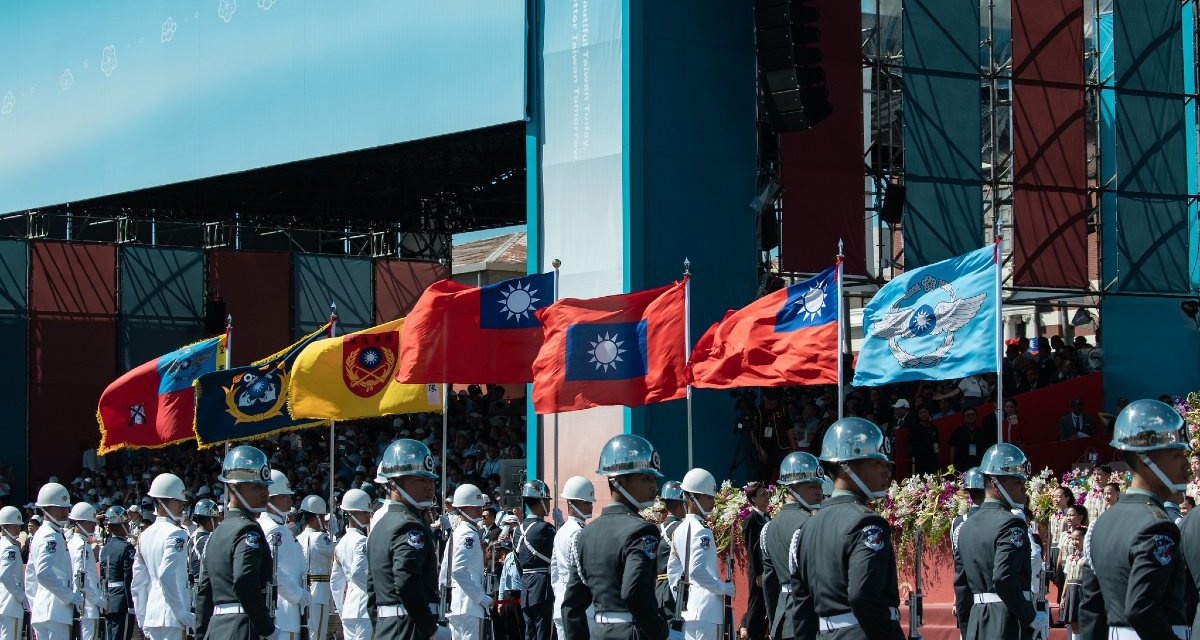
Image credit: Taiwan Presidential Office