General George S. Patton reminds us that a good plan, violently executed today is better than a perfect plan next week. Doctrine agrees. Field Manual 5-0, Planning and Orders Production clearly states that “planning and preparation accomplish nothing if the command does not execute effectively.”
The curious question then is why the Army remains so fixated on the military decision-making process (MDMP) and the laborious and still imperfect plans it produces—especially when there’s another choice at hand. The rapid decision-making and synchronization Process (RDSP) is the Army’s methodology for rapidly revising plans today.
Unfortunately, RDSP is not well known. The last six CTC Trends documents mention MDMP 436 times compared to just 17 for RDSP. In doctrine, FM 5-0 gives MDMP a careful step-by-step description over 56 pages compared to just 7 for RDSP. As of 2020, students at the Command and General Staff College received 30 hours of instruction on MDMP and just 2 on RDSP. The situation is not much better in our Army’s journals. Back issues of Military Review mention MDMP in 37 issues, while RDSP appears in just one. Here at the Modern War Institute, 28 articles mention MDMP while just 3 mention RDSP. Sadly, when RDSP is known, it sometimes gets the bad rap of “two majors in a room, making decisions.”
Assuming lack of attention reveals a lack of awareness, this is a problem. Units should know RDSP, as it provides a timely complement to MDMP. Other writers have noted that RDSP allows well-trained teams to deliver a wargamed course of action that integrates recognized variance in four to six hours, and my own experience as a battalion commander confirms this. Fortunately, this is exactly in line with historically available time for brigade and battalion planning in battle. Where MDMP’s thorough analysis yields plans that are often stale, RDSP by a well-trained staff is both fast and considered.
To win our battles, the Army should rebalance training away from MDMP toward RDSP.
Rapid Operational Decision-Making
RDSP is one of six doctrinal planning methods laid out in FM 5-0. Derived from earlier thinking, the goal of RDSP is an acceptable course of action. Notably, RDSP differs from MDMP in that it generally produces one satisfactory plan, and so omits the course of action comparison, analysis, and selection steps from MDMP. Current and future operations cells drive RDSP by combining “their experiences and intuition to quickly understand the situation and develop a course of action.” However, FM 5-0 is also clear that skill with RDSP does not just appear. Instead, “commanders and staffs develop this capability through training.”
RDSP follows completion of MDMP. MDMP produces the commander’s intent, base plan, and key warfighting products like the commander’s critical information requirements, execution matrix, and decision-support matrix. These tools help account for anticipated variance and decisions. Then, RDSP helps commanders resynchronize operations to stay on track as unanticipated variances from the base plan present themselves.
Variance is the key insight of RDSP. FM 5-0 defines a variance as the “difference between the actual situation and what the plan forecasted the situation would be at that time or event.” After recognizing variance, the commander and staff decide whether minor changes within the commander’s intent are sufficient to address the new opportunities and threats. Faced with substantial variance, the staff might significantly modify the plan or initiate MDMP.
Broadly, RDSP determines how variances impact the planned course of action and then revises the course of action to fit the new conditions over five steps. The first two steps of RDSP assess the situation, determine whether the variance requires minor or significant changes to the existing plan, and outline the unit’s options. The latter three steps develop, refine and validate, and then implement the course of action.
Perhaps because hardly anyone uses RDSP, doctrine better describes what RDSP is than how to do it. There’s a small amount of writing on how to apply RDSP at the division level, but almost nothing for brigades and battalions. These units with smaller staffs are less likely to have fully developed branches and sequels coming out of MDMP, are more taxed by on-call planning, and have the smallest future plans cells. While doctrine emphasizes the continuous nature of the assessment steps of RDSP, pulling small staffs together to focus on RDSP’s assessment steps can come at the cost of other critical staff functions during operations.
A Way
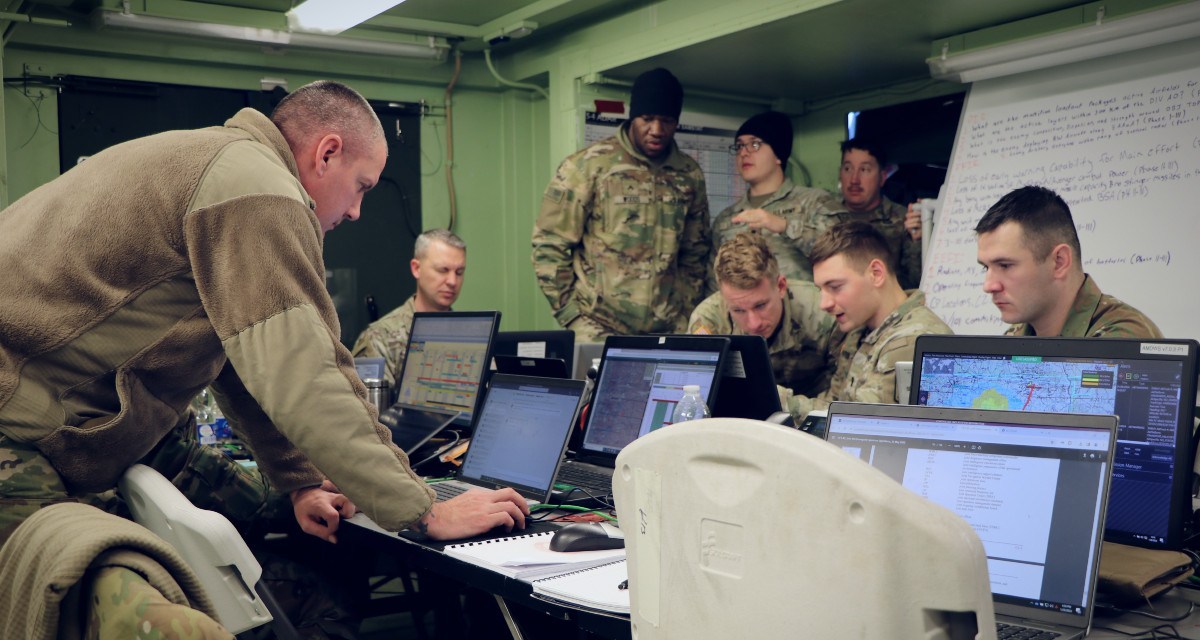
In my battalion, RDSP is the battle rhythm event that starts the daily planning effort. Validated through a Warfighter exercise and National Training Center rotation, we found several benefits to giving RDSP a central role in our planning. First, setting a daily planning period allowed us to also create a small future plans cell that complemented the staff during one twelve-hour shift each day. Second, the battle rhythm event guarded against gradual drift in staff estimates or cross-cutting issues that a single staff section might not catch. Routinely gathering an outside team under the supervision of a more experienced leader increases the likelihood that substantial variances are recognized and addressed.
The key question during the assessment is whether the variances can be handled within the commander’s intent. If it cannot, we begin MDMP. If it can be addressed within the commander’s intent, the staff then generates options to address the variance.
We developed a table to walk our plans cell through RDSP’s assessment steps (an example of the table can be found here). In the first step, the staff compares their updated running estimates against where they expected to be, filling out the “expected situation” and “actual situation” columns of the table below. They are alert for the presence of exceptional information that would trigger an anticipated decision. If no anticipated decision criteria is met, the staff notes the significant variances from the plan in the third column. Finally, the staff generates options the battalion could take to address the variance before moving into course of action development.
Let’s work an example. As Task Force Green’s RDSP meeting convened, the staff gathered key tools: the commander’s intent, the operation order, the commander’s critical information requirements, updated running estimates, a map with enemy and friendly dispositions, the execution matrix, and the decision support matrix. Reviewing their plan, Task Force Green expected both Attack and Battle Companies to be on line at Phase Line ALPHA with fire support, obstacles emplaced, effective communication, and sufficient supplies at a specified time, H+6. Instead, Attack Company had found limited enemy resistance and pushed forward to Phase Line BRAVO. This unanticipated opportunity came with costs: exposed flanks, expended fuel, no fire support, weak communications, and no clear picture of the enemy’s location. With variance across the warfighting functions, the staff completed the assessment table and Task Force Green’s executive officer determined that the situation required significant modification of the existing plan. After an hour of analysis, the staff carried options into course of action development.
In the two hours after the assessment, the planning team developed, refined and validated, and implemented an updated course of action. As they started, the planners incorporated proposed actions from the RDSP table into a single course of action that reinforced Attack Company with proposed changes to the three key warfighting products: commander’s critical information requirements, decision support matrix, and synchronization matrix. The planning team then wargamed this course of action with the box method on the decisive point, updated the warfighting products, and briefed the wargamed course of action to the commander. Upon approval, the assistant operations officer took another hour to turn the approved course of action into a fragmentary order for dissemination, completing RDSP.
In just four hours, Task Force Green’s staff rapidly developed, validated, and implemented a well-synchronized plan that accounted for unexpected variance. Directed courses of action are also quick, but tired commanders are unlikely to identify and address variances as well as a fresh staff.
Winning in Battle
Fixing the Army’s MDMP fixation is an imperative. MDMP is well understood thanks to significant investment in the Army’s schools and units. Students in every course from Battle Staff to the Special Forces Qualification Course invest hundreds of hours learning to develop time-consuming, optimal solutions. Almost none is spent learning how to rapidly revise plans while in contact through RDSP. Each of us has a role in rebalancing away from MDMP.
Units can start today with RDSP. Training and evaluation outline reports 71-BN-5002 and 71-BDE-5002 available on the Army Training Network offer checklists for units that want to effectively adjust their plans and win in combat. Our initial staff training for RDSP leveraged the tools described in this article, a simple tactical scenario, and large language models to build the necessary inputs. With these training inputs in hand, a one- or two-hour class is enough to establish a baseline for how RDSP will work for you. I have also found RDSP a useful framework for tactical exercises and garrison planning. Try it out.
But the Combined Arms Center at Fort Leavenworth could really drive broader change in how the Army decides and synchronizes during operations. The Combined Arms Doctrine Directorate could shift RDSP’s description from what to how by incorporating the table our unit employed. With updated doctrine, both the Command and General Staff Officer Course and the Battle Staff course should shift some hours spent on MDMP toward RDSP, ensuring that graduates return to the field able to both develop ideal plans and adjust them during the battle. Finally, leader training programs for both Warfighter exercises and combat training centers should introduce RDSP as an essential component of their staff education. Together, these reforms will develop leaders who can not only build optimal plans but also adjust them under fire.
MDMP is not enough. Lethal units must rapidly revise plans to seize opportunities and squash threats. Together, let’s push the Army away from exclusive focus on the time-consuming and still imperfect MDMP toward making better decisions in contact with RDSP.
Lt. Col. Zachary Griffiths commands 4th Battalion, 10th Special Forces Group (Airborne).
The views expressed are those of the author and do not reflect the official position of the United States Military Academy, Department of the Army, or Department of Defense.
Image credit: Spc. Andrew Simeri, US Army