
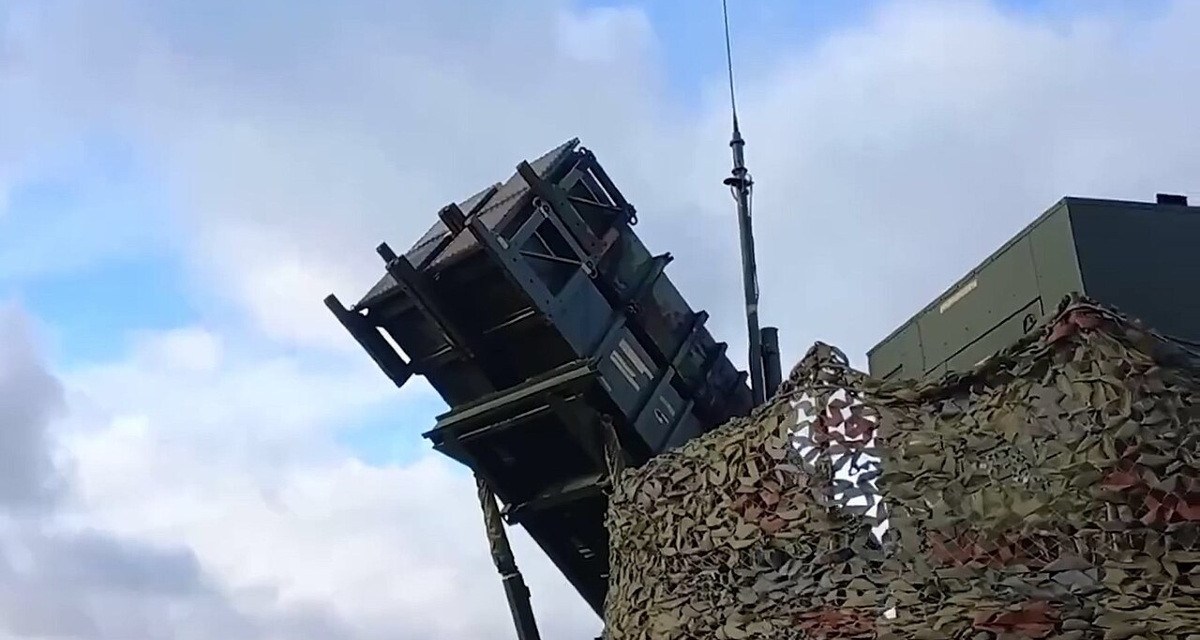
A Russian intelligence, reconnaissance and surveillance drone is on the hunt in eastern Ukraine. Its crew uses electronic intelligence information collected by a surveillance satellite to guide the full-motion video capable drone toward its target. A team of analysts assesses the target as a Patriot air defense system: an expensive and limited target that provides Ukraine its only defense against advanced Russian ballistic and aero-ballistic missiles. The drone crew spots the telltale components—a launcher, a portable electric generator, and finally the true target of the strike, the AN/MPQ-65 Patriot radar. The reconnaissance team rapidly passes the grid coordinates to the strike team, who utilize a group of one-way attack drones to strike and destroy the radar. Russian state media touts it as victory not just over Ukraine, but over the NATO nations that supplied the Patriot system and its munitions and the billions of dollars in aid gone to waste, posting videos of the strike on Telegram for the world to see. However, a Patriot system intercepts a ballistic missile the next day in the same area, protecting critical national infrastructure from Russian attack. Upon closer inspection, Russian mil-bloggers see discrepancies in the video: a launcher station with a nonstandard generator, Patriot interceptors made of what appears to be wood, a crew member calmly driving a tow truck to the destroyed radar. The second look is clear: It was a decoy.
Ukraine’s Decoys
Ukrainian Patriot units use decoys to deceive Russian targeting efforts, maintain coverage of critical Ukrainian infrastructure and population centers, and increase enemy costs. However, the United States primarily relies upon movement between alternate battle positions to stay ahead of adversary targeting. Army air defense units are hamstrung from using decoys by two factors: first, a lack of decoy equipment and employment training at the tactical level; and second, authorities over decoy use that are held at too high an echelon to have meaningful battlefield impact. But by heeding the lessons of Ukraine and addressing these two issues, the Army can equip its air defense commanders at the tactical edge to increase survivability of equipment, impose costs on the enemy, and maintain protection of critical assets.
In May 2025, Russian officials claimed to have already destroyed at least five Ukrainian Patriot air defense systems and as many as five more later in 2025. However, Ukraine had only received seven batteries as of October 2025 and maintains them to defend against Russian attacks despite the losses Moscow claims to have inflicted. Even though the true number of operational Patriot units is not publicly reported, this demonstrates the success of Ukrainian decoys. Decoys force Russia into a constant hunt for Patriot units regardless of how many Russian leaders believe they have destroyed, expending intelligence, matériel, and manpower resources to do so.
These decoys are often medium fidelity, meaning the equipment looks real enough to reconnaissance drones at altitude to be indistinguishable from genuine equipment. Enemy intelligence assets must rely on low-resolution video due to the heavily contested electromagnetic spectrum and the air defense threat to high-end surveillance drones, which have driven both sides of the conflict to utilize attritable, lower-capability intelligence, surveillance, and reconnaissance drones. This environment complicates target identification and lowers the detail required for a decoy to complicate enemy targeting. Although decoys can sometimes be identified upon closer inspection and review of attack footage, by the time one is identified as a decoy it has served its purpose. It delayed enemy targeting efforts and disrupted the targeting cycle, allowing the real unit to either conduct engagements or move to a new location.
These decoys can be made with painted wood, metal, and parts from broken equipment cannibalized for parts. They are cheap, easy to repair, and attritable. Strict emissions control measures among Ukrainian Patriot units further increases decoy viability and plausibility as a real target, in contrast with Patriot units that are more static and radiate on a regular basis. Another key aspect of Ukrainian decoy employment is developing a pattern of life. A team remains near the decoy to reposition the fake radar, launchers, and other life support equipment. Personnel tending to the decoys following strikes further provide Russian forces with false confidence in their assessment.
These techniques have enabled Ukrainian Patriot units to survive for more than three years under constant threat of surveillance, targeting, and attack by a capable and motivated enemy utilizing a mixture of ballistic missiles, cruise missiles, and attack drones. However, Ukraine’s approach relies on resourcing and decentralized authorities to conduct decoy operations. Brigade-, battalion-, and battery-level employment allows units to tailor decoys to their needs. For example, units supporting maneuvering forces may use fewer decoys or require less visual fidelity, while a unit with a more static defended footprint can more deliberately build up decoy employment techniques with higher fidelity. Ukrainian decoy systems are often utilized at the brigade or even battery level. United States Patriot brigade and battalion formations, by contrast, do not possess any organic decoy capability and operate under authorities for decoy employment that are held echelons above.
The US Army’s Two-Headed Decoy Problem
In some conflict scenarios the United States must be prepared for, adversaries and environments will require high-level deception plans and very high-fidelity decoys and deception operations. However, the proliferation of low-cost one-way attack drones, precise missiles, and automatic threat recognition–enabled weapons drive the requirement for good enough medium-fidelity decoys supported by tactical-level DISO (deception in support of operations security) activities to make decoy employment effective. It may be tempting either to try to build the perfect decoy, which is expensive to field and may have special technological considerations, or to dismiss low- to medium-fidelity decoys as useless in the face of modernized intelligence, surveillance, and reconnaissance capabilities that outperform those employed by Russia in Ukraine. But even against a peer or near-peer adversary the contested electromagnetic spectrum, contested space capabilities, and the limits of processing power, production, and human capital will already complicate targeting. This further builds the case for DISO at the tactical level to increase the survivability and effectiveness of expensive, exquisite capabilities such as air and missile defense units.
US Army Field Manual (FM) 3-13.4, Army Support to Military Deception states that Army commanders can execute DISO. However, these operations must be approved at least two echelons higher provided that the plan adheres to combatant command guidance. Since the smallest deployable unit (minimum engagement package) of Patriot is a battery, FM 3-13.4 thus implies that the lowest echelon of approval for tactical decoy employment is at the brigade level. However, air defense brigades are typically placed in direct support to the joint forces commander. This effectively places US Patriot battery DISO operations at the approval of division or corps commanders, an equivalent approval requirement to strategic military deception operations in accordance with FM 3-13.4.
Even with proper authorities and approvals, battalion and battery commanders lack the equipment and training necessary to conduct tactical deception operations. The US Patriot battery modified table of organization and equipment does not include matériel required to employ or construct decoys and Army Techniques Publication 3-01.8, Techniques for Combined Arms for Air Defense only has one sentence that describes decoy employment for passive air defense. This leaves US air defense battery commanders under-resourced and their soldiers untrained in the employment of decoys, unable to leverage their benefits in the same way Ukrainian forces do.
Three steps would help rectify this issue. First, US Army combatant commands should delegate authorities to US air defense battery and battalion commanders to employ medium-fidelity decoys in their defense design as an element of DISO.
Second, US Army Materiel Command should provide material resources to US air defense battalion commanders to construct and employ decoys, including broken or cannibalized equipment.
And third, US Army Transformation and Training Command should incorporate decoy employment techniques in training for passive air defense tasks and training publications.
These recommendations—and the observations from Ukraine that they are based on—apply to other warfighting functions and formations beyond air defense—including field artillery, command-and-control formations, Army aviation, and others. Leaders in these fields should learn from decoy employment in Ukraine and consider the application to their own formations.

As seen in Operation Epic Fury, air defenses are high-value targets due to low production capacity and high cost of equipment. However, the high cost of interceptors makes active defense highly attritional. Prudent use of decoys has the potential to increase the survivability of air defenses in a conflict where likely locations are fixed and well known. With Russia sharing intelligence with Iran to support targeting, decoys that have proved effective against Russian intelligence in Ukraine could provide utility against Russian intelligence–backed strikes in United States Central Command’s area of responsibility. However, US air defense battalion and battery commanders lack the requisite resources, authorities, and training to effectively employ decoys.
Only by addressing these issues will the US Army be prepared for tomorrow’s battlefield. By resourcing equipment and delegating authorities to US air defense commanders, the Army’s will enable air defense units to increase the survivability of their formations, impose costs on the enemy, and maintain protection of critical assets.
Lieutenant Colonel Trevor Alexander is an air defense artillery officer assigned to United States Northern Command and currently deployed in support of Security Assistance Group – Ukraine.
Captain Christopher Burlison is an air defense artillery officer assigned to the 10th Army Air and Missile Defense Command and currently deployed in support of Security Assistance Group – Ukraine.
The views expressed are those of the authors and do not reflect the official position of the United States Military Academy, Department of the Army, or Department of Defense.
Image credit: General Staff of the Armed Forces of Ukraine