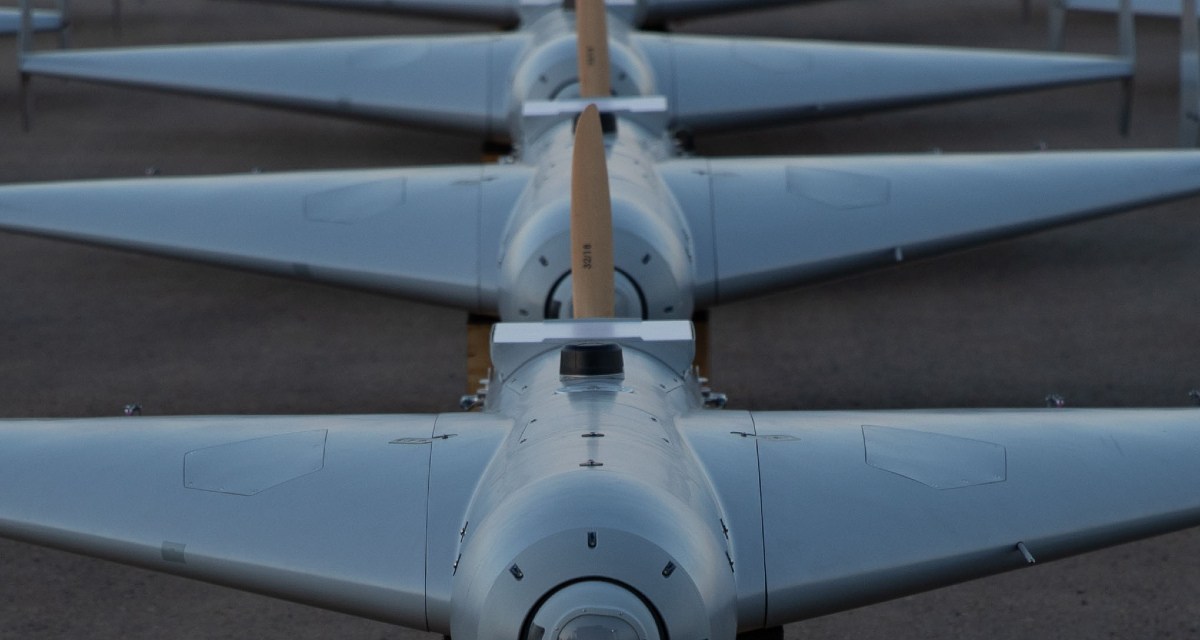
Attend any drone warfare conference, and you will likely hear the same refrain: There is no silver bullet when it comes to drone defense. This is often followed by presentations on the wonderful advantages of this or that defensive measure. The idea is so frequently expressed because it’s true. Protecting an infantry platoon from small, first-person-view drones entails technologies, training, doctrine, and approaches distinct from what is required to protect an oil refinery from a flock of large Shahed-136s or a naval destroyer from an integrated swarm of drone boats and aircraft. And all those requirements may change based on operating environment, regulatory policies, and adversary tactical and technological improvements.
But what often does not get the attention it deserves is drone offense. Targeting drone pilots, warehouses, supply chains, and other critical enabling assets can rebalance the cost equation—and force adversaries to react to American initiative. Much has been written about the cost imbalance of drone warfare, where $4 million Patriot missiles are used to defeat $1,000 drones. Even with improvements in low-cost interceptors like Raytheon’s Coyote and Anduril’s Roadrunner, the cost can still be one hundred to one. Destroying thousands of drones in a warehouse or in transit to the front is far more efficient.
To be clear, this argument does not imply we should ignore drone defense. Even with the best intelligence and proactive response, some adversaries will pull off attacks, probably many. Soldiers, infrastructure owners and operators, and society must be ready when that happens. Rather, the argument is only that the balance of discourse between defense and offense needs to shift, with more emphasis on how best to go on offense against adversary drones.
Approaches to Drone Offense
A good drone offense focuses on the essential enabling capabilities of drone warfare, aiming to disrupt or destroy the overall drone system. The mass drone attacks in the Ukraine-Russia war, where both sides launch salvos of hundreds of drones, often drive headlines and attention. However, what those headlines often overlook is the infrastructure that enables those attacks. Both Russia and Ukraine have built and fielded literally millions of drones, which requires someone to acquire the components, assemble the drones, transport them to the front line, train pilots to operate them, develop and disseminate the intelligence needed to support attacks, and carry out the operation. All of those systems can be attacked and disrupted.
Targeting a drone pilot would inflict far more harm than defeating a drone itself, not least because pilots are much more difficult to replace than the platforms they operate. Reports suggest Russia has experienced significant recruiting shortages, and is recruiting university students to be drone pilots with promises of high salaries and not working on the front line. Killing those pilots would worsen the shortage, while also making the recruiting even harder. But finding the pilots is a nontrivial challenge. The pilots may operate many miles from the front lines in relatively secure and defended areas. Operators in the Russia-Ukraine conflict increasingly use repeaters, including on other drones, to extend the range of flight operations and make triangulation more difficult. Nonetheless, both Russia and Ukraine have succeeded in finding and targeting each other’s pilots with bombs, missiles, and other weapons, and death tolls have “skyrocketed” as a result.
Drone motherships are also a growing vulnerability. States are increasingly developing transport systems that integrate drone launch, transport, recharge, and command and control. Systems like China’s Jiu Tian drone carrier, which carries a hundred drones, must by necessity be large, making them potentially easier to find than the drones themselves, although also perhaps more protected. Targeting and destroying motherships would destroy all the drones they hold, and if targeted while on the ground the effects could extend to associated support systems or personnel, as well.
Building, fielding, and preparing for drone operations also requires significant infrastructure. Production facilities in the Alabuga special economic zone in Russia reportedly produce three thousand Geran-4 drones per month. Production requires facilities, personnel, and transit of components in and completed drones out—all of which can be targeted with kinetic strikes, sabotage operations, or cyberattacks. Training facilities can also be targeted. According to Ukrainian forces, at least sixty hours of training are required for a new first-person-view drone pilot. That training must occur somewhere, and generating large numbers of pilots suggests some stable location, capability, and organization. Those training facilities can be sabotaged, disrupted, and destroyed.
The United States can also target drone supply chains. Radio Free Europe’s recent teardown of a Russian Geran-4 revealed numerous foreign-made components from China, the United States, and European nations. Strengthening enforcement of existing sanctions, and applying new ones, to limit adversary access to these components can inhibit production. Although drones and their components are often highly dual-use and militaries can adopt options that are difficult to disrupt—like 3D printing airframes—critical chokepoints with a small number of manufacturers certainly exist. The United States does not need to fully cut off supply—an extreme ask unlikely to succeed—but can settle for damaging adversary trust in that supply. Offensive sabotage such as Ukraine’s smuggling bombs into Russian first-person-view goggles can damage the perceived integrity of the supply, forcing an adversary to search for leaks and potentially closing off otherwise legitimate suppliers.
The Need for Intelligence
The challenge is that drone offense depends heavily on effective, actionable intelligence. Attackers need to understand adversaries’ tactics, find their pilots, characterize their supply chains, and find vulnerabilities in all the above.
The modern battlefield, it is said, is becoming transparent. Of course, reality is more nuanced: The mass aerial drone coverage on the Ukraine-Russian front line does not necessarily extend to other domains, and the increased use of decoys confounds clear understanding. Nonetheless, ubiquitous sensors, the proliferation of smartphones, and commercial satellite imagery offer unprecedented battlefield awareness. A challenge is effectively processing the vast data, developing actionable insights, and transmitting those insights to appropriate commanders in a timely manner. But artificial intelligence seems to help with that considerably, as suggested by the rapid targeting cycle in the war with Iran. Focusing intelligence collection and analysis on identifying and finding essential drone capabilities, especially potential chokepoints in the production process, would be extremely useful. Development of dedicated rapid reaction forces who are prepared and ready to quickly hit an identified target will also increase the likelihood that intelligence translates to battlefield results.
Exploitation is also a critical enabling capability. The growing field of drone forensics involves extracting critical information from drone hardware and software. That can include data on a drone’s flight paths, launch points, as well as images and video captured before the flight. Such information could lead to useful inferences about adversary drone tactics, doctrine, and operations, supporting follow-on offense. If the United States learns an adversary, say, favors particular types of launch points, that can guide the focus of sensors and staging of weapons. Of course, states are increasingly adopting measures to counter drone forensics and inhibit data exfiltration, but even basic information about the components and their origins could prove useful to analysts. In the Geran-4 teardown mentioned above, the physical drone was enough to collect tremendous data on the components and their origins. As drones are fielded at mass scale, the opportunities to characterize the drone supply chain are huge.
Discussions of drone warfare focus disproportionately on drone defense; defense is important, but we need to also be prepared to go on offense. That requires dedicated intelligence and analysis capabilities to identify and exploit essential chokepoints in adversary systems, and ensuring we have the systems to rapidly distribute actionable information to US forces to react in a timely way. But if we develop these capabilities and systems, we can rebalance the cost equation and bring the fight to the enemy.
Zachary Kallenborn is a PhD candidate in risk analysis at King’s College London researching global catastrophe, drone warfare, critical infrastructure, weapons of mass destruction, and apocalyptic terrorism. He is also affiliated with the University of Oxford, the Center for Strategic and International Studies, George Mason University, and the National Institute for Deterrence Studies.
The views expressed are those of the author and do not reflect the official position of the United States Military Academy, Department of the Army, or Department of Defense.