What role will the US Marine Corps play in a war in the Pacific? It depends on who you ask.
In July, the Marines offered a vision of how it sees its role, publishing Ground Combat Element (GCE) 2040. Then in October, the Army published new operational warfighting guidance, “How the Army Fights (HTAF).” The two documents are not in complete conflict with one another. But neither are they in total harmony. And harmonious synchronization is exactly what winning a joint fight requires.
In HTAF, landpower “binds the Army, Marine Corps, Special Operations Forces, and ground forces of our Allies and partners, each operating at distinct depth and scale.” The Army, as a service, “conducts prompt and sustained land combat.” It says the Marines “conduct land operations vital to naval campaigns and fleet support.” And it describes close battle as “the unique, indispensable operational element of land power—one that no other service can replicate at scale.”
The role assignment reflects the Army’s institutional perspective. It is not an insult. It also shapes defense budgeting, contracting, and equipment procurement.
GCE 2040 offers a different account of the Marines’ role. It states the problem as developing formations “centered on the Marine Division and its subordinate elements, capable of dominating peer-level ground combat through 2040.” It calls the GCE “the Joint Force’s only ground formation optimized to seize, hold, and defend critical maritime terrain.” It observes “Marines have fought ashore in division strength and greater in every decade since Guadalcanal,” and that “no compelling evidence suggests the pattern will change.”
The asymmetry here runs against the Marines. HTAF names the Marines repeatedly and assigns it a mission. One of the GCE 2040 framework’s five design principles is “joint integration by design, not adaptation.”
Both service documents stake overlapping landpower claims. Joint warfighting “by design” must begin at the conceptual level, not after a conflict begins. We ask: Where is the joint landpower framework that merges both services’ concepts into a winning approach to dominate and prevail in ground combat?
Sustainment is where that omission will cost Marines the most. Both services named “endurance” as a central pillar. The Army assigns endurance to “theater armies, primarily through theater enabling commands.” The Marines define it as protection, resilience, and sustainment; all-domain defense; tactical deception; signature management; and a stronger connection to the Marine air-ground task force’s logistics combat element.
Nothing in the Marines’ framework rises above the Marine expeditionary force. That is by design, not an error. But it means the theater layer of Marine endurance will be built, prioritized, and rationed by a service neither GCE 2040 nor the Marines’ own capstone document even mentions. In the Pacific, that structure is the Army’s 8th Theater Sustainment Command, the senior operational-level logistics headquarters in US Pacific Command. Without conceptual integration before a conflict begins, Marine operational-lift and sustainment requirements will compete against Army requirements inside a priority scheme where the Army continually succeeds.
These dependencies go beyond logistics. Both services will receive support from 8th Theater Sustainment Command, and each will need exquisite capabilities to close kill chains. The documents send a clear demand signal to the joint force without providing the capacity to meet it, leaving reconciliation to staffs. How the Army and Marines say they will fight carries one message for every staff officer: Find the seams and gaps in support and close them before the shooting starts.
Fires is where both services fit together, and where the overlap is easily missed. The Marine stand-in forces—small units operating inside China’s weapons engagement zone—are built to find targets, pass targeting packages, and close joint kill webs.
In 2024, US Indo-Pacific Command began pursuing a Joint Fires Network to link service-specific efforts, including the Army’s Project Convergence, the Navy’s Project Overmatch, and the Marines’ Project Dynamis. The objective remains to connect sensors, commanders, and weapons across the joint force to close kill chains. Yet the effort also raised a fundamental question: Could service-led modernization produce genuine joint integration, or would it preserve the seams and gaps it was meant to eliminate? The Joint Fires Network addresses the technical problem of connecting capabilities. HTAF and GCE 2040 raise the problem of aligning and synchronizing the concepts, roles, and resource demands.
The Army “requires long-range precision fires (LRPF) capacity and munitions volume inside the First Island Chain (FIC) sufficient to interdict adversary launch sites and maritime targets in the western Pacific.” GCE 2040 heavily focuses on long- and medium-range fires to support maritime denial and control. Same battlespace and targets, but two different documents. Both are sensing and shooting but nothing has decided which service does which, from where and under what conditions, or with which munitions.
Consider the problem in practice. Stand-in forces will remain inside China’s weapons engagement zone, conducting reconnaissance and sensing, passing targeting data to the joint strike enterprise. As Army formations flow into theater, they will generate their own demands for fires and sustainment necessary for deployment, protection, and operations. The joint force must reconcile the competing demands. Does it prioritize fires that enable stand-in forces’ sensing and targeting from forward positions or those that support arriving Army formations’ operations? How are limited resources allocated when demands conflict? No requirement is inherently more important. Both are integral to their respective service concepts but draw from finite joint force resourcing and capacity.
None of what we are arguing implies an interservice turf war. Convergence is a real asset. Leaner formations. Dispersion. Signature management. Reconnaissance and counterreconnaissance. Battlefield transparency. Strip the letterhead from HTAF and much of it reads like the Marine Corps’s Force Design. That is no surprise—the Marine Corps document came first.
But convergence without synchronization is two services reaching for the same island with half the ammunition. Marines should read HTAF, and soldiers GCE 2040. Then, the Marine Corps should do what its own design principle requires and integrate “by design, not adaptation”: Name HTAF in the next framework, identify where Marine endurance depends on Army theater structure, and establish how Marine and Army sensing and fires capabilities complement one another.
Major Benjamin Van Horrick is an active duty Marine Corps officer and the logistics command and control lead for Project Dynamis. He serves as the managing editor of The Connecting File.
Lieutenant Colonel Steven Bancroft is an active duty Marine Corps officer and currently serves as the commandant of the Marine Corps’ representative to the Hoover Institution as a Robert and Marion Oster national security affairs fellow. He has served in Iraq and Afghanistan and has ten years of experience in the Pacific theater, including two cumulative years in the Philippines.
The views expressed are those of the authors and do not reflect the official position of the United States Military Academy, Department of the Army, or Department of Defense, or that of any organization the author is affiliated with, including the United States Marine Corps and Department of the Navy.
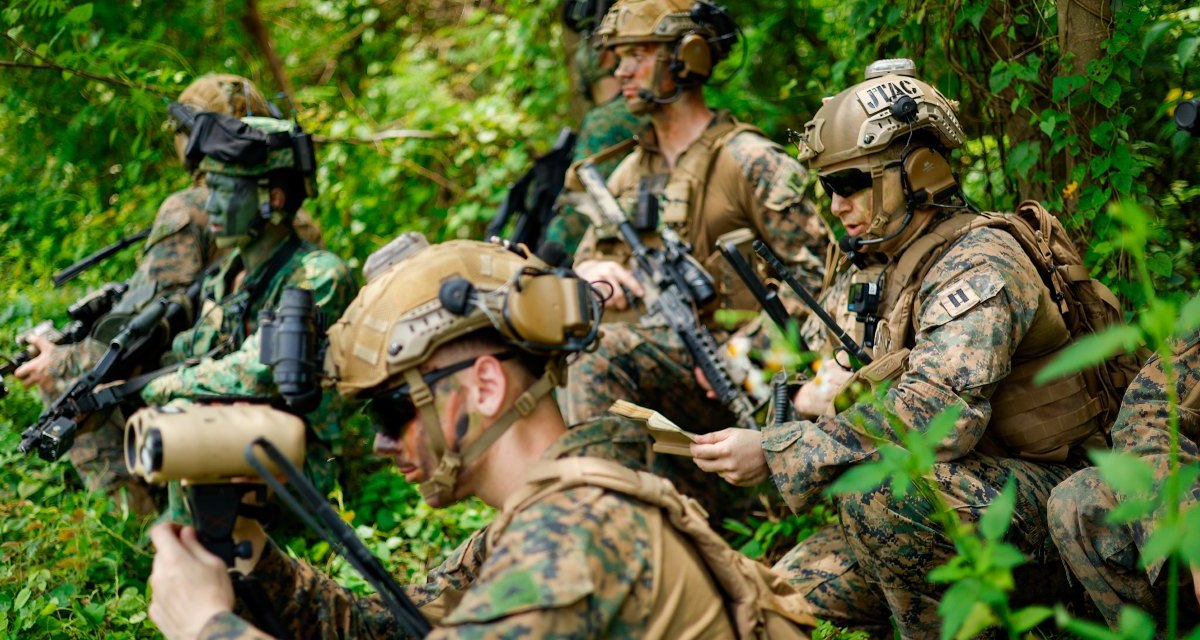
Image credit: Staff Sgt. Dana Beesley, US Marine Corps