Combined arms maneuver is being reimagined. The elements remain. The principles endure. But how we sense, decide, mass, maneuver, strike, and sustain is changing forever.
Technology alone will not win the next war—but the best technology, fully integrated and placed in the hands of our soldiers, just might. The aim is not autonomous war, but human-directed war with autonomous means—enabling battlefield dominance by allowing us to think faster, act faster, maneuver faster, and sustain the fight.
War Remains Human—How We Fight Is Changing
War has always been, and will remain, fundamentally human, a contest of wills conducted to achieve political objectives. Technology does not change that basic reality. But technology has repeatedly changed the character of warfare: how forces see, communicate, move, fight, protect themselves, and sustain combat operations. We are entering another such period of transformation.
Artificial intelligence, autonomy, robotics, inexpensive unmanned systems, ubiquitous sensing, and increasingly capable networks are already changing the battlefield. But the next step may prove far more consequential. Agentic AI—the ability of AI systems not merely to analyze information, but to reason across tasks, coordinate actions, and execute within established parameters—creates the potential to connect these technologies into something fundamentally different.
The significance is not simply a better drone, a more capable robot, or a faster decision-support tool. It is the ability to orchestrate, integrate, and synchronize all of them.
That distinction matters because combined arms has never really been about individual weapons. Its power comes from compounding and combining capabilities that ultimately overwhelm an adversary. Movement enables more effective fires. Fires enable movement. The two together produce maneuver. Air defense protects the formation. Engineers create mobility while denying it to the enemy. Intelligence drives operations and identifies opportunities. Electronic warfare blinds, disrupts, and deceives.
The individual elements matter. But their integration and synchronization creates the advantage. That fundamental logic will endure. What is about to change forever is how that integration occurs.
From AI as a Tool to AI as an Orchestrator
Much of today’s discussion about artificial intelligence focuses on AI as a tool for the individual soldier or commander: analyzing intelligence, identifying targets, optimizing routes, predicting maintenance requirements, or helping staffs develop courses of action.
Those applications matter. But they may represent only the beginning.
With Agentic AI’s emergence, we can now see a future in which it becomes part of the connective tissue of the formation—continuously sensing, interpreting, coordinating, and orchestrating actions across large numbers of human and autonomous systems.
Imagine a formation in which thousands of sensors continuously observe the battlespace. Autonomous systems operate in the air, on the ground, at sea, and increasingly in other domains. Some systems sense. Some communicate. Some jam. Some deceive. Some protect. Some deliver lethal effects.
No human headquarters can manually coordinate every interaction among thousands, or potentially tens of thousands, of these systems at the speed future warfare will demand. Nor should it try.
Similar to the role of command and control as the warfighting function that ties the other warfighting functions together to create traditional combined arms, orchestration is the generative AI tool that sits above all others, bringing synergy, harmony, speed, integration, and mass together, without the need to physically mass exquisite and manned platforms and make these irreplaceable elements vulnerable.
AI-enabled orchestration could allow commanders to establish intent, priorities, authorities, and boundaries while machines coordinate enormous numbers of subordinate actions necessary to achieve the desired effect.
That represents an important shift: Humans command, while AI and machines control. Humans own intent and purpose. Machines increasingly orchestrate the execution.
Mass Without Massing
For decades, Western militaries have pursued increasingly sophisticated—and increasingly expensive—platforms. Those platforms have produced extraordinary capability, but cost and complexity inevitably limit how many can be fielded.
Autonomy changes that equation. The battlefield is already demonstrating the value of relatively inexpensive unmanned systems deployed in enormous numbers. As autonomy improves, those systems will increasingly operate not simply as individual platforms but as coordinated formations.
This creates the possibility of mass without massing.
Traditionally, achieving overwhelming combat power often required physically concentrating forces. But concentration also creates vulnerability. Precision fires, persistent sensing, and long-range weapons make large formations increasingly detectable and targetable.
Autonomous systems offer another model. A force could remain geographically dispersed while rapidly concentrating effects, sensing, electronic warfare, deception, fires, and maneuver at the decisive point.
Mass therefore does not disappear. It changes form.
Future commanders may create mass through hundreds or thousands of relatively inexpensive autonomous systems operating alongside exquisite platforms and human formations. Some will inevitably be lost. Others will adapt, reposition, or assume new roles.
The objective is not simply to put more machines on the battlefield. It is to generate more action and dilemmas than the enemy can solve.
Beyond the Swarm
The term swarm is increasingly used to describe large numbers of autonomous systems. But simply launching hundreds of drones is not the transformational idea. The real breakthrough comes when the swarm itself becomes combined arms.
Consider a heterogeneous autonomous formation containing multiple types of systems. Some search for enemy forces. Others establish communications networks. Others jam enemy sensors or communications. Some create false signatures and deception. Others provide protection. Still others deliver lethal effects.
They do not all perform the same task. Yet, they collaborate. More importantly, they continuously reorganize based on the mission, enemy action, losses, and changing priorities, all within commander’s intent.
At that point, we are no longer simply talking about a drone swarm. We are talking about combined arms maneuver conducted through an intelligent, distributed human-machine formation.
The decisive advantage will therefore not come from autonomy alone. It will come from the orchestration of humans, autonomous systems, fires, maneuver, sensing, cyber, electronic warfare, space, and information into a coherent fighting ecosystem.
Mission Command at Machine Speed
This evolution makes mission command more important, not less.
A commander responsible for thousands of autonomous systems cannot control every action those systems take. Attempting to do so would surrender the very speed advantage autonomy provides.
Instead, commanders will increasingly command through intent. They will establish the mission, purpose, priorities, acceptable risk, authorities, constraints, and boundaries within which autonomous systems operate. Machines may then execute enormous numbers of tactical actions inside those parameters.
This raises one of the most important questions facing military institutions: Which decisions must remain human, which can be delegated to machines, and under what circumstances can delegation occur?
The answer will not be identical for every mission. An autonomous logistics convoy may operate under one set of authorities. A reconnaissance swarm may operate under another. Electronic warfare systems may be permitted to adapt rapidly within established parameters. Lethal autonomous systems will understandably require different levels of control, confidence, and accountability.
This is where doctrine, ethics, technology, and command converge. The challenge is not simply developing autonomous systems capable of acting independently. It is developing a command architecture that allows them to act independently without becoming independent of human purpose.
The Formation Becomes the Weapon
For much of the industrial age, militaries measured combat power largely through platforms and formations: numbers of tanks, artillery pieces, aircraft, ships, and soldiers. Those measures will remain relevant. But they may become increasingly incomplete. The more important measure of future combat power may be the performance of the entire networked formation.
How quickly can it sense?
How rapidly can it understand?
How effectively can it decide?
How dynamically can it allocate and reposition capabilities?
How quickly can it concentrate effects?
How rapidly can it adapt after losing systems?
How effectively can it regenerate combat power?
As these become critical measures, the individual platform becomes one node within a much larger combat system. An exquisite platform disconnected from that system may ultimately provide less battlefield value than a less sophisticated platform fully integrated into it. The formation—not the platform—becomes the weapon.
This also changes how we should think about modernization. The objective cannot simply be to procure the best individual systems. We must build the architecture that allows every sensor, shooter, autonomous platform, command node, and soldier to contribute to a larger integrated whole.
All of this returns us to a simple proposition: Technology alone will not win the next war—but the best technology, fully integrated and placed in the hands of our soldiers, just might.
The human must remain responsible for the purpose of violence even as machines increasingly execute its mechanics.
Combined Arms Maneuver Reimagined
Combined arms maneuver is not disappearing, it is evolving. The fundamental objective remains remarkably familiar: present the enemy with multiple dilemmas, create windows of opportunity, seize the initiative, maneuver and employ fires to gain positions of advantage, exploit success, and impose our will before the enemy can effectively respond.
The elements remain, the principles endure, but how we deliver them is changing forever.
The next generation of combined arms may integrate soldiers and machines; exquisite platforms and inexpensive autonomous mass; physical maneuver and cyber effects; kinetic fires and electronic warfare; humans exercising judgment and AI operating at machine speed. The force that masters this integration will not simply possess better technology. It will fight differently. It will sense, think, act, maneuver, mass effects without necessarily massing forces, and adapt faster than its opponent can respond.
This is what autonomous could and should mean to us now and in the future. The aim is not autonomous war. It is human-directed war with autonomous means—combining human purpose and judgment with machine speed, scale, and precision to create battlefield dominance and sustain it until victory is achieved.
Retired General James Mingus served as the thirty-ninth vice chief of staff of the Army.
The views expressed are those of the author and do not reflect the official position of the United States Military Academy, Department of the Army, or Department of Defense.
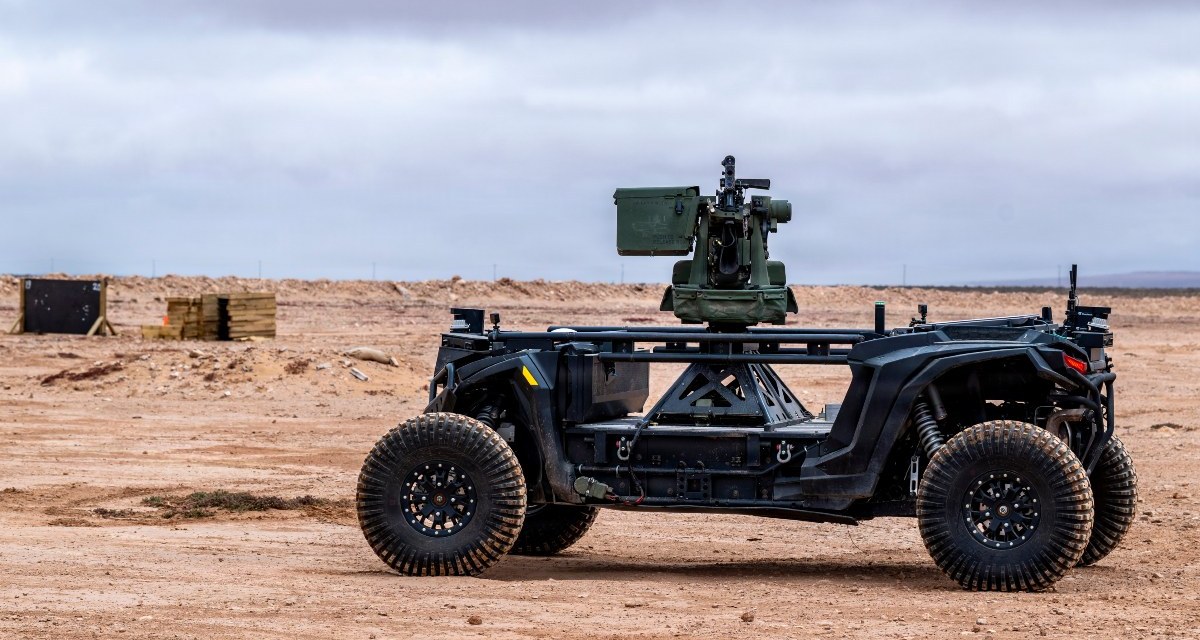
Image credit: Mass Communication Specialist 2nd Class Samuel Wagner, US Navy