
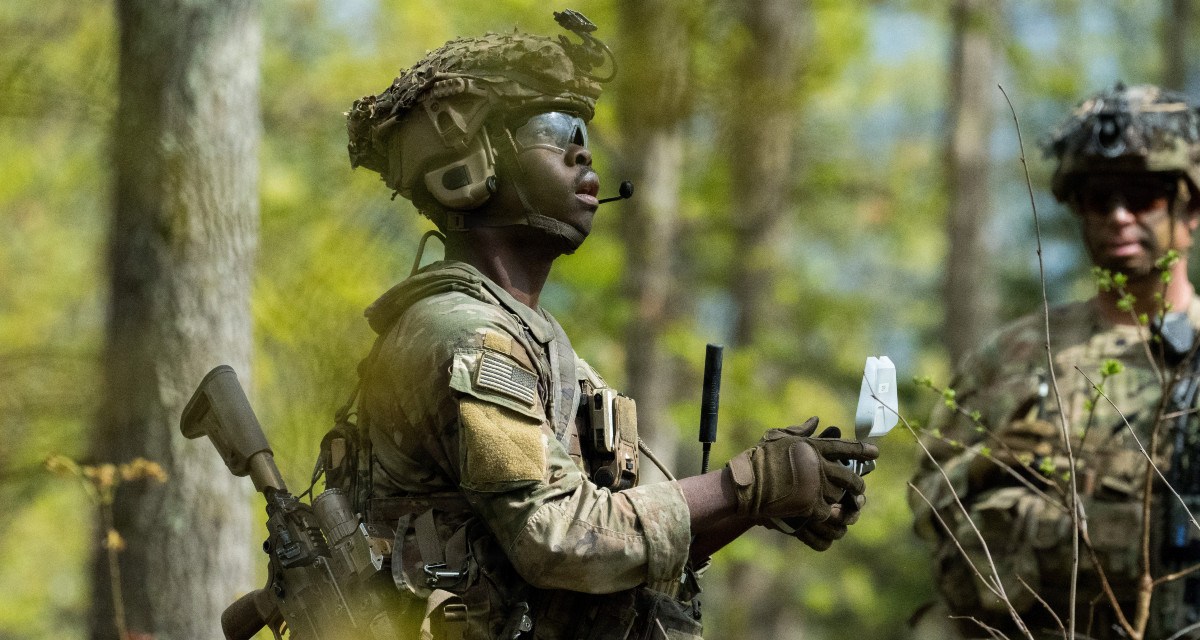
Today the jury is still out on whether or not drones will usher in the next military revolution. The related question of whether drones will be as lethal against American forces as they have been in the Russo-Ukrainian conflict has also produced a cognitive hung jury. In that ongoing war, drones are used either by themselves as direct one-way attack munitions or as part of an integrated system of fires, and are responsible for 70–80 percent of total casualties. This bloody toll should be chilling to military practitioners and thinkers alike.
One of the central challenges facing the United States Army today is how to integrate drones into existing combat formations. Should the drone merely augment the formation we already have, or should we begin rebuilding the formation around the drone? Foreseeing the future character of conventional ground combat is exceedingly difficult, and the reality inside the evolving character of warfare cannot be captured on the whiteboards of brainstorming sessions. While we can try to simulate combat at our training centers with mock battles, we can never replicate how soldiers act when their lives are on the line and when rounds shred the sound barrier above their ears.
Those of us who have studied war and experienced it firsthand are familiar with what has worked in the past: massive suppressive fire from machine-guns, supplemented by mortars or artillery, and the shock of maneuver during those final meters of battle, when we close with and destroy the enemy.
We also see what is working now as drones kill in Ukraine. However, some of the drones’ effectiveness is undoubtedly enabled by the established trench lines, which provide drone operators the time, space, and security required to perform their craft. Additionally, the sluggishness of Russian maneuver must make us ask: Is this the age of drones, or that of poor maneuver? But drawing universal conclusions from a single conflict is a dangerous business, as every battlefield possesses its own unique ecology. Also, we have not yet witnessed, at scale, two drone-enabled maneuver forces collide in fluid combat without the relative sanctuary of static, entrenched positions.
While we grapple with these questions, military history of early modern combat may offer some guiding principles, acting as a cadaver of sorts upon the table—something we can dissect to understand how earlier soldiers confronted the introduction of weapons systems that appeared to rewrite the grammar of violence.
Five centuries ago, the Spaniards were among the first in Europe to slowly integrate firepower into their formations, leading to the creation of the Spanish tercio. This response to gunpowder’s promise offers a useful lesson: Spanish formations did not immediately discard their traditional weapons, the pike and sword, in favor of novel technologies. Instead, they slowly and carefully integrated them into the tercio, marrying the pike and sword to the increasingly important arquebus. The Spaniards chose integration rather than replacement, creating a system in which traditional and new weapons coexist.
We should carefully consider integrating drones into our ground combat formations to form an American drone tercio, leveraging the combined power of a lethal trinity in ground combat: artillery, maneuver, and drones. But we should not abandon our traditional rifles, machine-guns, mortars, and vehicles.
Should China gamble on seizing Taiwan by force, American infantry units could find themselves fighting across a vast archipelagic battlefield where close air support or naval fires may not be readily available. Without the persistent airpower that has traditionally supported American ground forces since the Vietnam War, infantry units may be left to fight it out on their own. While lacking the payloads of traditional airframes, American infantry tercios can compensate through direct drone attacks and by employing organic fires more precisely to implement reconnaissance-strike tactics. Perhaps even more importantly, possessing this capability may increase the deterrent effect on China, knowing that American infantry units have not only fielded drones but have trained with them to a high level of readiness. The American tercio should therefore be built not merely to win the next battle, but to help make that battle less attractive to begin with.
While the United States; ground forces have not yet encountered drones in decisive ground combat, we should not wait for the forcing function of tactical defeat to inspire innovation. While defeats throughout military history have been its greatest teachers, the sanguine cost of tuition in this education is often too high.
The Fury of the Powder: When the Spanish Tercio Took the Field
In the late fifteenth and sixteenth centuries, gunpowder-fueled firepower did not politely announce its arrival on the battlefield. Rather, it arrived with thunder and shredded infantry formations. The Spanish soldier and military writer Bernardino de Mendoza described the “fury of the powder” as so great, aided by the “instruments of artillery, muskets, and arquebuses,” that it could break the dense formations of spear and sword that had dominated warfare for centuries. Mendoza was witnessing a change in the grammar of violence, as we are today.
Yet the arquebus delivering that fury of gunpowder had its flaws. It was heavy, slow to reload, and, like drones, vulnerable to weather conditions. After firing their volleys, the arquebusiers were vulnerable to infantry and cavalry units that closed in with cold steel. And like drones of today, these gunpowder weapons, while capable of delivering death from a distance, could not protect themselves from traditional ground threats. The Spanish answer was not to choose between gunpowder and steel, but rather, to integrate them.
The genius of the Spanish tercio lay in its gradual integration of the traditional lethal power of the pike and sword with the emerging firepower of the arquebus. The traditional pike provided protection and shock, while swords remained weapons for the bloody intimacy of close combat. When conditions were right for the arquebus to be unleashed, it extended and killed at a distance. Rather than asking a single weapon to do everything, the tercio had different weapons compensate for one another’s weaknesses.
The lessons of gunpowder-integrated armies in the early modern period tell the story of victory for those who evolved and the accounts of woeful defeat for those who clung only to cold steel. At Cerignola in 1503, Spanish arquebusiers firing from prepared positions helped shatter French assaults. At Bicocca in 1522, Swiss pikemen advancing against integrated firearms, artillery, obstacles, and infantry suffered devastating losses. At Pavia in 1525, firearms and pikes fought together in a more fluid battle that ended with the destruction of the French army and capture of King Francis I.
The smoke and noise emitted from the barrels of early modern combat highlighted how the arquebus delivered killing power at a distance. However, the pike was needed to protect the guns, and steel remained lethal when formations met in close combat. The tercio took the traditional tools of battle with novel firepower weapons and transformed them into a new system, effectively penning a new grammar of violence. The Spanish tercio made new and old work in concert, and that is the lesson we should steal.
The American Tercio
The US Army today shares key characteristics with the Spanish of the early modern period. We possess a highly trained ground force built around formations, weapons, and tactics that have shattered opposing armies for the past few decades. We should take care not to tear them apart simply because something new has arrived. The American infantry platoon, composed of three rifle squads and a weapons squad, should remain the core of our way of war. We should still train our riflemen to close with the enemy. Our machine-guns should still suppress and shred our enemies. And we should use our mortars and artillery to unleash a steel rain. Our infantrymen must preserve the capability to clear buildings, enter the trenches, and hold ground. The drone does not replace any of this, but employed skillfully, it can augment this lethality.
Through most of military history, the decisive fight began within the bounds of line of sight. Today, the drone is pushing that boundary outward. Drone-enabled formations can now find, fix, and strike an enemy beyond the infantryman’s line of sight, meaning tomorrow’s infantry unit must be capable of fighting before its riflemen ever make visual contact. Airpower that once required an airfield, aircraft, and a distant command structure can increasingly be carried in a rucksack or driven forward in the back of a truck. An American infantry tercio must bring that airpower with it. Its first fires should not begin within rifle range; rather, contact should already be underway long before the enemy comes into view.
An American tercio should therefore begin by marrying the drone to the traditional infantry formation, rather than replacing our time-honored way of conducting ground combat. Within the platoon’s third rifle squad, I propose cross-training one fire team as drone operators. It is important that they remain infantrymen first, capable of fighting, maneuvering, and closing with the enemy. But they can now possess another means to see and kill. When drones are jammed, grounded by weather, exhausted of battery, or smashed out of the sky, these soldiers do not become useless operators carrying dead technology. They remain ready as infantrymen. The platoon’s drone capability should be organized around four essential battlefield functions: direct attack; command and control; observation and calls for fire; and counterdrone operations and security.
But drone integration cannot end at the platoon level. At the company headquarters, drones and four operators should remain at the commander’s disposal to utilize as well. A battalion headquarters should have a dedicated section of ten drone operators, built around the same four functions as at the platoon level. This drone section would give the battalion commander a capability he or she can concentrate where the fight is hardest. This capability can enable a mass direct attack against a critical target, extend reconnaissance beyond the platoons, connect aerial observation to battalion fires, reinforce a company under enemy drone attack, or replace capabilities lost below. The platoon owns its drones for the immediate fight at its front, and the company and battalion commanders retain drones to shape the larger fight.
This creates a formation with drone capability embedded at the tactical edge but capable of being massed from above. More importantly, it preserves the infantry formation rather than hollowing it out to create an entirely new drone army. We should be wary of sacrificing infantrymen at the altar of the newest technology.
On the potential archipelagic battlefields of the Pacific against China, American infantry units will likely find themselves spread thin across islands fighting without the benefit of the on-call airpower that they have relied on for decades. By fielding the American tercio, infantry units can bring reconnaissance-strike lethality ashore to better employ the precise mass of organic fires. Infantry tercio formations spread across islands could form a sophisticated kill web, far more advanced than is possible by relying solely on weapon systems based on line-of-sight lethality. That capability would contribute to deterrence by denial; the purpose of the American tercio in the Pacific should therefore not simply be to make American infantry more lethal once war begins, but to make the prospect of defeating it less attractive before the first shot is fired. If we can make those weapons fight together before they are tested in the Pacific, the American tercio would become not only a battlefield adaptation but also another layer of American deterrence.
Writing the Drone-Enabled Grammar of Violence
Building an American tercio formation is only half the battle; the other half is writing the battle drills and training soldiers to perform them. For two decades of post-9/11 conflict, generations of infantrymen developed drills and battlefield instincts that taught them to work with rifles, machine-guns, mortars, artillery, and maneuver almost instinctively. We must now imagine, write, and train a new lethal choreography.
A drone-enabled platoon might fight through four broad phases. First, secure the air littoral by hunting enemy drones and operators while getting friendly reconnaissance and attack platforms overhead. Second, find and strike, with drones locating enemy positions, attacking exposed targets, and passing coordinates to artillery and mortars. Third, close with the enemy, maneuvering beneath those flying eyes while drones and traditional fires suppress enemy forces ahead. Finally, exploit as the objective falls, keeping drones overhead to detect counterattacks and pursue withdrawing forces beyond the infantry’s immediate reach.
The precise tactics will evolve, and many will undoubtedly shatter on the training ground. We need to experiment until employing drones becomes as instinctive to an infantry platoon as calling for mortar fire or emplacing a machine-gun. A new weapon becomes truly dangerous when soldiers no longer have to think about how to use it.

In the sixteenth century, Spanish tercios preserved the cold steel that had worked for centuries while still absorbing gunpowder-fueled weapons. When faced with a powerful new and novel weapons technology, the Spaniards did not choose replacement, but rather integration.
Today, we should keep the rifle, the machine-gun, the mortar and artillery, the armored vehicle, and above all, the infantryman who still has to cross the last hundred meters, enter the trench, and seize the ground. The modern American tercio, like its Spanish predecessor, will not be built around a single wonder weapon. Its lethality will stem from the relationship between old and new, between maneuver, artillery, and drones.
The American tercio should therefore be built before the first shots of the next war force us to build it under fire. Across the vast distances and scattered islands of the Indo-Pacific, American infantry may not always have an aircraft overhead or naval fire support close at hand. They must be able to carry some of that reach with them. Drones can extend the infantry’s eyes and weapons beyond the horizon, while rifles, machine-guns, mortars, artillery, and maneuver all it to retain the ability to finish the fight when technology fails and the battle closes to its bloody final meters. If we wait until American soldiers are being hunted from the sky to learn this lesson from history, we will have waited too long. Build the American tercio now, so that its first and greatest victory may be helping deter the war it was designed to fight.
Antonio Salinas is an active duty US Army officer, professor of strategic intelligence at National Defense University, and a PhD student in the Department of History at Georgetown University. Salinas has twenty-eight years of military service in the US Marine Corps and Army as an infantry officer, an assistant professor in the Department of History at the US Military Academy, and a strategic intelligence officer, with operational experience in Afghanistan and Iraq. He is the author of Siren’s Song: The Allure of War, Boot Camp: The Making of a United States Marine, and Leaving War: From Afghanistan’s Pech Valley to Hadrian’s Wall.
The views expressed are those of the author and do not reflect the official position of the United States Military Academy, Department of the Army, or Department of Defense.
Image credit: Adams Guerrero, US Army