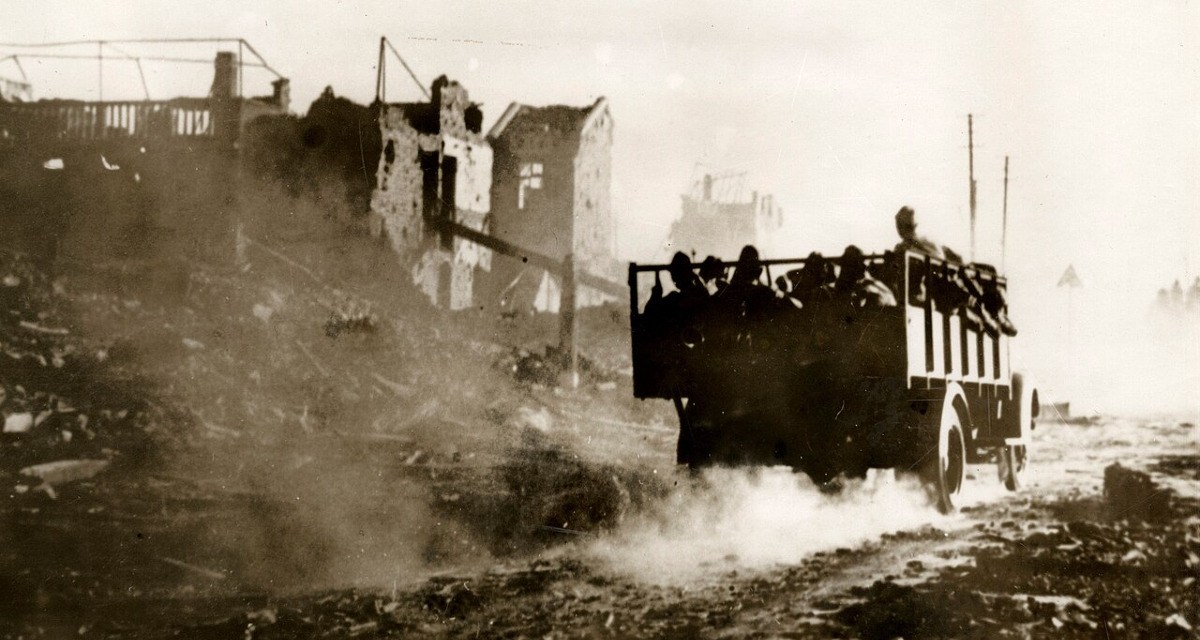
One historian wrote that it “presaged urban combat as it was to be waged . . . throughout the remainder of the twentieth century.” A journalist said that it was “as though a Verdun had happened on the Seine” or “a Gettysburg was fought in Harlem.” International media compared the siege of one building where defenders made a desperate last stand to the Alamo.
It isn’t the Battle of Stalingrad. It isn’t Manila, Hue, Mogadishu, or Grozny. It is the 1937 Battle of Shanghai, one of the earliest major engagements of the Second Sino-Japanese War. Between them, the Republic of China and the Empire of Japan committed a million troops to the battle. It was fought over more than three months, for control of what was at the time the second-largest metropolis in Asia. And the city’s large foreign-controlled sectors made it an incredibly complex urban battlefield.
The seventeenth installment in MWI’s Urban Warfare Project Case Study Series examines the Battle of Shanghai, extracting its most important and enduring lessons—from the critical factor of legitimacy in a fight for a globally connected city to challenge of synchronizing combat power in complicated, often chaotic, urban conditions. You can read it here, and be sure to follow the Urban Warfare Project for future case studies and continuing exploration of the challenges faced by military forces operating in cities.
Liam Collins, PhD is the director of Madison Policy Forum and a distinguished military fellow with the Middle East Institute. He is a retired Special Forces colonel with deployments to Iraq, Afghanistan, Bosnia, the Horn of Africa, and South America. He is the coauthor of The War for Karabakh: Strategy, Technology, and Victory, coauthor of Understanding Urban Warfare, and author of Leadership & Innovation During Crisis: Lessons from the Iraq War.
Major Jayson Geroux is an infantry officer with The Royal Canadian Regiment and is currently with the Canadian Army Doctrine and Training Centre. He has been a fervent student of and has been involved in urban operations training for twenty-five years. He is an equally passionate military historian and has participated in, planned, executed, and intensively instructed on urban operations and urban warfare history for the past thirteen years. He has served thirty-one years in the Canadian Armed Forces, which included operational tours to the former Yugoslavia (Bosnia-Herzegovina) and Afghanistan.
John Spencer is chair of urban warfare studies at the Modern War Institute, codirector of MWI’s Urban Warfare Project, and host of the Urban Warfare Project Podcast. He served twenty-five years as an infantry soldier, which included two combat tours in Iraq. He is the coauthor of The War for Karabakh: Strategy, Technology, and Victory, author of Connected Soldiers: Life, Leadership, and Social Connections in Modern War, and coauthor of Understanding Urban Warfare.
Amanda Zhao is an undergraduate student in the Georgetown School of Foreign Service, majoring in international politics (international security concentration) and minoring in government. She served as the lead researcher and author on this case study.
The views expressed are those of the authors and do not reflect the official position of the United States Military Academy, Department of the Army, or Department of Defense.