“We are not going to get involved militarily in any way on the Island of Formosa,” announced Secretary of State Dean Acheson in January 1950. Taiwan fell outside of America’s security commitment. He further described an American defensive perimeter spanning from the Aleutian Islands through Japan and the Philippines. For the rest of the Pacific, he said that “a [security] guarantee is hardly sensible or necessary within the realm of practical relationship.”
Along with Taiwan, Korea fell outside American guarantees. Concerned about provoking a conflict in Korea, the United States pressed South Korea to build a small, constabulary army that lacked heavy weapons. Without an American security commitment, forward-deployed United States forces, or a capable South Korean army, North Korea saw an opportunity to quickly reunify the peninsula. Five months after Acheson’s speech, North Korean forces invaded. T-34 tanks, invulnerable to South Korea’s light weaponry, spearheaded the attack and almost conquered the South before the United States could deploy forces to halt the communist offensive at the Pusan Perimeter. By October, China entered the war. This deterrence failure cost the lives of 36,516 Americans, hundreds of thousands of Chinese, and over two million Koreans.
After the deterrence failure that led to the Korean War, the United States recognized the necessity of forward presence to prevent war. Within two days of the start of that war, President Harry S. Truman deployed the 7th Fleet to defend Taiwan. In September 1954, the Chinese shelled Taiwan’s Kinmen Island. Two months later, the United States had signed a mutual defense treaty with Taiwan, which deterred further Chinese escalation.
The US Commitment to the First Island Chain
As the risk of a catastrophic war in East Asia has reemerged, the United States must maintain this lesson: When it has defended forward and demonstrated the capability and resolve to make aggression infeasible, it has deterred opponents. When it has not, it has invited war.
With that understanding, the 2026 National Defense Strategy commits the military to “build, posture, and sustain a strong denial defense along the [first island chain],” which includes Japan, South Korea, Taiwan, and the Philippines. By focusing on forward-deployed forces, which could immediately respond to Chinese aggression, the strategy reduces the potential for China to achieve its policy objectives in a quick, cheap war. The strategy prioritizes cost-effective, asymmetric capabilities to buttress America’s allies. It prevents war for cheap, so what is the argument against it?
In a recent analysis, Jennifer Kavanagh asks whether America’s commitments to the first island chain “really make Americans safer and more prosperous?” She argues that since the United States has limited interests in the region, it should withdraw to the more defensible second island chain and end its security commitments to the countries of the first island chain. While she leads a worthwhile thought exercise, her recommendations risk Chinese regional hegemony, war, and economic upheaval while precluding an overdue shift by the American military to cheap, asymmetric military capabilities.
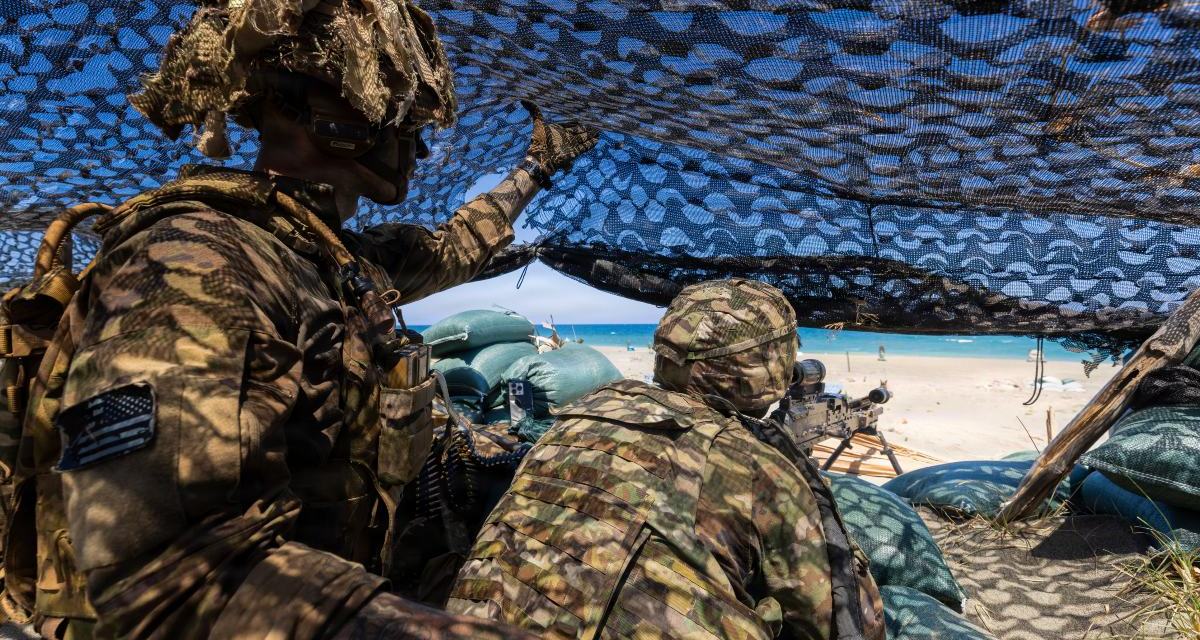
At the moment, her argument seems far from becoming policy. Elbridge Colby, head of policy in the Pentagon, recently briefed the Senate on the implementation of the National Defense Strategy, discussing the increasing complexity of Exercise Balikatan in the Philippines, which included a live fire of the new Typhon missile system. He also argued that America’s posture has led to increased commitment by South Korea, Japan, and Australia to regional security.
However, some recent events have raised questions about the endurance of America’s commitment to the first island chain. For example, the United States did not counter a Chinese diplomatic and economic campaign against Japan following Prime Minister Sanae Takaichi’s statement that a Chinese use of force against Taiwan would constitute an “existential threat” for her country. The United States has also postponed missile shipments to Tokyo, paused a planned arms sale to Taiwan, temporarily operated without an aircraft carrier in the region, and scaled back military exercises with South Korea. Whether a critic’s charge that all of this amounts to “great-power collusion” or it is just the messy detritus of multifaceted great-power competition is not the point. The point is that perceptions of a weakened commitment could undermine allied confidence and create opportunities for China to expand its sphere of influence within the first island chain.
The US administration would argue that these moves are apart of deterrence as it attempts to navigate the trade-offs of deterring China “through strength, not confrontation”—seeking to preserve the capability to deny Chinese aggression while not provoking Beijing—it raises an important question: Where does the balance lie between strength and confrontation?
The Problem with Narrow National Interests
To provide the foundation of her argument for restraint, Kavanagh begins by defining US interests in Asia, which she does more narrowly than either the current and previous administrations. She writes that “The United States has two core interests in Asia worth protecting with military power: defending the US homeland and safeguarding access to key economic markets and trade routes.”
While such an approach can seem intellectually fruitful, the use of national interests to drive policy can be problematic. A narrow list of national interests cannot capture the complexity of American foreign relations.
Kavanagh mentions safeguarding markets, but she sees no core interest in ensuring peace in the region, although the United States traded $2 trillion in goods with Asia in 2025. A war over Taiwan would indefinitely disrupt the world’s supply of advanced computer chips. As the American economy has become reliant on those chips to fuel its economic growth and technological competitiveness, a prolonged interruption in their production would risk an economic crisis.
The Risk of War
When Kavanagh does discuss the risk of war, she seems to see the main threat as being unintended escalation. She argues that “The United States should also remove the long-range fire system (the Typhon) currently located in the Philippines, as it’s both unnecessary to support the commitments outlined here and highly escalatory.” Her argument raises a crucial debate on whether forward-deployed forces deter conflict or escalate its risks.
China would certainly argue that the American deployments of Typhon to the Philippines or THAAD to Korea are escalatory. But that is Chinese messaging, not reality. In a similar vein, Xi Jinping regularly cites The Thucydides Trap. Even though that book has several methodological problems, it provides Xi with a means to argue that provocative moves could lead to war.
In contrast to Xi’s self-serving argument, historical experience provides little support for the proposition that provocation through position is itself the primary cause of war. Of course, leaders often cite enemy provocations to legitimize military action, but that does not mean those incitements actually caused a war. Adolf Hitler blamed Polish “saboteurs” for war in 1939. Vladimir Putin blamed Ukrainian “fascists” for war in 2022. In fact, both Poland and Ukraine, in worrying about provoking war through escalation, delayed military mobilization and so presented tempting targets.
Whatever their public justifications, leaders tend to initiate wars when they gamble that a short war could be a cost-effective means of achieving a policy objective. In addition to the Korean War, modern history is replete with examples of leaders gambling on a short war: the Suez Crisis, the Six-Day War, the Indo-Pakistan War of 1971, the Yom Kippur War, the Cambodian-Vietnamese War, the Sino-Vietnamese War, the Soviet-Afghan War, the Iran-Iraq War, the Falklands War, the Persian Gulf War, the Afghanistan War, the Iraq War, the Russo-Georgian War, and the Russo-Ukrainian War. As with those examples, the risk of war in the first island chain comes not from US provocation but from Xi Jinping betting he could quickly seize Taiwan in a fait accompli before American intervention.
Influencing Beijing’s Calculus
As often in history, Beijing may miscalculate; therefore, the United States should leave little doubt in Chinese leadership’s minds that a short war is infeasible. Forward-deployed forces, which could credibly and affordably contribute to the defense of Taiwan, would weigh heavily on the Politburo’s calculus. American forces in the first island chain can immediately sense, decide, and act against attempts to alter the status quo, creating uncertainty for Chinese planners about whether an initial move can succeed.
While maintaining strategic ambiguity, deterrence by denial involves a strong cognitive component. Units inside the first island chain remain visible and persistent within the adversary’s planning factors. Their presence forces Chinese planners to account for US capabilities immediately rather than treating them as reinforcements that may arrive too late to influence a campaign. The Army’s Typhon system illustrates this dynamic. Its current position in the Philippines, combined with Standard Missile-6’s countermaritime capability, provides the Philippines with a credible means of holding Chinese destroyers at risk if they violate the Philippines’ exclusive economic zone or threaten sovereign claims around island features in the West Philippine Sea. Forward positioning therefore strengthens deterrence not by eliminating strategic ambiguity but by making that response sufficiently credible that China must account for it in its planning.
Kavanagh argues that “the United States should remove most Army and Marine Corps deployments from Asia and cut air and naval power significantly. The remaining US forces should be consolidated at more survivable bases farther from China’s coast and tasked with securing US economic interests and signaling continued US involvement in the Pacific region.” From that distance, any signal would be feeble. Beijing may gamble that political delays, deployment timelines, and Chinese antiaccess/aerial-denial (A2/AD) systems would prevent US forces from intervening before the People’s Liberation Army achieves its objectives.
The Case for Asymmetry and Survivability
Recent conflicts in Ukraine and the Middle East have demonstrated how land forces using cheap, asymmetric capabilities can deny the sort of maritime access that China would require for any aggressive campaigns. A second island chain strategy would eliminate US options to pursue similar approaches, including autonomous aerial drones, maritime platforms, antiship missiles, and affordable mass munitions to control maritime gaps. It would increase American reliance on expensive systems required to operate at extended ranges and penetrate Chinese A2/AD.
Kavanagh characterizes forces in the first island chain as “vulnerabilities not assets.” She treats survivability primarily as a function of geographic distance rather than of a force’s ability to survive while remaining relevant in a crisis. The distinction is important. General Charles Flynn, former commander of US Army Pacific, described China’s A2/AD architecture as “primarily designed to defeat [US] air power and maritime power,” while noting that it is less optimized to find, fix, and finish distributed, mobile land forces.
While China’s missile strategy focuses heavily on static US bases and infrastructure, mobile land forces present a distinct targeting challenge. Contemporary conflicts have demonstrated that ground forces can survive months of strikes and still contest access to waterways like the straits of Hormuz and Bab al-Mandab. Additionally, compared to the deserts of the Middle East, the thick canopies and dense urban conglomerations of the first island chain provide far more concealment for ground forces.
Small, mobile, distributed, and networked ground formations like the Army’s multidomain task forces and Marine Corps Marine littoral regiments are designed to survive in such environments. They are not simply “tripwire forces” to draw the United States into conflict, but rather essential elements in a denial strategy to prevent China from achieving any initial success. Equipped with space and cyber capabilities and with long-range fires, these forces can also disrupt the sensing and strike systems threatening partners and US air and maritime forces. Removing them would reduce broader joint survivability and freedom of action.
Meanwhile, the second island chain is no sanctuary. Guam, Tinian, Saipan, Palau, Micronesia, and the Marshall Islands provide strategic depth but face geographic and infrastructure constraints that limit dispersion, concealment, maneuver, and sustainment. Greater distance reduces the number of Chinese systems able to engage US forces but concentrates them in relatively few static locations. And any US systems with the range to operate from those locations will be harder to conceal.
Moreover, distance provides little protection against threats that do not depend on physical proximity. Chinese cyber actors associated with Volt Typhoon penetrated critical infrastructure in Guam, while Salt Typhoon targeted homeland telecommunications infrastructure. Chinese electronic warfare capabilities can now detect and suppress radars at extended ranges, while satellite communications and navigation jamming could have a disproportionate impact on the second island chain’s integrated defense system. China may feel sufficiently confident in its ability to disrupt response times of US forces in the second island chain that it would gamble on a fait accompli.
As a final consideration, the second island chain cannot provide a logistical substitute for the first. The United States has invested decades developing Guam and sites elsewhere in the Marianas, yet infrastructure limitations still constrain force build-ups. The second island chain simply lacks the capacity to absorb the forces and functions currently distributed across Asia. Additionally, the infrastructure on these islands is underequipped to rapidly deploy forces at scale.
Ultimately, survivability must be judged by what the force must accomplish. A force that survives because it is too distant to be targeted is also too distant to shape China’s decision-making.
Our Allies’ Calculus
A withdrawal would risk that our allies no longer feel America’s commitments to them are credible. It would reinforce Chinese cognitive warfare efforts, which seek to establish a sense in the populations of the first island chain that since the United States is unreliable and resisting China alone is futile, it would be best to collaborate with China.
An abandonment would jeopardize recent commitments that America’s partners have made to regional security. South Korea has promised to invest 3.5 percent of its GDP on defense, Japan has increased its capabilities while devoting itself to a “free and open Pacific,” Australia signed the AUKUS trilateral security partnership, and Taiwan has invested in its new erosion strategy to better resist a Chinese invasion. Japan and South Korea exercised together in Freedom Edge, while Japan and the Philippines have expanded defense cooperation and increased their surveillance and countermaritime capabilities. The United States should reward this progress while continuing development of integrated intelligence, air defense, and command-and-control systems alongside its partners. Developing and maintaining interoperability cannot occur remotely from the second island chain; it requires constant cooperation.
Xi’s Gamble
The United States will never be able to peer inside of Xi’s head, but he must know that gambling on conflict in the Pacific could earn his place in history as the unifier of China or risk defeat, his legacy, and the stability of the Chinese Communist Party regime. Will he be more likely to take that wager with the presence or absence of forward-postured US forces? History points to the answer. The United States demonstrating a strong hand in the first island chain will help Xi recognize that war is a bad bet.
Lieutenant Colonel Ben Blane is a US Army field artillery officer with multiple operational deployments and experience throughout the Indo-Pacific. He holds an undergraduate degree from the United States Military Academy and graduate degrees from Columbia University and John Jay College. He is a research fellow for the Modern War Institute.
Robert G. Rose is the chief research officer at the Modern War Institute. He holds an undergraduate degree from the United States Military Academy and graduate degrees from Harvard University and, as a Gates Scholar, from Cambridge University.
The views expressed are those of the authors and do not reflect the official position of the United States Military Academy, Department of the Army, or Department of Defense.
Image credit: Sgt. Nathan Arellano Tlaczani, US Army