
The brigade commander watched the icons representing his lead battalion move toward the enemy’s defensive belt. Somewhere ahead were minefields, observation posts, unmanned aircraft, and artillery waiting for the formation to reveal itself. But the brigade was not moving forward blindly.
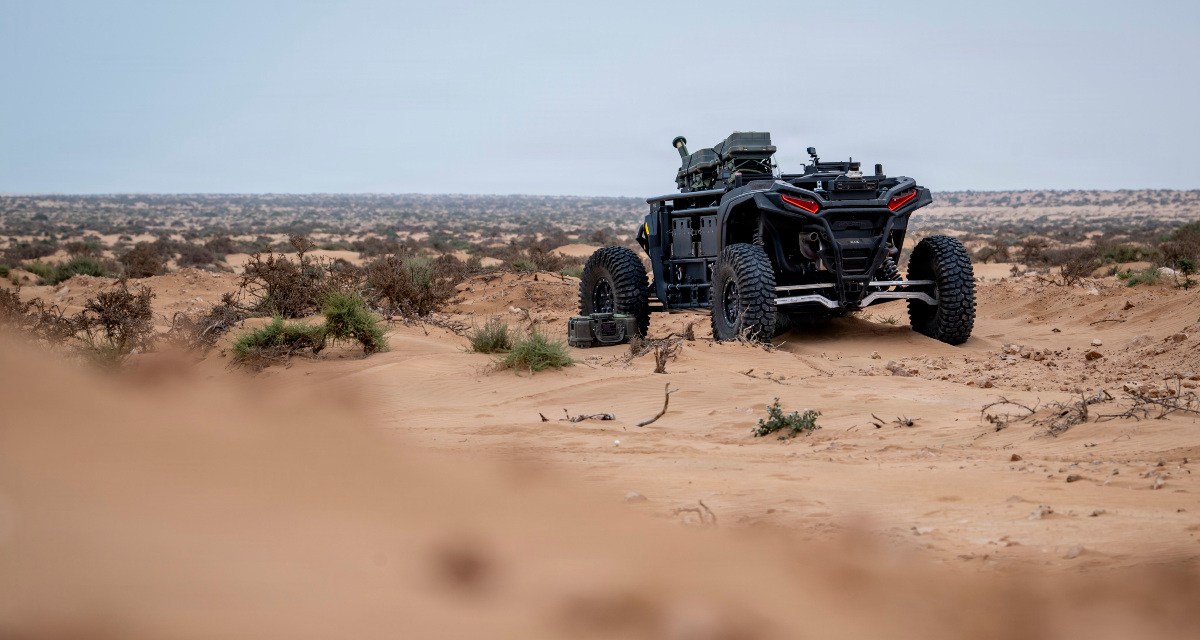
Autonomous ground systems were already operating kilometers forward of the tanks and mechanized infantry combat vehicles. Working with unmanned aircraft and other sensors, they identified enemy positions, obstacles, and trafficable routes before the manned formation became committed. When they detected an enemy observation post covering the brigade’s planned axis, a subordinate commander authorized its engagement. Other autonomous systems moved with the armored formation, carrying counterdrone, electronic warfare, sensing, and deception capabilities that helped protect the manned formation from observation and attack.
The reconnaissance picture showed that the planned axis led into a heavily defended obstacle belt, but it also exposed a weak point. The commander shifted the brigade’s axis. Tanks, mechanized infantry combat vehicles, engineers, artillery, and autonomous systems converged at the weak point, while other autonomous systems remained distributed across the formation to protect the attack.
The brigade broke through without surrendering its momentum. As the tanks and mechanized infantry combat vehicles exploited into the enemy’s depth, autonomous systems pushed forward again, searching for the next enemy positions and extending the brigade’s reach.
The commander could see farther, protect his combat power, and maintain the tempo necessary to exploit the penetration. No single autonomous system created that advantage. Scale did.
Why the Army Needs Autonomy at Scale Now
The problem the Army must solve is not how to put more unmanned systems on the battlefield. It is how to restore the ability of formations to maneuver despite persistent observation and attack. Autonomy at scale is one means of helping commanders do that.
Ukraine provides the clearest current warning. Persistent unmanned aircraft, responsive fires, dense obstacles, and electronic warfare have made it extraordinarily difficult for formations to concentrate and maneuver without detection and attack. Movement creates signatures, and signatures create opportunities for the enemy to find, fix, and strike a formation.
But Ukraine is a warning, not a blueprint for every battlefield. In the Indo-Pacific, dispersed formations may operate across islands, littorals, and difficult terrain without assured access to the air and maritime domains for resupply or support. The geography is different, but the requirement is similar: extend the formation’s reach while reducing the number of soldiers who must be exposed to accomplish it.
Recent Army writing has increasingly focused on how to restore maneuver. Lieutenant General Thomas Feltey and his coauthors argued that the battlefield dynamics on display in Ukraine do not make maneuver obsolete. Instead, formations must regain the mobility and tempo required to penetrate an enemy defense and exploit into its depth before the defender can recover. “We are going to be fighting under constant observation, and in some form of contact at all times,” retired General James Rainey observed in 2023, while serving as commanding general of Army Futures Command. “The enemy is going to be able to see us somewhere—[in the] electromagnetic spectrum, digitally, [or] from space.” Autonomous systems at scale can help restore the ability to maneuver under the modern threat environment.
The Army’s shift to division-centric operations does not diminish the importance of the brigade in this problem. The division may be the Army’s principal tactical warfighting formation, but the brigade remains its primary combined arms, close-combat maneuver force—the echelon where many of these autonomous capabilities will have to be integrated into the fight. For a brigade commander, that begins with three practical problems: seeing and understanding the enemy farther forward, protecting the formation as it moves, and sustaining increasingly dispersed forces. A brigade that cannot do those things risks being detected and fixed before it can create a position of relative advantage.
Scale Changes the Formation
A handful of autonomous systems can add capability to a formation. Scale changes the equation.
Give a company commander one tank and he has a powerful weapon. Give him a tank platoon and he begins to think differently about maneuver, mass, protection, and the missions his formation can accomplish. Autonomous systems will create a similar change. Commanders need enough systems to stop thinking primarily about where to employ an individual robot and begin thinking about how autonomy changes the formation.
The first requirement is quantity. With sufficient numbers, commanders can distribute capabilities across the depth and width of the battlefield, mass systems or effects against a problem, and accept the loss or failure of individual platforms without losing the capability.
Distribution does not eliminate mass. It creates another way to achieve it. Autonomous systems can remain physically dispersed to reduce vulnerability to enemy sensing and fires, then converge when a mission requires physical concentration. In other situations, the platforms can remain distributed while massing their sensing, electronic warfare, deception, protection, or other effects against the same tactical problem.
But quantity alone is not the end state. The greater advantage will come from an autonomous ecosystem in which systems carrying different payloads operate over resilient networks and integrate with manned and unmanned formations. Reconnaissance, counterdrone, electronic warfare, communications, deception, sustainment, and other capabilities can then be distributed across the formation and brought together as the tactical problem demands.
At scale, autonomous systems can help a brigade gain the depth it needs to see and understand the enemy, protect and disperse its formation, and sustain maneuver across a larger area.
Ultimately, autonomy at scale must allow formations to add capability without a proportional increase in operators, sustainment requirements, network demands, and command burden. And the platforms that deliver that added capability must be characterized by mission autonomy—the ability, individually or as a group of systems, to receive a task and purpose and execute within defined constraints without requiring continuous human direction.
The Army does not need to wait for every element of mission autonomy to mature before beginning. Many of the building blocks exist today. Reconnaissance and security, protection, and resupply offer three missions where commanders can begin learning what autonomy at scale does to a formation.
What Commanders Can Do Now
Reconnaissance and Security
The Army is already rethinking how brigades conduct reconnaissance and security. Emerging organizations such as the multifunctional reconnaissance company and multidomain effects platoon reflect an effort to combine reconnaissance, drones, electronic warfare, sensing, and effects to understand and shape the battlefield ahead of the main body. Ground autonomy can extend that emerging concept farther in depth and width without requiring a proportional increase in soldiers operating forward.
Army Doctrine Note 26-2, “Applying the Operational Framework to the Modern Battlefield,” goes further, identifying it as an “operational imperative to make initial contact with sensors and unmanned systems.” Autonomous ground systems provide another means of doing exactly that.
A commander could task them to reconnoiter a route or zone and answer specific information requirements: Where is the enemy? Where are the obstacles? Which routes can the manned formation use?
Instead of pushing soldiers forward simply to observe, autonomous systems can remain forward, cover more terrain, and extend the brigade’s ability to understand the battlefield before committing manned combat power. In the near term, autonomous systems will not replace scouts or independently conduct a doctrinal screen. They can, however, increase forward depth, provide early warning, and shift some of the formation’s most exposed sensing tasks away from soldiers.
Protection
Seeing farther does little good if the manned formation cannot survive long enough to maneuver. Tanks, mechanized infantry combat vehicles, Strykers, and lighter formations all need protection from the aerial and electronic threats that increasingly expose movement to enemy attack.
Autonomy at scale can contribute to protection in two ways. First, it allows commanders to disperse capabilities across greater depth and width without dispersing soldiers at the same rate. Dispersion makes it harder for the enemy to find and strike concentrations of combat power, while autonomous systems can mass again, or mass their effects, when the tactical situation requires it.
That logic is consistent with ADN 26-2, which emphasizes distance, dispersion, and concealment as means of mitigating risk and describes sufficient depth as necessary to disperse and protect formations.
Second, autonomous systems can create a moving protective layer around the manned formation. Systems carrying counterdrone, electronic warfare, sensing, and deception capabilities can accompany the main body, operate forward, or protect exposed flanks. As the fight changes, commanders can shift those systems toward the main effort or another vulnerable part of the formation.
Commanders will never have unlimited protection assets. Autonomy at scale gives them another way to distribute protection across the formation, preserve combat power through dispersion, and then concentrate platforms or effects where they are needed to enable maneuver.
Resupply
Resupply may be the mission for which autonomy application is most attainable today. Its value is not simply removing a driver from a logistics vehicle. Autonomous resupply can help commanders sustain smaller, dispersed formations in places where repeatedly sending soldiers and manned vehicles creates unacceptable risk.
Ukraine is demonstrating the value of unmanned ground systems at scale, even though most are not yet autonomous. Ground robots are increasingly carrying supplies and evacuating casualties across terrain where persistent observation and attack make routine movement dangerous. By August 2026, Ukrainian unmanned ground systems had reportedly conducted more than one hundred thousand frontline missions, with logistics and evacuation accounting for the overwhelming majority of missions in some of its most experienced formations. Most of these systems remain remotely operated or have only limited autonomous capabilities, but their employment demonstrates the value of shifting dangerous and repetitive logistics tasks from soldiers to machines. Greater autonomy could extend that advantage by allowing fewer soldiers to supervise more systems and reducing dependence on continuous communications.
The US Army is beginning to apply some of the same lessons. During 3rd Brigade, 82nd Airborne Division’s training cycle and Joint Readiness Training Center rotation, autonomous ground vehicles conducted repeated resupply missions, including an eight-kilometer contested resupply to an isolated sniper team. The scale was far smaller than Ukraine, but the underlying lesson was similar: Autonomous systems can move critical supplies forward while reducing the number of soldiers repeatedly exposed along predictable resupply routes.
This matters because dispersion only works if the Army can sustain it. ADN 26-2 observes that sustainment and friendly mobility help determine the depth to which formations can move. Autonomous resupply can help commanders sustain that depth while reducing the human exposure required to do it.
From Operating Systems to Commanding Formations
Today, soldiers largely operate or supervise individual robotic systems. That model will not scale. A brigade cannot add dozens of autonomous systems if each requires another operator, screen, and continuous stream of instructions.
The near-term transition will likely be mixed. Commanders will integrate manned formations with remotely operated and increasingly autonomous ground and aerial systems. Different systems may conduct reconnaissance, carry payloads, move supplies, provide communications relay, or contribute other effects while soldiers and leaders coordinate them as part of the combined arms fight.
Ukraine is beginning to demonstrate what this intermediate stage can look like, even though the systems themselves remain largely remote controlled. In December 2024 near the city of Hlyboke, Ukraine’s Khartiia Brigade used more than fifty aerial and ground unmanned systems to perform different functions as part of a coordinated operation. The systems did not independently replace the combined arms formation; soldiers were still required to secure and hold terrain. The significance was not the autonomy, but the ability to coordinate multiple unmanned capabilities against the same tactical problem.
The Army should progress from operating individual systems, to supervising multiple systems, to coordinating mixed manned-unmanned teams, and eventually to commanding autonomous formations using the principles of mission command.
In the near term, a commander might task autonomous systems to reconnoiter a zone, resupply a dispersed unit, or conduct portions of a breach. The commander establishes the task, purpose, constraints, and authorities while humans supervise execution. As commanders gain confidence in the systems, they should have to tell them less about how to accomplish a task and more about what needs to be accomplished and why.
Eventually, a commander could employ an autonomous formation much as he employs a subordinate formation today. It might be tasked to screen a flank, protect the main effort, or conduct another defined mission. The commander provides intent and constraints; the autonomous formation determines how to accomplish the mission within those constraints.
This future depends on more than autonomy alone. Systems carrying different payloads will need to operate across resilient networks and integrate with manned and unmanned formations. Secure and redundant communications remain important, but autonomy that depends on continuous connectivity will fail precisely where the Army most needs it. Mission autonomy must eventually allow systems to continue executing assigned tasks through denied, degraded, intermittent, or limited communications without demanding constant human intervention.
Human commanders will retain lethal decision authority consistent with applicable policy and authorities. The larger point is that autonomy must reduce the command and cognitive burden, not add another layer of systems for leaders to manage.
Learning to Fight at Scale
The Army does not need another series of short demonstrations that place a handful of autonomous systems in a formation and then remove them. Those events can help assess technology, but they cannot teach commanders how autonomy at scale changes the way a brigade fights.
The Army should continue rapid prototyping, operational assessment, and refinement of autonomous technology while formations begin training with it now. These are not competing activities. The technology and the formations that employ it must develop together.
There is historical precedent for learning this way. The first British tanks entered combat in 1916 as an imperfect response to a battlefield increasingly dominated by trenches, obstacles, machine guns, and artillery. They were mechanically unreliable, and their initial tactical employment was immature. Yet armies did not wait for a perfect tank before beginning to learn how armored vehicles could help restore maneuver. The technology improved as soldiers learned how to employ it, and eventually the tank became one element of a broader combined arms solution.
The parallel with autonomy is not exact, but the lesson matters. Retired Lieutenant General Eric Wesley recently argued that the answer to the modern drone problem will not simply be more drones; the requirement is to restore the ability to maneuver under the threat they create. Autonomous ground systems may be one part of that solution. Waiting for them to become perfect before formations begin training with them would separate technological development from the soldiers and commanders who must discover how the capability changes the fight.
Operational brigades therefore need meaningful quantities of autonomous systems for sustained training at home station before they arrive at a combat training center. Commanders and soldiers need time to train, assess, retrain, and adapt. They need enough systems to distribute capabilities across their formations, mass them against tactical problems, experience failures, reorganize, and continue the mission.
This is also how commanders build trust. The relevant question is not whether an autonomous system will ever fail. It is whether commanders understand its reliability well enough to account for failure and determine what level of risk they are willing to accept for a particular mission. Equipment losses that might be unacceptable for one mission may be entirely rational for another if they accomplish the mission while avoiding greater human exposure.
Units also need the ability to iterate with industry as they learn. Soldiers should be able to train with a capability, identify shortcomings, work with developers, and put an improved capability back into the field during the same training progression. Prototype the technology. Train the formation. Assess performance. Refine both.
The obstacles are real. Networks remain vulnerable. Tactical formations face significant power and energy constraints. Industry must demonstrate that it can produce, maintain, and support systems at meaningful scale. Leaders must determine how many systems their formations can absorb without creating an unsustainable operator, sustainment, or cognitive burden. Those challenges are reasons to begin learning now, not reasons to wait.
The first time a brigade employs autonomy at meaningful scale should not be at a combat training center. It should arrive there prepared to fight with it.

The brigade commander in the opening vignette did not succeed because autonomous systems replaced tanks, mechanized infantry combat vehicles, scouts, engineers, or soldiers. He succeeded because autonomy gave the formation greater depth, helped protect its combat power, sustained its dispersion, and allowed the commander to mass capabilities at the point of advantage.
That is the opportunity autonomy at scale presents. Autonomy does not replace combined arms. It becomes part of combined arms. Reconnaissance and security, protection, and resupply are practical places to begin, but the larger change will come as commanders move from operating individual systems to coordinating mixed manned-unmanned teams and eventually commanding autonomous formations through mission command.
Much of the technology required to begin that transition exists today, even if it is not yet perfect. The Army should continue to prototype and refine the technology while giving operational formations the systems, time, and repetitions required to learn how to fight with it. Technology, tactics, organizations, and trust must develop together.
The changing battlefield is already challenging the Army’s ability to see first, survive contact, sustain dispersed formations, and maneuver against an enemy capable of persistent observation and attack. Autonomous systems alone will not restore maneuver. But employed at scale and integrated into combined arms formations, they can help create the conditions that allow soldiers and manned formations to maneuver again.
Army leaders do not need to know exactly what the autonomous formation of the future will look like before beginning this work. They need to put sufficient capability into the hands of soldiers now, learn from its limitations, and allow formations to discover how autonomy changes the way they fight.
The question is no longer whether autonomous systems will join Army formations, but whether the Army will learn to fight with them at scale before the next war demands it.
Dave Rowland is a retired US Army colonel who served in and deployed with airborne, Ranger, and Stryker units. He last served as commander of the 3d US Infantry Regiment (“The Old Guard”). He is the author of Green Light, Go! The Story of an Army Start Up.
Brian Hester is a retired command sergeant major who most recently served as the senior enlisted adviser of US Army Futures Command. Previously, he was command sergeant major of US Army Central. After enlisting as an infantryman, he served in every infantry leadership position from team leader through command sergeant major. He deployed three times to Iraq, twice to Afghanistan, and once to Kosovo.
The views expressed are those of the authors and do not reflect the official position of the United States Military Academy, Department of the Army, or Department of Defense.
Image credit: Mass Communication Specialist 2nd Class Samuel Wagner, US Navy