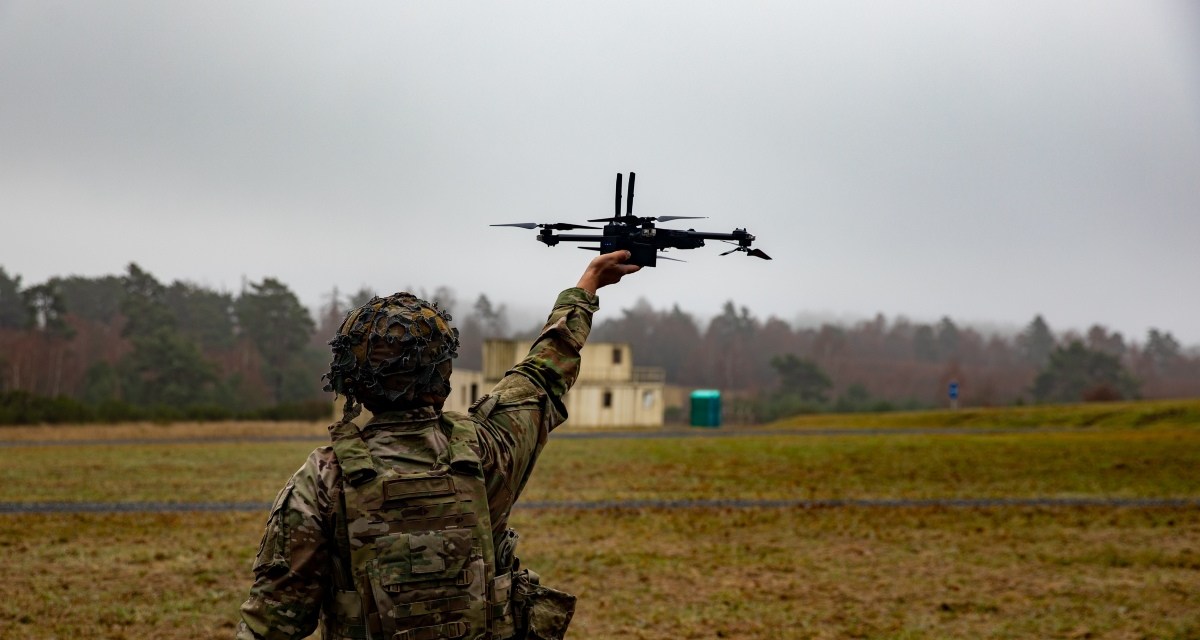
Across contemporary battlefields, inexpensive drones increasingly operate as components of distributed systems that combine software processing, computing hardware, and tactical networks to accelerate AI-enabled detection, analysis, and engagement. These technologies are evolving rapidly, and many of their future applications are still unknown. What is already clear, however, is that technological advantage alone will not determine success. As military history repeatedly demonstrates, competitive advantage ultimately depends upon developing the people capable of employing new technologies more effectively than their adversaries.
The US Army’s approach to tactical drone operations reflects this enduring challenge. Although investment continues to accelerate, the associated personnel management system has changed comparatively little. Across the force, soldiers routinely operate more and more complex systems as additional duties rather than as part of a recognized career field or professional specialty. That model may have been adequate when small drones served primarily as niche reconnaissance assets. It is fundamentally inadequate for AI-enabled operations in which autonomous systems have become integral to maneuver, fires, intelligence, and command and control.
Artificial intelligence does not eliminate the need for skilled soldiers; it changes the nature of their expertise. As autonomy assumes a greater share of navigation, target recognition, and data processing, personnel transition from manually operating individual aircraft to supervising autonomous systems, validating AI-generated recommendations, managing distributed networks, and integrating machine-generated information into tactical decision-making. The limiting factor in generating combat power from these systems is no longer a soldier’s ability to fly a drone. It is the Army’s ability to develop professionals capable of integrating autonomous systems into combined arms operations under the demanding conditions of modern combat.
Unmanned system operations have evolved from a specialized technical capability into a routine component of combined arms maneuver. Sustaining that capability requires personnel who can continuously adapt to electronic warfare, software updates, evolving enemy tactics, and rapidly changing autonomous technologies while maintaining persistent operational tempo. Organizations that treat autonomous systems as an additional duty will struggle to generate enduring combat effectiveness. Those that cultivate dedicated technical expertise and institutional career pathways will possess a decisive operational advantage.
The war in Ukraine, where autonomous systems have become central to large-scale combat operations, has offered the clearest and most leading-edge evidence of these patterns. While the US Army has dramatically less direct operational experience with them, key learning opportunities—like 1st Brigade Combat Team, 82nd Airborne Division’s ongoing combat deployment to the US Central Command area of responsibility—reinforce the lessons emerging from Ukraine. The brigade’s deployment, examined against the backdrop of the war in Ukraine, suggests that the Army’s greatest challenge is no longer fielding the autonomous systems themselves but developing the personnel capable of employing them in combat.
Meeting that challenge requires more than increasing the number of drone operators. It demands a holistic strategy to recruit, develop, assign, promote, and retain the soldiers and leaders responsible for employing AI-enabled autonomous systems across the force. The Army must professionalize autonomous systems employment by recognizing it as an enduring area of military expertise, supported by dedicated career pathways, deliberate leader development, and personnel policies that preserve technical expertise throughout a soldier’s career. Without corresponding reforms to the personnel system, advances in artificial intelligence will yield diminishing operational returns, leaving the Army with increasingly capable technology but insufficient human capital to employ it effectively.
Organizing Expertise for Tactical Employment
Creating a successful personnel model for AI-enabled operations begins with a fundamental organizational question: Where should autonomous systems expertise reside? For decades, responsibility for unmanned aircraft naturally gravitated toward the aviation branch because these platforms were often expensive, technically complex, and primarily employed as centralized reconnaissance assets. Larger systems, such as the MQ-1C Gray Eagle, shared many operational characteristics with manned aircraft, requiring specialized and significant flight operations, launch-and-recovery procedures, airspace coordination, and maintenance expertise. Today’s tactical autonomous systems fundamentally challenge those assumptions. They are increasingly inexpensive, numerous, and embedded directly within maneuver formations, making traditional organizational distinctions less relevant.
The Army should assign responsibility for autonomous systems according to their operational function rather than their technical characteristics. Traditionally, the Army has embedded specialized expertise within maneuver formations whenever doing so improved responsiveness and combat effectiveness. Mortar teams, forward observers, combat engineers, joint terminal attack controllers, and communications specialists all reside alongside the formations they support because tactical commanders require immediate access to those capabilities during combat. AI-enabled autonomous systems increasingly fit this same model. Their operational value depends upon persistent integration with maneuver formations, where autonomous capabilities can generate reconnaissance, strike, and protection effects at the speed required by modern combat.
Where the Army chooses to place autonomous systems expertise carries important personnel implications. When autonomous systems are treated as centrally managed aviation assets, technical proficiency naturally concentrates at higher headquarters. As they become routine components of maneuver, however, expertise must accompany the formations that require the effects they provide. Accordingly, personnel policies should make the soldiers responsible for sustaining autonomous operations permanent members of maneuver units rather than temporary attachments or additional-duty operators, supported by assignment models and career pathways that preserve and develop this expertise within the maneuver force.
Unlike aviation personnel, whose expertise is focused on the operation and sustainment of aircraft, autonomous systems specialists derive their value less from mastery of a specific aircraft than from their ability to integrate evolving autonomous capabilities into combined arms operations. For example, advances in autonomy seen in many drones reduce the relative importance of manual flight proficiency while increasing the importance of integrating autonomous systems, communications networks, edge processing, and AI-enabled decision support into a cohesive combat capability.
This does not eliminate the need for specialized aviation expertise. Larger Group 3 systems that require complex maintenance, dedicated launch-and-recovery infrastructure, and extensive airspace coordination should be operated by aviation personnel within brigade formations. Conversely, the smaller systems routinely employed by battalions and companies function less as traditional aircraft than as organic maneuver capabilities. Their effectiveness depends on organic employment within the units they support rather than periodic attachment from centralized organizations.
Accordingly, the Army should develop dedicated autonomous systems specialists within the maneuver branches rather than relying on additional-duty operators or external aviation support. Like the infantry mortar community, these personnel would possess specialized technical expertise while remaining fully integrated into the tactical formations they support. Their purpose is not merely to operate the systems but to sustain the continuous integration of AI-enabled reconnaissance, strike, and protection capabilities into combined arms maneuver.
Ultimately, the question is not which branch owns these capabilities. It is how the Army develops and positions the expertise required to employ them effectively. As AI-enabled operations continue to compress decision cycles and decentralize battlefield action, the Army’s competitive advantage will increasingly depend upon placing skilled autonomous systems professionals at the lowest echelon capable of generating operational effect. That requirement begins with recognizing autonomous systems employment as a professional specialty rather than an additional duty.
The Tactical Autonomous Systems Specialist
The Army’s transition to AI-enabled operations demands more than additional personnel; it requires establishing tactical autonomous systems specialists as a recognized professional field, managed through deliberate career development and personnel policies within the maneuver force. The specialist designation should describe a career field rather than a specific duty position. Soldiers within the specialty could serve in multiple roles across tactical formations, including as drone operators, autonomous systems technicians, team leaders, instructors, and capability integrators as their expertise develops throughout their careers. Unlike today’s additional-duty drone operators, tactical autonomous systems specialists would be responsible for sustaining the Army’s tactical autonomous ecosystem by integrating sensors, edge processing, tactical data networks, AI-enabled analysis, and autonomous platforms to generate reconnaissance, strike, and protection effects during combined arms operations. Their value lies not in flying individual aircraft but in ensuring that information moves rapidly and reliably from collection to decision to action under combat conditions.
This distinction is also significant as advances in autonomy will continue to reduce the need for pilots to possess high flight proficiency to operate most small tactical systems, such as Group 1 drones. Once the aircraft are launched, flown, and recovered with relative ease, the value these specialists provide will lie not in controlling the aircraft themselves but in their ability to integrate autonomous systems into combined arms operations, supervise AI-enabled tools, and support digital information architecture.
While serving as a battalion operations officer in 1st Brigade Combat Team, 82nd Airborne Division during its deployment to US Central Command, I was responsible for integrating AI-enabled and autonomous capabilities and synchronizing their employment with operations. That experience demonstrated that AI-enabled operations depended upon much more than aircraft proficiency. Personnel were responsible for integrating edge processors, tactical communications networks, software services, and autonomous platforms into a single autonomous ecosystem. At a single launch-and-recovery site, one edge processor could ingest up to twenty simultaneous sensor feeds. Replicated across a brigade, personnel could be confronted with hundreds of concurrent data streams and an even larger number of machine-generated detections. AI-enabled tools can perform initial object detection, tracking, and correlation while prioritizing information for human review. The specialist’s workload therefore shifts from flying individual aircraft to validating high-priority detections, resolving conflicting information, identifying false positives, assigning limited network and processing capacity, and delivering actionable information to the appropriate commander or shooter. Rather than replacing human judgment, AI enables specialists to focus that judgment where it creates the greatest operational advantage.
Although autonomy reduces the need for continuous manual flight control, it does not diminish the importance of technical proficiency. Autonomous systems specialists should serve in small teams, filling distinct roles necessary to sustain continuous autonomous operations under combat conditions. Their responsibilities extend beyond aircraft readiness to sustaining the entire autonomous ecosystem upon which tactical decision-making depends. They must configure, monitor, and troubleshoot the communications architecture connecting aircraft, edge processors, commanders, and shooters. Their objective is not to maximize the performance of a single aircraft, but to maintain the flow of data and effects across an AI-enabled autonomous ecosystem despite electronic attack, degraded connectivity, equipment failure, and enemy observation.
Success in this role depends on a unique combination of tactical competence and technical aptitude. These personnel must possess the physical endurance to establish, displace, and sustain launch-and-recovery sites while operating alongside frontline maneuver units under constant threat. At the same time, they must demonstrate the technical proficiency to supervise AI-enabled systems, recognize degraded algorithm performance, manage distributed software-defined capabilities, and adapt rapidly as software, enemy tactics, and battlefield conditions change.
Recognizing autonomous systems employment as a distinct professional specialty requires more than additional training. The Army should establish a dedicated military occupational specialty for tactical autonomous specialists within the maneuver force. A distinct MOS would provide the institutional foundation for specialized training and career development while preserving technical expertise across assignments. Within this career field, progressively demanding positions would allow soldiers to advance from system employment and technical roles to team leadership, instruction, integration, and capability development positions.

Building AI-Literate Leaders
AI-enabled operations also create new personnel requirements for the officers and noncommissioned officers assigned to lead them. These leaders do not need to be able to operate every platform or possess the same technical depth as tactical autonomous systems specialists. They do, however, need sufficient technical literacy to understand what AI-enabled systems can and cannot do, interpret machine-generated recommendations, recognize degraded performance, and make sound tactical decisions when automation is uncertain or incorrect.
Commanders are no longer required merely to synchronize maneuver, fires, and logistics. They must also understand the capabilities and limitations of AI-enabled systems well enough to determine when to trust automated recommendations, when to question them, and when to override them entirely. As autonomous systems assume a greater role in tactical decision-making, technical literacy becomes a command competency rather than a niche technical skill.
Developing this competency requires changes to professional military education. Courses at every level should incorporate AI-enabled operations, autonomous systems employment, tactical networking, and human-machine teaming as routine components of leader development. The objective is not to produce software engineers, but commanders capable of employing complex autonomous capabilities with confidence and judgment. These educational reforms should be reinforced through assignment policies that recognize the growing importance of technical competence. Officers and noncommissioned officers selected to lead formations employing autonomous systems should demonstrate both tactical credibility and the aptitude to understand complex human-machine systems.
AI-enabled formations also require a different command philosophy. Rather than directing every autonomous capability, leaders must establish clear intent, appropriate authorities, and effective human oversight, while empowering technical specialists to continuously adapt systems in response to changing operational conditions. Successful commanders will increasingly be distinguished not by their ability to control every action, but by their ability to integrate human judgment and machine performance into a cohesive autonomous combat system.
The Army has repeatedly adapted its leader development system to accommodate transformational changes in warfare, from mechanized maneuver to cyber operations. Artificial intelligence demands a similar evolution. AI literacy should become a deliberate component of officer and noncommissioned officer development rather than a competency leaders are expected to acquire independently.
Developing Autonomous Systems Personnel
Artificial intelligence changes the character of the profession of arms, but it does not diminish the importance of the soldier. As autonomous systems assume greater responsibility for sensing, navigation, data processing, and target recognition, the remaining human responsibilities become increasingly consequential. Rather than performing routine tasks manually, personnel supervise autonomous systems, validate AI-generated recommendations, manage distributed networks, and make tactical decisions under uncertainty. Success in AI-enabled operations, therefore, depends not on reducing human involvement but on developing soldiers whose judgment, adaptability, and technical competence enable them to employ increasingly sophisticated human-machine teams effectively in combat.
The defining characteristic of these personnel is adaptability. Unlike many legacy weapon platforms that remain relatively stable over years of service, AI-enabled capabilities may evolve significantly during even a single operation or campaign through software updates, revised AI models, new sensor integrations, and changes in adversary tactics. Soldiers at the edge will need to modify software configurations, update target-recognition models, alter network architectures, or adjust employment techniques in response to observed changes in the operational environment. The Army’s competitive advantage will therefore depend less on mastering individual technologies than on developing personnel capable of continuous learning and rapid adaptation. Adaptability should become a core criterion for selecting, evaluating, and developing autonomous systems specialists throughout their careers.
These demands require a different approach to personnel selection. Success in AI-enabled operations depends not only on tactical competence, but also on technical curiosity, systems thinking, sound judgment, and the ability to learn rapidly under pressure. Rather than relying primarily on volunteers or unit-level assignment decisions, the Army should deliberately identify soldiers who demonstrate these attributes through aptitude assessments, observed performance, and ongoing evaluation over the course of their careers. The objective is not to identify computer programmers or network engineers, but soldiers capable of integrating complex autonomous capabilities into tactical operations while exercising disciplined judgment in uncertain environments.
AI-enabled operations also require soldiers capable of balancing confidence in machine-generated recommendations with the judgment to question them when necessary. Automation can reduce cognitive workload and accelerate decision-making, but it can also introduce false positives, biased recommendations, and misleading confidence. Personnel must therefore develop disciplined skepticism alongside technical competence, recognizing both the capabilities and limitations of autonomous systems. Human judgment remains indispensable not because artificial intelligence is ineffective, but because combat continually presents novel situations that exceed the assumptions upon which AI models are trained.
The physical demands of these positions remain equally significant. Autonomous systems teams operate alongside maneuver forces on increasingly transparent battlefields where launch-and-recovery and command-and-control sites are vulnerable to detection, electronic warfare, and precision fires. Personnel must rapidly establish and displace operating locations, sustain continuous operations under austere conditions, transport heavy batteries and equipment, troubleshoot complex technical systems, and remain prepared to fight as members of the formations they support. Autonomous systems reduce the need for continuous manual flight control, but they do not reduce the physical demands of operating and sustaining those systems under combat conditions.
Developing and sustaining these attributes require professional development to be a continuous process rather than a set of initial qualification events. Initial training can establish baseline proficiency, but it cannot prepare personnel for technologies that will continue evolving throughout their careers. Autonomous systems specialists should therefore participate in recurring technical education, operational experimentation, and opportunities to contribute to capability development alongside operational assignments. Career models should encourage the continuous refinement of technical expertise while exposing personnel to emerging operational concepts, ensuring that professional growth keeps pace with technological change.
Ultimately, AI-enabled operations demand an uncommon combination of tactical competence, technical aptitude, cognitive adaptability, and physical endurance. These qualities cannot be generated through additional-duty assignments or short qualification courses. They must be deliberately identified, cultivated, and retained through a personnel system that recognizes autonomous systems employment as a long-term professional specialization. Building effective human-machine teams, therefore, begins not with technology but with investing in the soldiers whose expertise enables that technology to generate decisive combat effects.

Artificial intelligence will not diminish the importance of soldiers on future battlefields, but it will fundamentally change the expertise required to employ combat power effectively. As autonomous systems become increasingly integrated into reconnaissance, maneuver, and fires through AI-enabled processing and resilient tactical networks, the Army’s competitive advantage will depend less on fielding individual technologies than on developing the people capable of integrating them into combined arms operations. Human judgment, adaptability, and leadership will remain indispensable even as machines assume a greater share of routine cognitive and physical tasks.
Meeting this challenge requires more than just procuring more hardware and software and integrating them into existing formations. It demands a deliberate transformation of the Army’s personnel system. Recruiting soldiers with the technical aptitude to succeed in AI-enabled operations, developing specialized expertise through progressive education and operational experience, preparing leaders to command human-machine teams, and retaining highly skilled professionals must be institutional priorities rather than unit-level ad hoc initiatives. Autonomous systems may evolve rapidly, but the expertise required to employ them effectively can only be developed through sustained investment in people over the course of a career.
Throughout its history, the Army has repeatedly adapted its personnel system to accommodate transformational changes in warfare. Artificial intelligence represents the next such transformation the Army must adapt for. Operational lessons emerging from both the war in Ukraine and recent Army combat deployments demonstrate that success will depend as much on developing the right people as it does on fielding ever-evolving technology. Therefore, the employment of autonomous systems should be recognized as a long-term professional specialization supported by dedicated career pathways, deliberate leader development, and personnel policies designed to preserve expertise over the course of a career.
Ultimately, the military that fields the most autonomous systems will not hold the decisive advantage in AI-enabled warfare. Instead, it will belong to whoever most effectively recruits, develops, empowers, and retains professionals capable of employing those systems in combat. Technology can be produced, copied, and eventually countered. A professional force built through deliberate personnel management cannot. Therefore, in the age of artificial intelligence, the Army’s enduring competitive advantage will not rest in its algorithms, but in its soldiers and leaders.
Major Lucas Ziller is a US Army infantry officer with operational and planning experience within Army, special operations, and joint formations, including the integration of AI-enabled and autonomous systems into combat operations. He is pursuing a PhD in public administration at North Carolina State University, where his research focuses on artificial intelligence, autonomous warfare, and organizational adaptation.
The views expressed are those of the author and do not reflect the official position of the United States Military Academy, Department of the Army, or Department of Defense.
Image credit: Spc. Adrian Greenwood, US Army