As with most recent conflicts, commentary on the recent Iran War used a variety of confusing terms to describe the success of the air battle. Pundits and officials alike spoke of air dominance, air supremacy, air superiority, and control of the air. Meanwhile, in Ukraine, others talked of air parity. In reality, these terms are so last century. This is a factual statement, not a throwaway line.
The fundamental reason the terms now confuse rather than bring clarity is that the air is now filled by more than only the manned aircraft that were present when these definitions were established. The airspace of modern wars is now routinely also used by large numbers of remarkably diverse types of rockets, cruise missiles, ballistic missiles, and drone systems. Compounding this, such unmanned systems are now used by everybody: states, nonstate actors, and all the military services, whether land, sea, or air. It’s a busy sky, open to all, used by all. and at all times.
These terms all suggest a certain ownership of the sky that’s no longer possible, even in limited ways.
Archaic Terminology
The terms can trace their origins back to the first half of the last century. “Air superiority” is perhaps traced as far back as 1917; “command of the air” was popularized in 1921 by Giulio Douhet; in 1923 US Army Major General Mason Patrick used “aerial supremacy”; in 1925 Billy Mitchell wrote about “control of the air”; in 1938 “air parity” was being debated in Britain’s Houses of Parliament; and in 1942 President Franklin D. Roosevelt spoke of “domination of the air” while the war plans drafted to achieve this sought “air ascendancy” over the adversary.
In many cases, such terms were undefined, meant to be dramatic and used in rhetorical justifications for creating, sustaining, or enlarging air forces. In the first half of the twentieth century, manned aircraft were the principal means to defeat air attacks. The need to gain control of the air through air-to-air combat was a compelling rationale for forming air forces.
In this century however, it’s no longer possible for one side in a war to prevent another using the air. In the 2026 war, Iran kept on launching missiles and drones throughout and beyond the conflict while in the face of intense Israeli and US air operations. This inability to own the air is even evident in cases of extreme airpower differentials such as that between the United States and the nonstate Houthi group in the 2025 Operation Roughrider in Yemen. The Houthis kept on launching drones, cruise missiles, and ballistic missiles until well after the United States had wearied of the operation.
It can be argued that this is reflected in control of the air being defined doctrinally as “a level of influence in the air domain relative to that of an adversary.” The degree of control then rests on an assessment of the degree to which the other is influential in the air, not on fielded capabilities or on the effect these capabilities have on the war. Still, there remain shortcomings.
In the civil war in Myanmar, the military government had supersonic fighter-bombers and armed helicopters while the insurgent bands had small hobbyist drones purchased from Chinese commercial businesses across the border. For a couple of years the insurgents steadily advanced and captured significant territory, a feat in which their drones played a significant role—some say a decisive one. The drones though gave the insurgents no control of the air. The government’s air assets operated virtually unimpeded seemingly in complete control of the air but were relatively uninfluential in being unable to stop the drones operating as they wished. Trying to compare relativities between Myanmar’s jet fighters and hobbyist drones in terms of their “level of influence in the air domain” is an apples and oranges task; they are fundamentally different and cannot be practically compared.
Over time, control of the air has gradually come to be seen as a continuum running from little influence to great. However, the terms used to set out where on the continuum an air operation is, such as air supremacy and air superiority, do not easily lend themselves to expressing shades of gray. The terms lack nuance, are contextual, and are imprecise in offering any quantifiable basis, leaving the person using the terms to decide on their applicability to the circumstance. There are echoes of Humpty Dumpty in Lewis Carroll’s Through the Looking-Glass: “When I use a word . . . it means just what I choose it to mean—neither more nor less.”
The most often used term is air superiority, that: “degree of control of the air by one force that permits the conduct of its operations at a given time and place without prohibitive interference from air and missile threats.” This again does not adequately capture today’s reality of mixed manned and unmanned system employment.
Using the extreme case of the United States and the Houthis again, the former could conduct operations in the Red Sea as it wished although the latter’s missile and drone attacks continued and contributed to the loss of an F/A-18. This could be construed as not “prohibitive interference” even if the interference persisted across Operation Roughrider. In Yemeni airspace the issue was less clear given the Houthis’ air defense systems quickly shot down seven Reaper drones using surface-to-air missiles. With an ongoing Houthi air defense threat, Operation Roughrider could not proceed as planned after the initial thirty days. In some respects, this might be seen as representing “prohibitive interference” and thus air superiority was not achieved as doctrinally defined. There is no doubt though that American air capabilities and capacities were always far superior to—that is technically better than—the Houthis’.
On the other hand, it is certainly also not the lesser case of air parity in which the influence criteria no longer holds sway. Air parity is instead “a condition in which no force has control of the air [and] in which both friendly and adversary land, maritime, and air operations may encounter significant interference by the opposing force.” Parity as a word means equivalence or equality. When the United States fought the Houthis, the Houthis never attained any identifiable form of air operation equivalence. The Houthis did though continue attacking during and after the periods discussed. Neither air superiority nor air parity sensibly fits the US/Houthi case and by extension, neither does air supremacy or air dominance.
Reform Attempts
Unhappiness with the inferences of the air superiority, parity, and supremacy terms has led some to advocate for a new label, air denial. This term is held to particularly apply to the Ukraine War, where both sides can deny their respective territorial airspace to the other’s manned aircraft in terms of imposing an unacceptable attrition rate. Air denial is then apparently only applicable to manned aircraft and not to rockets, cruise missiles, ballistic missiles, or drones. Air denial as a useful term falls down in being a condition seemingly only appropriate for some types of air vehicles.
The air littoral term has also been coined. This is intended for the lower altitudes, say below ten thousand feet, where large numbers of small and medium-sized drones might operate in certain areas. As fighter aircraft or medium-range surface-to-air missile systems are less suited for engaging such drones, it is implied that these air defense assets should be reserved to intercept targets flying above that nominal cutoff altitude. This highlights that the air littoral concept is derived from traditional airspace management measures that control friendly air operations using height, location, and time—or as the air littoral advocates write, “time, planar distance, and altitude.”
The reason given to adopt the air littoral term is the need to reconceptualize control of the air as a “volume rather than a flat bounded plane.” It is argued the air littoral should be decoupled from “the blue skies,” principally as the sky is now occupied not just by manned aircraft but also by rockets, cruise missiles, ballistic missiles, and drone systems. However, the air is indivisible in that parts of it cannot be cordoned off. Rockets, cruise missiles, ballistic missiles, and drone systems operate below and above ten thousand feet. Air defense systems of whatever kind may need to defend against hostile attack from any arbitrarily chosen altitude.
The air littoral argument is correct in that combat airspace now includes rockets, cruise missiles, ballistic missiles, and drone systems. However, creating a new airspace management term is a limited doctrinal response to this new reality, not an answer to it.
Now What?
The multiple shortcomings with the various traditional ways of describing control of the air are unsurprising. Air wars today are waged very differently to the air wars of the first half of the twentieth century, for which the terms were coined. The skies are increasingly crowded with unmanned systems. Therefore, the terminology—air parity, air superiority, air supremacy, and control of the air terms—derived when manned aircraft were the only means of using the air should be retired, as least in professional usage.
If these older terms are abandoned, what might replace them? Kazunobu Sakuma has devised a clever solution called the “two-parities model,” which creates a four-quadrant matrix from access and exploitation. Either both combatants may access and exploit the air, only one can do so, or neither can. This highlights some issues useful when planning air operations and it’s applicable to manned aircraft and unmanned air systems. On the other hand, as argued, everybody can now access and exploit the air if they choose to; the terms then don’t allow discrimination between combatants or describe their successes.
The old terms remain rhetorically powerful; superiority, dominance, and supremacy exude confidence and send a message of combat triumph. This has its downsides, however, in implying a level of safety from hostile air attack. Passive defenses can seem unnecessary but, as the Iran War demonstrated, some rocket, missiles, and drone attacks are likely to penetrate. Moreover, intercepting incoming ballistic missiles overhead means potentially damaging debris falling on people and facilities. The old terms arguably mislead.
Irrespective of the old terminology’s shortcomings, their advocates express a fundamental truth. It is critically important to counter the adversary’s use of the air. And maybe that’s the answer. Instead of relying on outdated, subjective, and imprecise terms, focus instead on the mission of countering—that is, counterair operations.
In being a type of air operation—not a condition—counterair is inherently objective and can be used with precision, which gives it much greater utility.
With more than a quarter of this century already gone, now might be a good time to move on from using last century’s terms.
Dr. Peter Layton is a Royal United Services Institute (London) associate fellow and a visiting fellow at the Griffith Asia Institute (Brisbane, Australia). A retired Royal Australian Air Force Group Captain, he has extensive aviation and defense experience and is the author of the book Grand Strategy and coauthor of Warfare in the Robotics Age.
The views expressed are those of the author and do not reflect the official position of the United States Military Academy, Department of the Army, or Department of Defense.
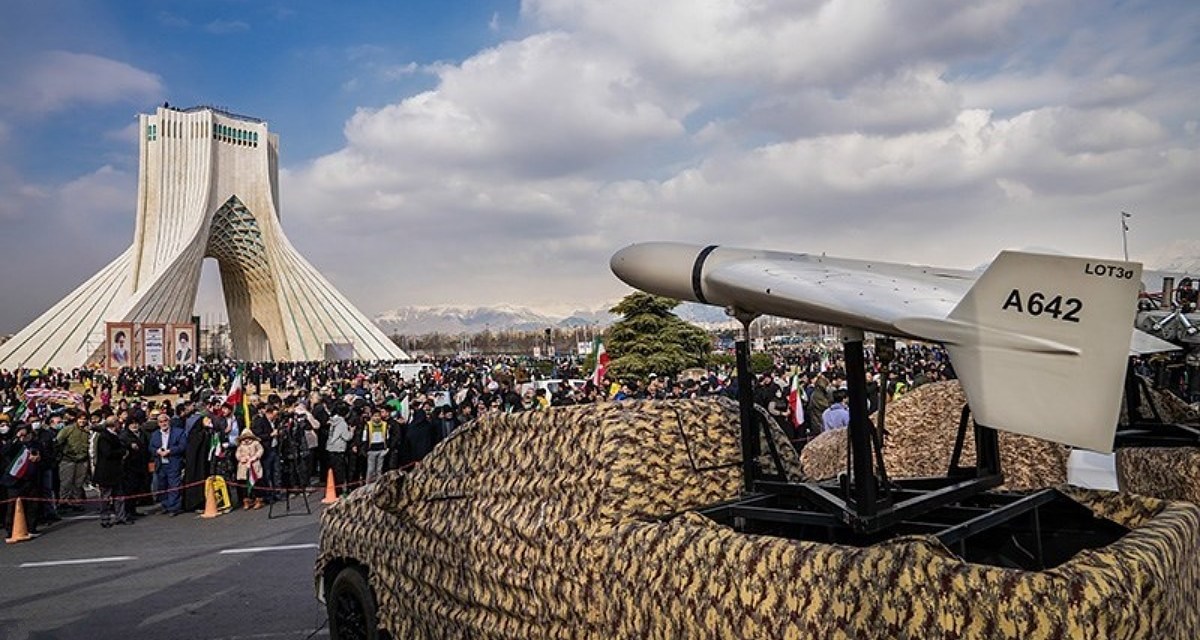
Image credit: Tasnim News Agency