
Modern military training excels at teaching processes such as the troop leading procedures, the military decision-making process, and the standardized call for fire. Yet one of the most critical elements of leadership remains difficult to develop deliberately: judgment under uncertainty.
On today’s battlefields, where speed, complexity, and uncertainty are increasing, the ability to exercise judgment under pressure is not a luxury, it is decisive. We train for certainty in a profession defined by uncertainty. Judgment is often assumed to emerge through experience, yet it is rarely developed systematically. Leaders are not simply required to make decisions. They must interpret incomplete information, balance competing demands, and act in time to exploit fleeting opportunities. These conditions cannot be fully captured through instruction alone; they must be experienced.
But even experience alone is not enough. Judgment under uncertainty does not reliably emerge on its own. It must be deliberately designed, trained, and refined through a coherent system that integrates wargaming, decision-forcing exercises, and structured reflection.
Despite this, professional military education often emphasizes the application of models and procedures. These are necessary, but they are not sufficient. The central challenge is not how to teach decision-making as a process, but how to deliberately develop the judgment required to act under conditions that resist structure.
This requires more than exposure. It requires design.
Nature of Judgment
Judgment in leadership is often described, but less often examined in terms of how it is formed. It is not a discrete skill that can be taught in isolation, nor does it emerge from theory alone. Over the course of my career, I have heard from both serving and former leaders that judgment develops through repeated exposure to situations where competing imperatives must be reconciled under constraints. Leaders must balance mission accomplishment with responsibility for their people, often under time pressure and with incomplete information. These decisions are rarely clear-cut. They involve trade-offs that must be explicitly or implicitly justified, both to superiors and to subordinates.
In practice, judgment is expressed not only in major decisions, but in small, discretionary acts: adjusting tempo, redistributing effort, preserving combat power, or accepting risk in one area to mitigate it in another. These actions are often low visibility, but they are central to maintaining effectiveness and legitimacy.
Judgment is best understood not as a single decision, but as a cycle of perception, attention, reflection, and decision while operating under pressure. This challenges the idea that decision-making follows a linear process. Instead, these elements interact continuously, shaped by context, hierarchy, and accountability.
Illusion of Certainty
The difficulty of developing judgment is compounded by a persistent tendency to seek certainty. As Martin van Creveld observed in Command in War, the history of command can be understood as a continuous attempt to meet the demand for information with improved systems of control. This effort is understandable but ultimately limited. More information does not necessarily produce better decisions. The central problem is not availability of information, but interpretation.
War is nonlinear and inherently uncertain. Additional data often increases the number of signals that must be processed under time pressure. What matters is not the accumulation of information, but the ability to recognize what is relevant, focus attention effectively, and act before the opportunity passes. This requires familiarity and experience, not simply access to more data.
The implication is clear: Judgment cannot be developed by improving information alone. It must be developed through exposure to uncertainty.
Gap in Training
Professional military education has long recognized the importance of experience. However, the way experience is structured often falls short of deliberately developing judgment. Instruction provides knowledge. Exercises provide practice. But not all practice creates the conditions necessary to develop judgment.
For judgment to develop, three elements must be present:
- Real trade-offs between competing priorities
- Bounded discretion within constraints
- Meaningful consequences of decisions
Crucially, judgment does not form in conditions of perfect planning or flawless execution. It forms in ambiguity, under time pressure, and in situations where consequences matter. Without these elements, decision-making becomes procedural rather than interpretive. Participants learn how to follow a process, but not how to navigate uncertainty. This is not a failure of intent, but a matter of design. The challenge is not to add more content, but to structure experiences deliberately to produce judgment.
Structured Decision-Making as a Development Tool
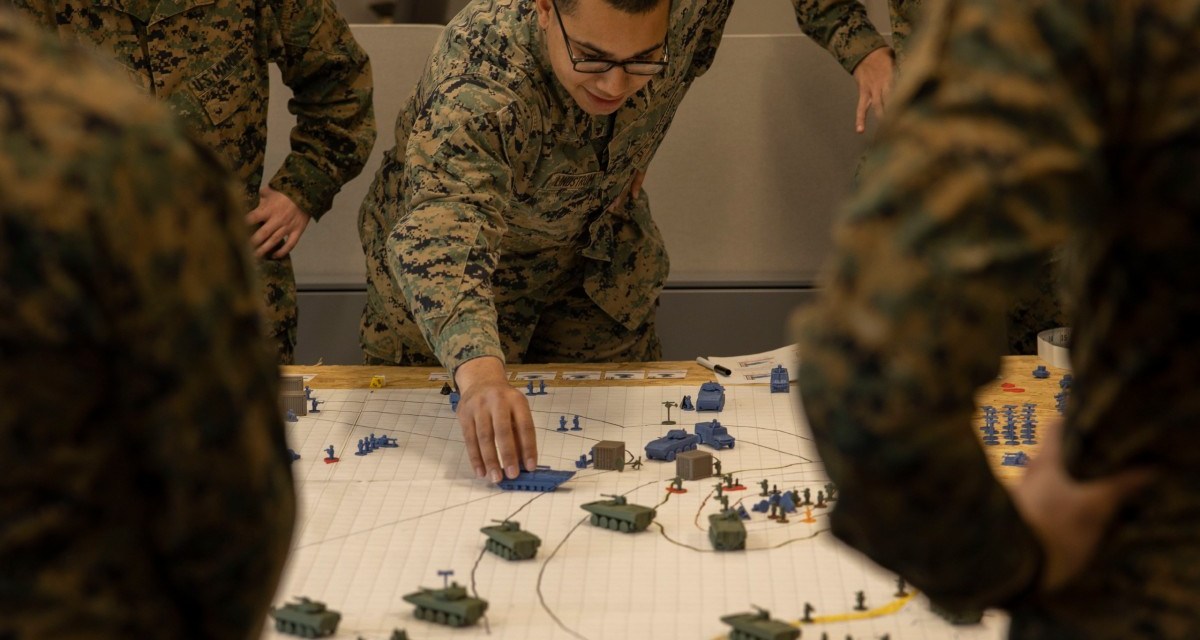
One approach that addresses this gap is the use of structured decision-making environments, such as tactical decision games and wargaming. These methods present participants with a situation, limit the available information, and require a decision within a constrained timeframe. They do not attempt to replicate reality in full detail. Instead, they isolate the key elements of uncertainty, time pressure, and consequence.
Their value lies in repetition and variation. Participants are exposed to multiple decision points, often with different outcomes, each requiring interpretation and justification. This creates repeated cycles of decision, variation, and reflection. Over time, this builds familiarity with uncertainty and strengthens the ability to act within it. The objective is not to produce a single correct answer. It is to develop the ability to make and defend a decision under conditions that resist certainty.
We cannot train judgment directly. We create the conditions in which it is formed.
Toward a Coherent System
If judgment develops through structured exposure to uncertainty, then the question becomes how to scale this within military training. Historically, methods such as Kriegsspiel provided a systematic approach to developing decision-making through repeated, facilitated scenarios. Modern equivalents exist, but their use is often uneven and dependent on individual initiative rather than institutional design.
What is required is a more coherent system for developing judgment, one that integrates:
- Decision-forcing experiences (such as tactical decision games)
- Iterative variation (through wargaming and scenario design)
- Structured reflection (through after-action review and discussion)
Together, these elements create a repeatable cycle through which judgment can be deliberately developed and refined.
The Army has explored similar concepts before. The Army Research Institute’s 2004 assessment of the Think Like a Commander training program found that repeated exposure to tactical decision-making exercises improved adaptive thinking and battlefield decision skills under conditions of time pressure and uncertainty. Rather than treating judgment as an innate trait developed only through operational experience, the program approached it as something that could be deliberately cultivated through structured practice and reflection.
Institutional Implications
If judgment can be deliberately developed, then it must be treated as a core training requirement rather than an assumed byproduct of experience.
This has several implications:
- Development should begin early, at initial entry and junior leader levels
- Training should be progressive, building complexity over time
- Failure should be normalized as part of the learning process
- Decision-making under uncertainty should be integrated across training environments
The goal is not to eliminate uncertainty, but to prepare leaders to act effectively within it.

The challenge of leadership and command has never been the absence of information, but the presence of uncertainty. No system can eliminate this. Judgment is not the product of theory alone. It is formed through experience, shaped by constraint, and tested in action. If we seek to develop it deliberately, we must design the conditions that allow it to emerge.
Certainty is not achievable. Judgment is. The goal is to prepare leaders to act within uncertainty deliberately and effectively.
The question is not whether judgment can be developed. It is whether we are willing to institutionalize the conditions necessary to develop it.
Jerry Hall is a retired US Army officer with over thirty years of experience in wargaming, modeling and simulations, and professional military education. He currently works as a senior consultant supporting joint, bilateral, and multinational wargaming. He is the creator of Art of Command, a project focused on decision-making under uncertainty.
The views expressed are those of the author and do not reflect the official position of the United States Military Academy, Department of the Army, or Department of Defense.
Image credit: Cpl. Marc Imprevert, US Marine Corps