During a year on the staff of the ROK/US Combined Forces Command in 2023, I never asked an American counterpart the question behind much of our work: Would the United States really trade Los Angeles for Seoul? The question was not forbidden. It was simply impossible for it to produce an honest discussion. No American officer serving in an institution built to defend South Korea could say no, and no South Korean officer particularly wanted to watch him try. We returned instead to writing war plans.
That turn from an unanswerable political question to practical military preparation captures the purpose of conventional-nuclear integration, or CNI. It cannot remove political uncertainty or give South Korea authority over US nuclear weapons. It can give both militaries plans, procedures, and habits that make a coordinated response less dependent on the verbal assurance of any single leader. That is the system.
When President Donald Trump directed the Department of Defense to substantially reduce Ulchi Freedom Shield, the bilateral alliance’s largest annual command-post exercise, some saw it as a test of that system. The exercise had been scheduled to run for eleven days but ended after five. The allies completed the initial defensive phase and canceled the second phase, which would have rehearsed counterattack operations. The decision was a serious operational setback.
But one shortened exercise cannot answer every question about the alliance. The more useful question is whether the disruption spread beyond training into the other parts of CNI. Evidence available thus far does not show that it did. The reduction demonstrated that even when those parts of CNI most sensitive to political dynamics are affected, that does not signal that the US-ROK CNI framework itself is unraveling.
What CNI Does
For decades, South Korea prepared to fight with conventional forces while the United States retained responsibility for nuclear deterrence. The two missions supported each other, but they were not planned as one system. CNI narrows that gap. Because CNI is not a single organization or agreement, it is best examined through six practical functions: planning, intelligence and information sharing, consultation, command and control, exercises, and capability integration.
The six functions trace how coordination must work from preparation to execution. Planning aligns threat assessments, scenarios, and possible responses. Intelligence and information sharing give both sides a common picture of a crisis. Consultation connects national leaders before and during nuclear decision-making. Command and control turns their decisions into military action. Exercises test whether those arrangements work under pressure. Capability integration connects South Korean conventional forces and US strategic capabilities to the same mission.
This framework is useful because no single meeting, plan, or exercise can show whether CNI is functioning. Political consultation can continue while training declines, and detailed plans can exist without the forces or command arrangements needed to carry them out. Assessing all six functions helps determine whether the Ulchi Freedom Shield reduction affected only exercises or signaled a broader decline in US-ROK CNI.
A review of the alliance’s development since 2007 shows that the six functions have not advanced in lockstep. Official statements generally portray steady progress, but the six functions developed through periods of experimentation, setbacks, and recovery. Planning generally moved first, while capability integration developed more slowly. Intelligence and information sharing, consultation, and command and control tended to advance together, as the allies built the mechanisms needed to coordinate decisions and operations, and exercises proved the most politically responsive function. The divergence became especially clear after 2018, when combined exercises were scaled back to support diplomacy with North Korea, while much of the alliance’s planning and consultation remained in place. Integration accelerated again as the allies responded to North Korea’s 2022 nuclear doctrine, which specified conditions for preemptive nuclear use.
That history matters because a change in training does not automatically mean that plans, consultation channels, information-sharing procedures, command relationships, and assigned capabilities have changed with it. Exercises make those arrangements visible and test whether they work. They are also public events that national leaders can alter quickly. The other functions are less visible and often change more slowly.
How the System Took Shape
CNI did not emerge from a single agreement. North Korean provocations and nuclear advances repeatedly exposed weaknesses in the alliance’s ability to coordinate conventional and nuclear responses, prompting Washington and Seoul to deepen integration. After North Korea’s second nuclear test, the allies issued a “joint vision” statement in 2009 that reaffirmed extended deterrence but offered little operational detail. The sinking of the South Korean warship Cheonan and the shelling of Yeonpyeong Island in 2010 pushed the allies toward regular consultation and coordinated planning. North Korea’s third nuclear test in 2013 led to a joint tailored deterrence strategy built around specific threat scenarios.
Progress did not follow a straight line. North Korea’s nuclear and missile advances in 2016 and 2017 accelerated planning and exercises. The diplomatic opening of 2018 then led Washington and Seoul to scale back combined exercises. The exercise function changed quickly, but much of the planning and consultation built during the previous decade remained. The episode showed why exercises are an important but unusually sensitive measure of integration.
North Korea’s 2022 nuclear doctrine, which authorized preemptive use under specified conditions, drove the next phase. The 2023 Washington Declaration created the Nuclear Consultative Group. In 2024, the allies adopted guidelines for nuclear deterrence and nuclear operations. A 2025 fact sheet described work on planning, information sharing, consultation, exercises, and South Korean conventional support for US nuclear operations.
By 2025, CNI rested on recurring meetings, agreed procedures, joint planning, and repeated military activity. A decision by a leader could disrupt an individual exercise, but changing one exercise would not by itself dismantle the broader CNI framework.
What Ulchi Freedom Shield Changed
President Trump’s intervention struck the part of CNI most exposed to international politics. It shortened the command-post exercise and removed the phase designed to rehearse the transition from defense to counterattack. Yet it did not stop all training. Seven of the fourteen battalion-level or larger field exercises associated with Ulchi Freedom Shield continued through August 28 at their scheduled times and scales. From September 7 to 11, South Korea, the United States, and Japan also completed Freedom Edge, which included maritime, air, cyber, ballistic missile defense, and antisubmarine warfare training. Freedom Edge did not replace the canceled phase of Ulchi Freedom Shield, but the continued field exercises and trilateral training show that exercise activity was reduced rather than halted altogether.
The next question is whether the effects are spreading to the other functions. The Nuclear Consultative Group offers the clearest public test. Its fifth meeting in December 2025 reviewed ongoing work and approved a work plan but announced no new agreement. Its sixth meeting in June 2026 produced new security guidelines and reported further work on information sharing, crisis consultation, CNI, and exercises. That meeting occurred before the shortened exercise, so it cannot prove that the work will continue.
The allies plan to convene a seventh Nuclear Consultative Group meeting in the second half of 2026, which will provide the first test of whether it continues to produce substantive results. A consultative body can survive on paper while losing practical value. Public statements need not reveal classified plans, but they should show that officials are completing agreed work, updating guidance, and carrying it into military practice. Repeated meetings that only restate the US commitment would suggest that CNI has stalled.
Command and control and capability integration require the same test. Combined headquarters should continue to rehearse nuclear consultation, decision processes, and the connection between US nuclear options and South Korean conventional support. Units assigned CNI missions should continue to train, and capability development should remain tied to the plans it supports. The shortened exercise removed one opportunity to test those arrangements. No public evidence yet shows that the underlying procedures or missions were abandoned.
What to Watch Next
Four developments would show that the Ulchi Freedom Shield setback is spreading. First, Nuclear Consultative Group meetings could cease or repeatedly produce no new guidance. Second, joint plans and nuclear guidelines could stop being updated or implemented. Third, procedures for information sharing and crisis consultation could narrow or fall into disuse. Fourth, command arrangements and integrated capabilities could no longer be tested regularly through combined exercises.
No single indicator would settle the question. Nuclear work is classified, and a quiet public statement may reflect secrecy rather than inactivity. A reduced exercise may also be offset by other training. Concern should rise when setbacks recur and reinforce one another. If headquarters cannot test command relationships, planners lose feedback. If information-sharing procedures are not practiced, technical or legal problems can remain hidden. If units do not rehearse their supporting missions, capability integration may exist only in documents.
Continued progress would also leave visible signs: new Nuclear Consultative Group guidance, updated work plans, nuclear scenarios in major exercises, rehearsed command relationships, and capability decisions linked to CNI missions. None would prove that the alliance will perform perfectly in war. However, they would indicate that the effects of the August disruption had not spread across the broader CNI framework.
A Setback in Exercises, Not a Collapse of CNI
Ulchi Freedom Shield exposed a limit of institutionalization. Two decades of planning, consultation, and combined training do not prevent a president from shortening the alliance’s most important annual exercise. The lost counterattack phase and reduced field training matter. Repeated interventions could erode proficiency and leave other parts of CNI untested.
That risk is not evidence that broader erosion has already occurred, however. The allies continued portions of the associated field training, and no public evidence shows that the August decision altered the plans, guidelines, consultative mechanisms, command procedures, or capability work that make up the rest of CNI. For now, the intervention disrupted one function without demonstrably undoing the others.
CNI still cannot answer whether an American president would ultimately risk Los Angeles for Seoul. It was never designed to. Its value lies in reducing the chance that the alliance faces that choice unprepared. The recent episode showed that a president can reach into the system and directly impact one part of it. The historical record, together with evidence available since August, suggests that that is not the same as dismantling the whole.
Hongki Lee is a major in the Republic of Korea Air Force and an FA-50 fighter pilot. He previously served on the staff of the ROK/US Combined Forces Command and holds a master’s degree in international affairs from Penn State University.
The views expressed are those of the author and do not reflect the official position of the United States Military Academy, Department of the Army, or Department of Defense, or that of any organization the author is affiliated with, including the Republic of Korea Air Force, the Republic of Korea Ministry of National Defense, and the Republic of Korea government.
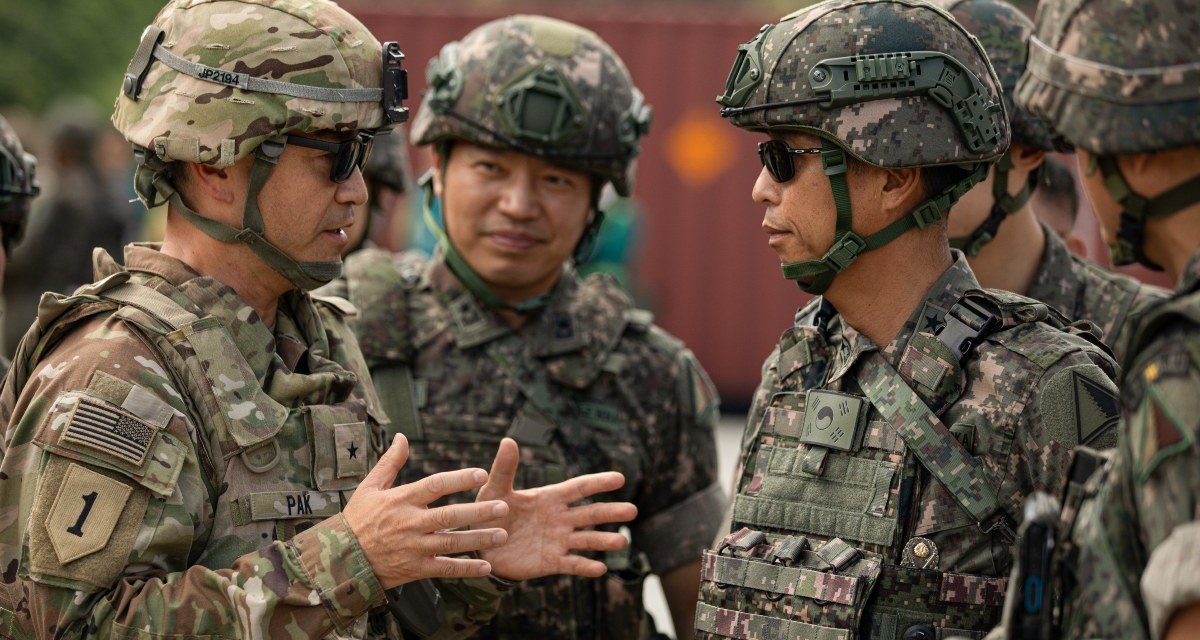
Image credit: Staff Sgt. Reginald Harvey, US Army