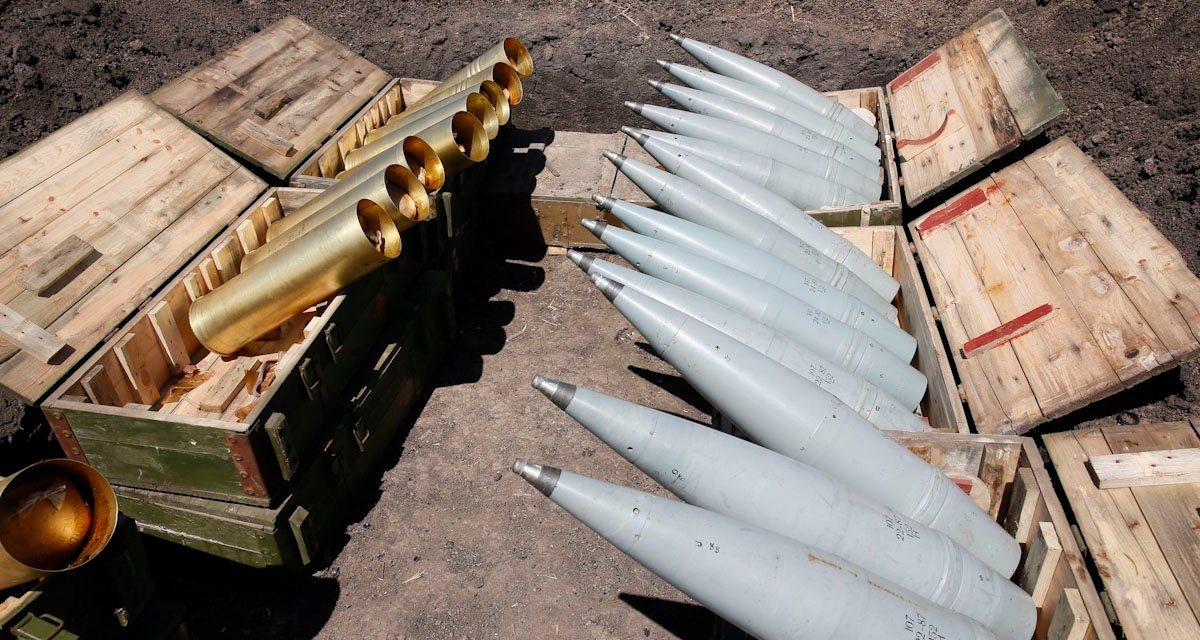
Russia’s battlefield endurance in Ukraine is determined not by the size of Soviet‑era stockpiles but by a temporary industrial window—a period when production plus imports outpaces daily shell consumption. In 2025 Russian factories churned out about seven million artillery, mortar, tank and rocket rounds, excluding guided multiple-launch rocket system and loitering munitions—roughly nineteen thousand rounds per day—while open‑source estimates put Russian expenditure at ten to fifteen thousand rounds per day. As long as production and imports meet or exceed consumption, Moscow can sustain the war and rebuild reserves. When throughput falls below usage, the window closes and operational tempo shrinks.
Allied strategy, therefore, should not be guided by counting stockpiles, but by measuring—and taking steps to influence—throughput. Public intelligence reports, defense journalism, and other open‑source data combine to offer a view of that throughput. In some instances, audited totals are available; elsewhere educated estimates are necessary. But by combining these and acknowledging the distinction, it is possible not only to identify a range of the most likely current throughput, but also to assign a degree of certainty to it. The industrial window concept can then be applied to both Russia and its opponents, highlighting how cross‑theater demands shape ammunition availability and offering practical implications for planners.
The Industrial Window and its Indicators
An industrial window exists when production plus imports matches or exceeds consumption (P + I ≥ C). When this is true, warfighting endurance depends on maintaining the flow rather than on the absolute size of stockpiles. To anticipate when Russia’s window may close, planners should monitor monthly shell output, volumes of Iranian and North Korean shipments, availability of chemical precursors such as mélange, concentrated nitric acid, and nitrocellulose, labor mobilization levels, and energy supply disruptions. The tempo of drone and glide bomb attacks can also signal how Russia substitutes air‑delivered munitions for shells. Applied symmetrically, the same logic helps assess allied resilience: European and US production must keep pace with combined battlefield consumption across multiple theaters, from Ukraine to the Middle East and Indo‑Pacific.
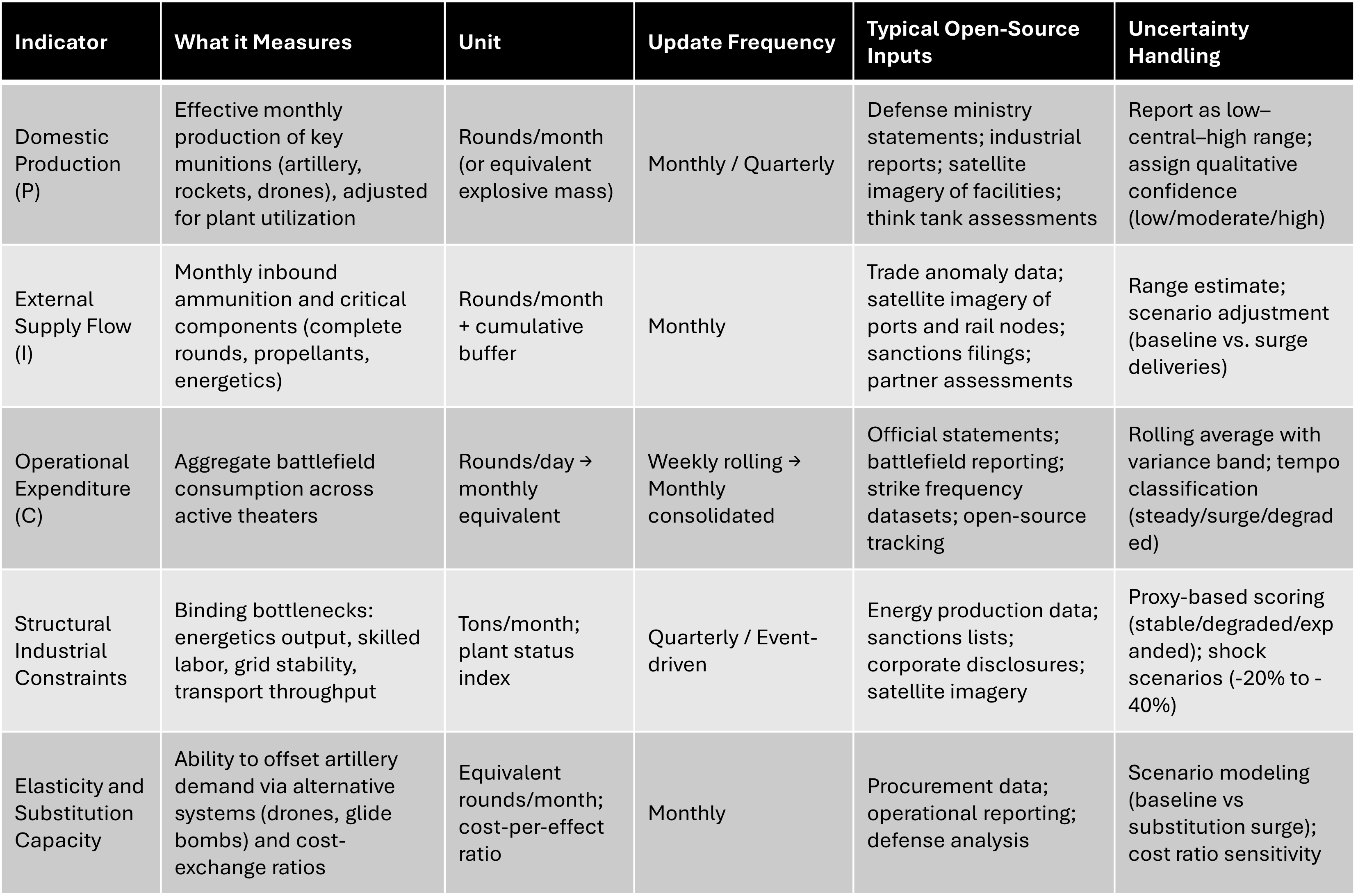
The tables below summarize key indicators and translate them into operational implications. Table 1 illustrates how to operationalize the production, imports, and consumption framework as a monitoring dashboard.
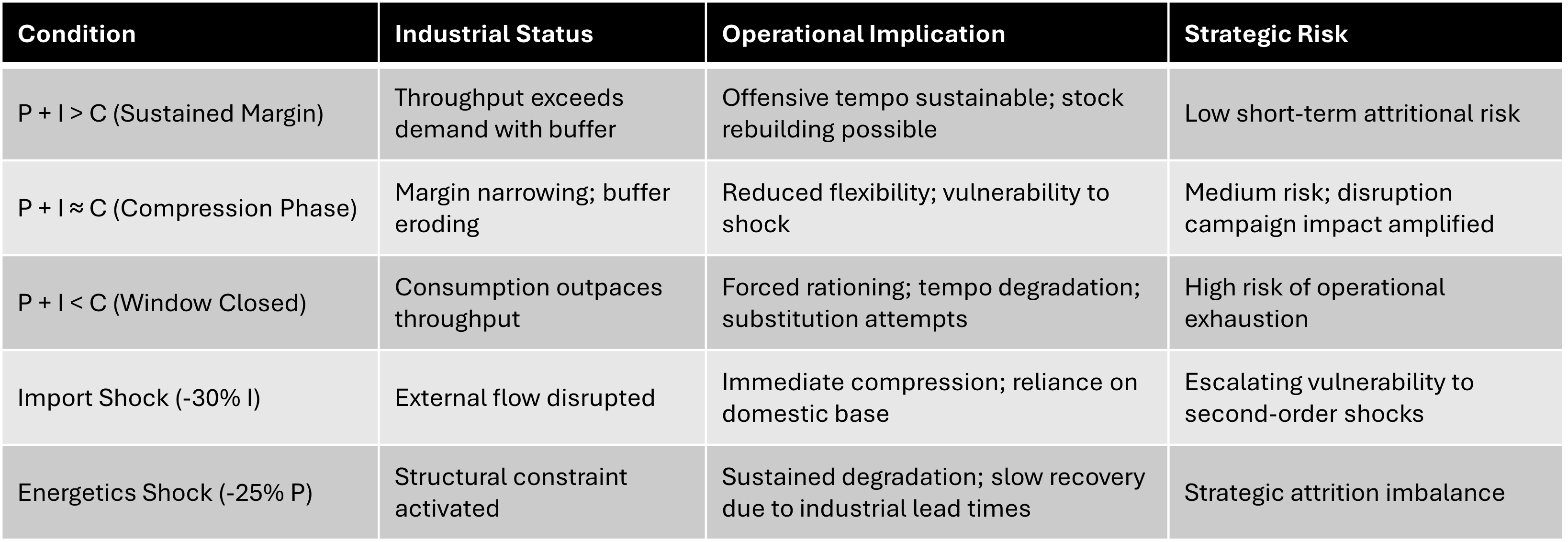
Next, table 2 translates threshold conditions into operational implications for planners.
Russia’s Throughput, Imports, Vulnerabilities, and Disruption Vectors
A 2026 Estonian intelligence report estimates that Russian factories produced about seven million artillery, mortar, tank, and rocket rounds in 2025. The breakdown includes roughly 3.4 million howitzer shells, 2.3 million mortar rounds, 800,000 tank and infantry fighting vehicle rounds, and 500,000 rockets. These figures are approximate intelligence estimates rather than audited production logs. They represent effective output, not maximum installed capacity, which may be 10–20 percent higher. Unit costs remain low: A legacy 152-millimeter shell reportedly costs less than 100,000 rubles (approximately $1,200), several times cheaper than a NATO 155-millimeter round, which averages about $4,000 across the alliance. Since 2023, Russia has cumulatively imported between five and seven million shells from Iran and North Korea. However, according to Ukraine’s Defense Intelligence, by late 2025 North Korean deliveries had fallen by more than half compared to 2024, and roughly half of the delivered shells required refurbishment before use. This illustrates the elasticity of the external supply flow (I) and represents a concrete example of the industrial window beginning to compress from the import side.
In terms of components and precursors, Russia produces concentrated nitric acid and the propellant mélange in a limited number of facilities, including major plants in Berezniki and Novomoskovsk. Sanctions can target these materials, but in some cases it is complicated by their dual‑use nature. Nitrocellulose feedstock, another critical precursor, was largely imported until 2023 and only recently began to be made domestically. Expanding nitrocellulose and nitric acid production typically requires eighteen to thirty-six months, making energetics the slowest and most rigid part of the supply chain.
Labor shortages and the structural reliance of Russia’s public finances on energy export revenues, curtailed by Western sanctions, further constrain its war economy. Mobilizing skilled machinists and engineers from civilian industries creates wage inflation and erodes other sectors. Explosives and propellant production require uninterrupted electricity and natural gas; attacks on grids or pipelines could indirectly slow output. Ukraine’s deep‑strike campaign demonstrates that the window can be narrowed from within. In April 2025, Ukraine’s SBU security service used drones to strike the Murom Instrument‑Building Plant three hundred kilometres east of Moscow. Reuters reported that the plant produces ammunition ignition devices and that local authorities acknowledged a fire that damaged two buildings, including a storage facility. Two months later, Ukrainian-developed FP‑5 Flamingo cruise missiles hit a large ammunition depot near Kotluban in Russia’s Volgograd region, triggering secondary explosions and destroying tens of thousands of rounds. Such attacks both destroy inventory and disrupt refurbishment cycles, slowing the delivery of new rounds.
Allied Throughput and the Companion Window
Allied endurance is governed by the same inequality. Europe’s Act in Support of Ammunition Production was enacted in 2023 with the aim of boosting annual output to roughly two million 155-millimeter shells by late 2025, while Rheinmetall and other primes aim to produce 1.1–1.5 million shells per year by 2027. The United States produces about forty thousand 155-millimeter rounds per month and is targeting one hundred thousand per month in 2026, for a projected total of more than one million shells over the course of the year. Aggregated, these programs could yield around three million shells this year. On the consumption side, Ukrainian forces fire an estimated two to seven thousand rounds daily, according to open‑source reports and official statements; exact figures vary and are highly sensitive to supply. Allies must also reserve stocks for other contingencies. Interceptor demand adds additional stress: During the June 2025 Iran–Israel war, US forces reportedly fired more than 150 Terminal High Altitude Area Defense (THAAD) interceptors—about a quarter of the global inventory—and Patriot PAC‑3 MSE production is only about 600–650 missiles per year. Because allied P + I must cover multiple theaters, the allied industrial window is narrower and more elastic than Russia’s. Applying the framework means comparing daily allied throughput against aggregate consumption across theaters. If P + I for 155-millimeter shells is eight thousand per day and consumption (C) in Ukraine and other hotspots approaches or exceeds that figure, the allied window begins to close. Strategists should therefore synchronize production ramps with realistic demand forecasts and prioritize energetics—explosives and propellant chemicals—just as Russia does.
Cost Exchange, Cross‑theatre Stress, and Fungibility
Low‑cost drones and glide bombs further stretch Russia’s window. Each Shahed‑type drone costs roughly $20,000–$50,000, whereas a single surface‑to‑air interceptor costs several hundred thousand dollars. Russia tolerates loss rates above 75 percent because forcing defenders to expend expensive interceptors yields a favorable economic ratio. Moscow increased Shahed launches from about two hundred per week in September 2024 to over one thousand per week by March 2025. This figure includes Shahed‑136, Shahed‑238, Geran‑2 and jet‑powered variants, which differ significantly in cost and performance. Ukraine counters with electronic jamming and first‑person‑view drones, but Western interceptors are depleted faster than they are replaced. Cross‑theater dynamics amplify these pressures. THAAD interceptors used in the Iran–Israel war came from the same stockpiles that protect US forces in Iraq, Europe, and Asia. Iranian drones and missiles rely heavily on imported microelectronics; supply‑denial measures against one regime can indirectly constrain the other. The corollary to munitions’ essential fungibility is that any shell or interceptor consumed in one theater is unavailable elsewhere. Since the onset of the ongoing US-Israel campaign against Iran, hundreds of interceptors—including Patriot, THAAD, and SM-series missiles—have been expended to defend against Iranian attacks in the region, reportedly involving over five hundred ballistic missiles and nearly two thousand drones in just the first week of the conflict.
Military planners should therefore view ammunition as a global pool rather than siloed inventories, and anticipate how crises in the Middle East or East Asia may narrow the industrial window for Ukraine.
Implications for Military Planners
The industrial window lends itself naturally to use as an operational metric. Intelligence and operations staffs should therefore track P + I and C for both adversaries and allies, looking for inflection points when throughput no longer covers consumption. This could inform decisions on force posture, ammunition allocation, and timing of offensives. It also recalibrates planning toward targeting the flow, not just the stockpile. Disruptive efforts should prioritize chokepoints: sanctions or embargos targeting dual‑use precursors such as mélange and nitric acid, interdiction of shipments from Iran and North Korea, and support for Ukrainian long‑range strikes on production facilities. Demand reduction matters. Electromagnetic jamming, high‑powered microwaves, laser systems, and autonomous interceptor drones can defeat cheap munitions at low cost. Adopting cost‑per‑engagement metrics helps commanders decide when to fire an interceptor and when to rely on other defenses. Expanding energetics production and diversifying supply chains will also shift the throughput balance in allies’ favor. Energetics—explosives and propellant chemicals—are the binding constraint on shell output. This applies to both Russian and Western production lines. Allied investment must focus on nitric acid, TNT, and nitrocellulose production lines and engage partners in Asia to diversify sources. Shell casings are important, but without energetics there is no throughput.

Russia’s industrial advantage is finite. In 2025 the window remained open because factories produced around seven million shells and imports covered up to half of its artillery consumption. Yet the window is elastic: Cheap drones, foreign suppliers, and cross‑theater offsets can stretch it, while sanctions, supply disruptions, demand reduction, deep strikes, and allied industrial surges can compress it. The production, imports, and consumption framework offers a simple tool for planners to monitor endurance and to design policies that shorten the war. By treating ammunition as a global flow rather than a static stock, military professionals can allocate resources more wisely and avoid strategic surprises.
Cosimo Meneguzzo is a defense and geopolitical independent analyst focusing on military logistics, industrial warfare, and strategic competition. He has written on Russian force generation, supply-chain resilience, and arms flows for outlets including the US Naval Institute’s Proceedings and The Maritime Executive and has briefed for the Italian Center for High Defense Studies. His research examines the intersection of industrial capacity, attrition warfare, and strategic sustainability in high-intensity conflicts.
Fabrizio Minniti is an expert on international security. As a researcher for the Military Centre for Strategic Studies, he has written reports in the fields of intelligence, international terrorism, nuclear doctrine, European security, and defense policy. He was appointed as an external consultant for EUBAM-Rafah in Israel and has worked as a political advisor to the deputy commander of NATO’s Resolute Support Mission in Afghanistan.
The views expressed are those of the authors and do not reflect the official position of the United States Military Academy, Department of the Army, or Department of Defense.
Image credit: mil.ru, via Wikimedia Commons