“Tell me how this ends.”
Those were the words of David Petraeus, then a major general and the commander of the Army’s 101st Airborne Division, uttered just days after his division entered Iraq as part of the US-led invasion.
Fast-forward twenty-three years, look one country to the east, and Petraeus’s comment feels remarkably applicable. Once again, just days after commencing combat operations, the challenge of predicting what outcomes US military power will achieve, what unforeseen forces (whether violent, political, or other) it might unleash, and how it will impact the regional balance is a virtually impossible one. There are clear information gaps regarding what’s going on inside Iran. But amid the many questions, several stand out as particularly illuminating. As answers to these questions emerge, we will be given some glimpse of—if not the final outcome—at least what comes next.
What regime leaders remain?
On the first day of the conflict, Israel announced it had killed over forty Iranian leaders, including Supreme Leader Ali Khamenei. As of writing, however, fewer than ten have been named. These include Khamenei’s advisor Ali Shamkhani, Defense Minister Aziz Nasirzadeh, and Islamic Revolutionary Guard Corps (IRGC) commander Mohammad Pakpour. With Khamenei’s death, an interim leadership council of three will temporarily rule until the Assembly of Experts—in a notably opaque process—chooses a new supreme leader.
So who is left to debate and determine Iran’s retaliatory strikes? Who is in contention to become the next supreme leader? Who will guide Iran’s response and the trajectory of potential negotiations? Answers to these questions will determine the course of the coming days and weeks of the conflict, and very likely Iran’s future, assuming the current form of government emerges unscathed. Most likely, equally or more hardline officials remain both in the military and security leadership as well as in line for supreme leader. The current leadership council comprises Iran’s reformist president, Masoud Pezeshkian, hardline judiciary chief Gholamhossein Mohseni Ejei, and a Guardian Council member, Ayatollah Alireza Arafi—a mix of conservative, hardline, and somewhat moderate leaders.
As Iran replaces leaders during wartime, it is likely to consider hawkish, hardline officials that it perceives can see it through both the external and internal challenges ahead. Understanding who is left among the ranks will help narrow down the potential replacements and assess Iran’s next steps as it navigates military conflict and possible renewed negotiations with the US administration of President Donald Trump. Will hardline hawks with nothing to lose further escalate until they run out of options and ammunition? Or could moderate voices prevail as the remaining regime attempts to deescalate?
Do Iranians have the will to fight for regime overthrow?
In December and January, protests erupted in Iran. Unlike previous protests which were not nationwide and largely focused on fuel costs, human rights abuses, and corruption, these protests were largely driven by economic grievances and began with Tehran’s Grand Bazaar amid the Iranian rial dropping to its lowest-ever value. The bazaar was a major catalyst in the 1979 Revolution and is historically one of the most influential conservative centers of gravity in Iranian society. These protests quickly spread to other sectors of Iranian society, including but not limited to women, Kurds, and a host of different social and economic classes. However, while the size, scope, and drivers of these protests were unprecedented, they do not necessarily indicate an overwhelming desire to overthrow the regime.
Given the Grand Bazaar’s role as a major center of support for the current regime yet simultaneously as the originator of these protests—and against the backdrop of the economic conditions hitting the country—we are closely watching for signs about the population’s will to fight for regime change. There are many unknowns, but what is clear is that the regime had largely managed to suppress these protests prior to Operation Epic Fury. How will the external attacks on the regime and military targets, and the potential accidental civilian impact, influence Iranians’ will to fight the regime?
Following the death of Khamenei, there was a mix of public grieving and celebrations in Iran, indicating that support for regime overthrow is far from ubiquitous. The population is not homogenous; it comprises many ethnic backgrounds and political ideologies. As in many countries, city ideologies differ from rural. Despite recent nationwide protests, government restrictions make it difficult to determine the current level of support for the regime, which almost certainly is not zero. Furthermore, government-imposed internet blackouts since January have hindered the ability for citizens to effectively communicate and organize dissent. Meanwhile, anecdotal external celebrations following Khamenei’s death are not a great indicator of internal perceptions. Even among those who do want a new form of government, which may well be a majority, it is unclear how much they are willing to risk to get there, particularly if it means facing a sophisticated and entrenched military apparatus that cannot be taken out with US and Israeli airstrikes alone. Moving from protests to government overthrow is not a direct or easy path.
What is the civilian death toll?
In any war, civilian casualties are expected. As the conflict unfolds, it will be difficult to get accurate numbers of civilian casualties, particularly as we rely largely on Iranian state reporting for such numbers, which likely will be exaggerated in an attempt to influence international perceptions. On the first day of the conflict, Iran claimed 165 people—mostly children—had been killed in a strike on a school in Minab in southern Iran; the United States has said it is investigating the incident. A human rights NGO reported over 100 civilian deaths on the first day, while state media reported 555 civilian casualties after the first three days. Again, with limited outside reporting, it is difficult to corroborate these numbers.
A high civilian death toll has the potential to quickly undermine US and Israeli operations with the sympathetic population and international community. In Gaza, Israel turned from victim to aggressor in the eyes of the international community when civilian casualties mounted. If civilian deaths begin to rack up—particularly if they include high-profile incidents like attacks on schools and hospitals—supportive members of the Iranian population are likely to become disillusioned with the United States’ so-called help. This could make the perceived cost of regime change too high to support, making the case for maintaining the status quo and ending violence rather than risking more deaths of family members and neighbors.
What are the intentions of Iran’s regular army?
There are two parallel military structures in Iran: the IRGC, a household name even in the United States, and the less spoken of and less ideological national army known as the Artesh. These entities have different doctrines and different missions. Following the Iranian Revolution, Khamenei opted to keep the army intact, believing that doing so would minimize any risk that it would act against the regime. Khamenei also created the IRGC as a counterweight to the Artesh, charging it with regime protection. Though the two often coordinate operations, over the years the regime has purposefully kept the two at odds, giving better funding and access to the IRGC. Despite being poorer than the IRGC, the Artesh is larger in size. Not surprisingly, US and Israeli strikes are being directed at IRGC locations, including its headquarters, rather than Artesh infrastructure. In addition, the IRGC almost predominantly controls Iran’s missile and drone stockpiles, making it a likely target in future strikes, further degrading the organization.
Of note is the IRGC’s critical role in the Iranian economy, raising the question of accountability and the extent to which the population will blame it for Iran’s economic woes. Given the circumstances, it is reasonable to wonder whether, if protests were to reignite to January levels, the Artesh would consider breaking with the regime. This matters because regime change without boots on the ground is very unlikely. However, in the event that the Artesh were to act as those boots on the ground, what would this mean for the country? Would the army be able to support a regime-ending revolution? Or would this lead the country into a civil war between the Artesh and the IRGC?
How long can Iran sustain its military response?
Iran has a finite number of missiles and drones—albeit a high one—that it is using to retaliate against the US and Israeli operations and demonstrate continued strength. Many of its longer-range missiles and launchers were targeted by Israel during the Twelve-Day War in June. On Sunday, Israel announced Iran’s ballistic missile launcher inventory had been cut in half from its June operations and the first day of Operation Epic Fury, leaving roughly two hundred launchers remaining.
Iran also maintains a large number of short- and medium-range options to strike targets in the region, most of which are dispersed across the country and some of which are buried in underground storage facilities, and experts have suggested that Iran still has more ballistic missiles that can target US regional bases than the US military has interceptors. In the early days of the conflict, however, Iran appears to be favoring use of drones over ballistic missiles to retaliate in the region. It has launched relatively few missiles compared with past responses. This may be due to depleted launcher inventories, or an attempt to reserve remaining short- and medium-range missiles for later in the conflict when Gulf interceptors are expended.
The United States and Israel are likely to prioritize striking missile launchers, as well as production facilities to stem replenishment. Drone sites are likely more difficult to target, while drones are much easier to continue to build. The answer to how quickly Iran’s missile and critical weapons stockpiles are depleted depends in large part on the pace and accuracy of Operation Epic Fury’s strikes aimed at destroying these systems. US and Israeli analysts surely are conducting battle damage assessments and doing the math to subtract destroyed weapons from assessed inventories. Though exact numbers are less clear to the external observer, how long Iran can sustain military operations—in the range of weeks to months—will be a key factor in determining the viability of the regime after the conflict.
How are US and Iranian regional partners responding?
Iran has attacked several countries across the region in response to Operation Epic Fury, including the United Arab Emirates, Kuwait, Qatar, and Bahrain, all which host US military installations. Both Saudi Arabia and Oman have received multiple blows, including drone strikes on the US embassy in Riyadh and a port in Oman. The Gulf Cooperation Council (GCC) convened on Sunday to address the escalating strikes, issuing a condemnation of what it described as a “heinous Iranian attack targeting GCC countries” and characterizing Iranian actions as a “clear breach of international law.” Though no decision has been made, there are some indications that Saudi Arabia will respond to continued strikes on oil infrastructure.
Since the beginning of the conflict, many GCC countries have refused to allow the US military use of their airspace or territory to launch attacks. However, this may change if Tehran continues to escalate strikes on oil and other critical infrastructure. Gulf country involvement in the conflict very likely would further muddy operations and objectives and may lead to further unintended or uncontrolled escalation as well as civilian casualties.
Iran’s regional proxies and partners have also joined the conflict, with both Lebanese Hezbollah and Iraqi Shiite militias launching attacks. Hezbollah launched several missiles into Israel, leading the Israel Defense Forces to call up more than seventy thousand reservists for a possible land incursion into Lebanon; some troops crossed the border in a limited incursion Monday night. Iraqi militias claimed several attacks targeting US and partner bases in Iraq and the region. Either US or Israeli aircraft retaliated by striking the headquarters of the Popular Mobilization Front, an umbrella network encompassing many of these same Iraqi Shiite militias, in Anbar province. Iran’s Shiite proxies may be further drawn in following a Sunni Gulf state attack on Iran, with the potential to further escalate the conflict across the region.
Notably, one expected actor has not responded to Iranian calls for support: the Houthis. Based in the northern region of Yemen, the Houthis have projected power not only to the Red Sea and Gulf of Aden, but also with direct attacks against Israel in 2025. As of now, the Houthis have only issued statements of support for Iran, and are yet to declare any military support for the regime. If the Houthis were to reenter the conflict, they would likely resume their campaign of pressure on shipping in the Red Sea, which had largely subsided following the Gaza ceasefire in October. Attacks on commercial shipping would continue to raise the economic costs of the conflict and intensify pressure on global trade, but they are unlikely to be decisive in determining how the conflict ultimately ends.

Ultimately, the biggest gap of all is what the United States and Israel hope to achieve. President Trump has stated operations will not end “until all our objectives are achieved.” But what are those objectives? Do calls for the Iranian population to “take over” their government indicate regime change is the strategic goal? Or are the more limited but still expansive objectives laid out Monday by Secretary of Defense Pete Hegseth—destroying Iran’s missiles and missile production capabilities, its navy, and its nuclear program—the actual ends toward which the means of airpower and seapower and ways of precision strikes are aimed?
Whatever the strategic objectives, whether they are achieved will be determined not only by the scale and scope of the ongoing Operation Epic Fury, but also by the answer to the six questions above. The answers will not tell us how this ends—but they will point us in the direction of the conflict’s outcomes, both immediate and long-term.
Sydney Laite served as a senior intelligence officer at the Defense Intelligence Agency, where she worked for over fifteen years. During her tenure, she focused extensively on Middle East issues and, most recently, provided direct intelligence support to the prior secretary of defense. Sydney currently works in private sector intelligence and holds a master of science in strategic intelligence from the National Intelligence University.
Haleigh Bartos is an associate professor of the practice in the Carnegie Mellon Institute for Strategy and Technology at Carnegie Mellon University. She previously spent well over a decade in various positions and organizations supporting US policymakers. She teaches courses on national security, terrorism and policy support at Carnegie Mellon University.
Buckley DeJardin is a student at Carnegie Mellon University, studying international relations and political science as well as business. He has worked as an Iran Analyst with the American Enterprise Institute’s Critical Threats Project and is currently writing his honors thesis on coalition counterterrorism operations against the Houthis.
The views expressed are those of the authors and do not reflect the official position of the United States Military Academy, Department of the Army, or Department of Defense.
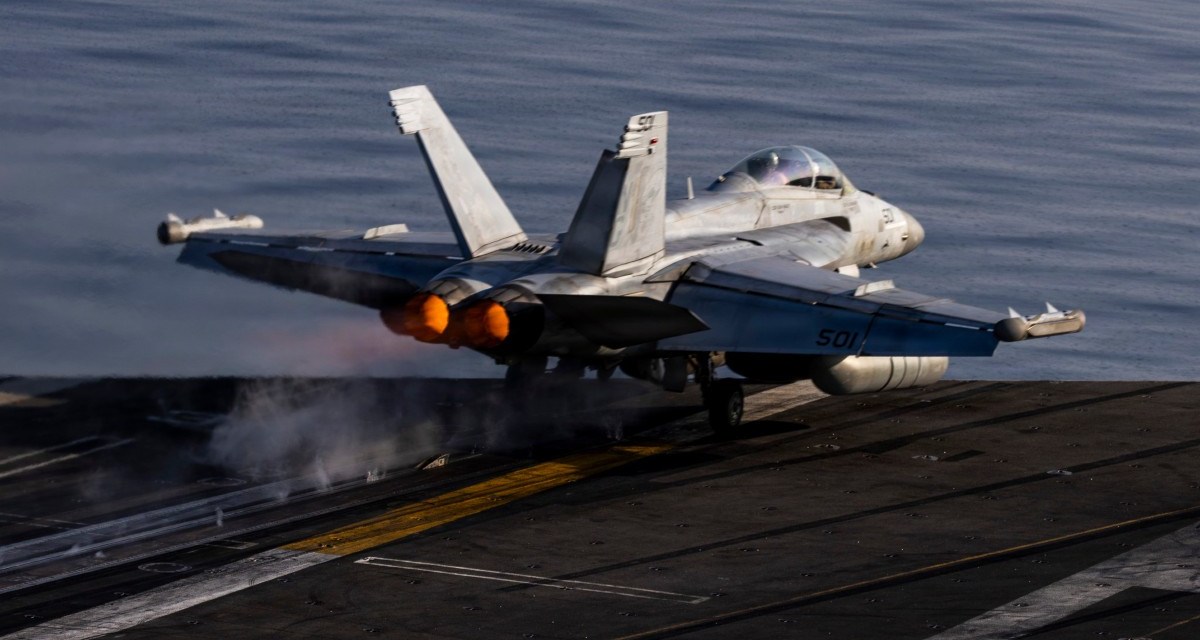
Image: The USS Abraham Lincoln conducts flight operations in support of Operation Epic Fury, March 2, 2026. (credit: US Navy)