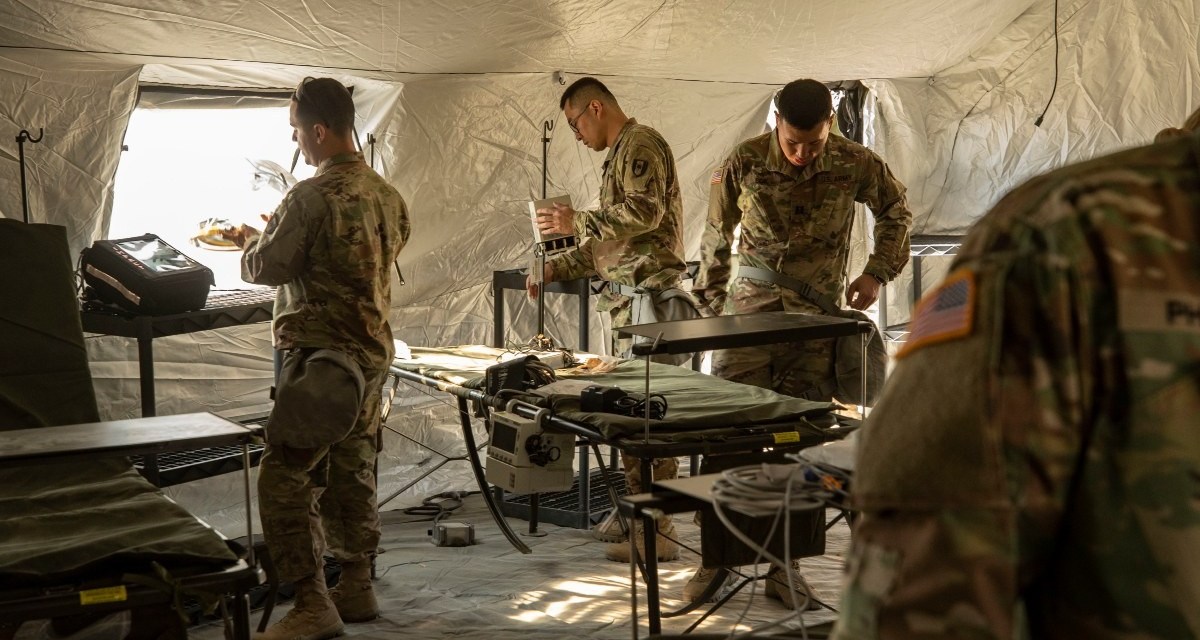
Imagine this: You are the dental team lead for a forward support element. Your section is set up in a remote, austere environment—one tent, limited equipment, and responsibility for every US soldier and allied service member in the area. Late in the afternoon, as sick call begins, a line of tired troops is already forming outside your tent. You know it will be a long evening, but nothing your team can’t handle. You and your two seasoned 68Es—dental specialists—have done this before.
Then the sterilizer dies.
Your tabletop Tuttnauer unit—the autoclave used in the field to sterilize equipment, the heart of your operation, and the final safeguard in your infection-control chain—simply stops responding. You have six clean instrument sets left. Once those are used, nothing else can be treated until instruments are sterilized again. The patient line grows longer. You stay calm and do what trained Army dentists do: switch to your small reserve of single-use exam kits and start triage. You quickly identify who needs urgent care, but the math isn’t in your favor. Your kits won’t last, and your autoclave won’t be back on line any time soon.
There is no medical maintenance support here. Even if there were, the odds of having the right replacement part in this location are low. You realize you’re now choosing between ibuprofen and MEDEVAC (medical evacuation) for soldiers who need timely extraction, root canals, or restorations. You know exactly how to treat them—but without clean instruments, your dental operation is effectively over.
Then the camp generator shuts down unexpectedly.
With the sterilizer already offline, the loss of power further degrades the operating environment—impacting lighting, suction, imaging, and the ability to safely sustain clinical workflow. Thankfully, you can still perform a limited number of extractions and apply maxillomandibular fixation for select jaw fracture patients with the remaining sterile kits, but the repair timeline for the autoclave and the power is unknown. Your clean kits will eventually run out. At this point you consider every workaround you’ve ever seen for sterilization—including the pressure-cooker method used by some Special Forces dental elements. It works on an electric stove or over an open flame and has been validated, but its limits show immediately in this setting: Without electricity, you lose the safest and most controlled heating method; capacity remains small; the heating and cooling cycle slows turnaround; and operating it over a field-expedient heat source carries practical risks. It is a creative solution, but it is optimized for small, agile teams—not for a larger conventional population that relies on you for the next several months. You also understand the logistical challenge of acquiring a new sterilizer; no one has an extra, and ordering one mid-deployment is unlikely to succeed. Most importantly, you understand the cost and risk of MEDEVAC—not just in dollars, but in pulling soldiers away from their battle positions for a dental issue you could have treated on site if you had clean instruments.
You look at the cold, silent seventy-three-pound sterilizer on your table. It is a single point of failure—one that stops your entire mission. Mobility constraints prevent carrying a backup. And in that moment, staring at a dead machine and a growing line of patients, a simple question forms:
What is our plan B when the autoclave fails?
A Contingency Option: Cold Sterilant
To find any real plan B for field dentistry, the option must fit what I call the MDS trifecta: mobility, durability, and sustainability. In other words, it has to be light enough to move with the team, tough enough for austere environments, and affordable enough to maintain during extended operations. With those criteria in mind, one contingency option worth examining is a cold sterilant—a liquid chemical capable of destroying all forms of microbial life, including spores, through timed immersion and without the need for heat or electricity.
A useful example is Zeta 2 Sporex, produced by Zhermack, an Italy-based medical manufacturer. It is supplied as a powder and is straightforward to use. Per the manufacturer’s instructions, mixing forty grams of powder with two liters of water at 68 degrees Fahrenheit yields a cold sterilant solution that remains active for twenty-four hours. In practice, the workflow mirrors what we already do before using an autoclave: Instruments are prerinsed and scrubbed, then submerged in the solution. A ten-minute immersion achieves a 6-log reduction—99.9999 percent—of bacterial spores, the benchmark for a sterilant claim under EU standards. Afterward, the instruments are rinsed thoroughly to remove any residual solution. The mixture has a light blue tint, which helps visually confirm that no residue remains after rinsing. Within about an hour, the instruments are cleaned, dried, and ready for use—without a single watt of electricity.
Zeta 2 Sporex meets multiple European Norm (EN) standards, including EN 13727 (bactericidal), EN 13624 (fungicidal), EN 14348 (mycobactericidal) and EN 14563 (tuberculocidal), EN 14476 (virucidal against HIV, HBV, HCV, poliovirus, adenovirus, norovirus), and EN 13704 (sporicidal). Passing EN 13704 allows the manufacturer to claim the product is a “sterilant” under EU regulations rather than a “high-level disinfectant” or “disinfectant.” A nine-hundred-gram tub of powder typically retails on the civilian European market for €40–45 (civilian pricing, not reflective of any US government procurement cost). At that ratio, a single tub can support approximately twenty-two days of daily cold sterilant preparation if preportioned into individual forty-gram packets. The weight—about two pounds total—is barely noticeable in a rucksack.
Compared to the cost and operational impact of a MEDEVAC for preventable dental emergencies, the expense of maintaining a small reserve of cold sterilant is minimal. More importantly, having a way to produce clean instruments without power means soldiers can be treated on site and returned to their battle positions rather than evacuated for a solvable problem.
Fix It Through Policy
At this point, a fair question may come to mind: Why use a European product as the example? The answer reveals the real issue. The US-made cold sterilants I know of are liquid-based, which means they fail the mobility requirement of the MDS trifecta. And while Zeta 2 Sporex fits the operational need described earlier, it is not FDA-approved. That is why it cannot be purchased or used in the United States, even though it is approved under European Norm standards. In practical terms, this means all of our NATO partners in Europe can employ this capability as their contingency plan in the field—but we cannot.
In my view, based on field experience, this is not a product problem—it is an Army policy problem.
Current guidance, per Army Regulation 40–60, Army Medical Materiel Acquisition Policy, states that the Army Medical Department will acquire only FDA- or EPA-approved products when such approvals are required for comparable civilian-use items. That standard works well for garrison environments, but it leaves field medical and dental units with no flexibility when operating in austere, power-denied, or disrupted supply conditions—precisely the environments we expect in large-scale combat operations.
My purpose here is not to argue for one product or to request exceptions one item at a time. Rather, there is a larger opportunity that lies in modernizing our policy and regulations to better support joint and multinational operations. A potential addition might read:
To enable interoperability and readiness in joint and multinational environments, field medical and dental units may acquire and employ medical or dental products that meet European Norm standards or equivalent regulatory approvals recognized by NATO partner nations when FDA or EPA approval is not available. Such items may be used for training and evaluation in garrison and, when mission requirements dictate, for operational use in deployed environments under command-approved risk assessment and medical oversight.
An update like this would not weaken standards—it would expand flexibility for commanders and clinical leaders in the exact environments where flexibility matters most. It would allow us to close the capability gap created by single points of failure and power-dependent systems. And it would align US field care with the coalition forces we expect to fight alongside.
Returning to the original scenario, imagine that a NATO dental officer deployed in the same area walks into your tent with a tub of cold sterilant and says, “Use this until your autoclave is repaired. It’s quick, simple, and doesn’t require electricity.” And you have to reply, “I can’t. It’s not FDA-approved. You can treat your soldiers with it—but I can’t treat mine.”
No commander wants his or her unit to be the one team in a joint or combined operation that cannot use a safe and validated capability available to every allied partner.
Honest Talk: Limitation of a Plan B
To be clear, cold sterilant is not a perfect solution. It has real limitations and acknowledging them up front is important. It requires more water than an autoclave, especially during the post-immersion rinse to ensure all chemical residue is removed. Instruments also need to be used within a relatively short window after treatment—there is no equivalent to steam-sterilized pouch storage, where instruments can remain ready for days as long as the pouch is intact. The chemical formulation can be corrosive over time and may shorten instrument lifespan, although replacing instruments is still far less costly than evacuating soldiers for preventable dental emergencies.
Additionally, products like Zeta 2 Sporex are marketed primarily for devices that cannot tolerate heat sterilization. In a civilian clinic, this makes sense: If the autoclave is functioning, there is no reason to use a chemical sterilant for routine instruments. But our scenario is not a civilian clinic. We are discussing contingency conditions—periods when the autoclave is down, power is out, resupply is delayed, and work cannot stop simply because the ideal option is offline.
None of these limitations disqualify cold sterilant as a field-expedient capability. They simply clarify why it is—a plan B, not a replacement for the gold standard of steam sterilization. The intent is not to displace autoclaves in garrison, but to give field teams a safe, validated method to continue treating soldiers when the primary system fails. In large-scale combat operations, ideal conditions are unlikely to exist. What matters is identifying risks, mitigating them where possible, and maintaining the ability to care for the force. This is one practical way to do that.
A Much-Needed Discussion
Let me be clear: I fully respect the regulatory authorities that shape our clinical practice—whether federal agencies, Army regulations, or medical governing bodies. Infection control exists for a reason: patient safety. Autoclave-based sterilization remains our gold standard. But as a soldier, I also understand that some of the regulations we follow were written for predictable, well-resourced environments. The field is none of those things. By its nature, it is unpredictable, and no regulation can anticipate every condition we may encounter.
Military dentistry is unique. The men and women who deliver it must meet the same clinical standards as their civilian counterparts while operating under constraints those counterparts will never see. In challenging, resource-constrained environments, leaders often face a choice between the ideal and the acceptable—and it is the acceptable option that keeps soldiers in the fight. Service regulations should empower field leaders to adapt safely when ideal resources are not available. And in the contingency environments we are preparing for, commanders need options that are validated, safe, and interoperable with our allied partners.
The key point here is not about this specific plan B—Zeta 2 Sporex—but rather that tomorrow’s operational environment will demand that we have one. At a minimum, that requires a professional conversation about policy and regulation updates and what an acceptable plan B should look like when the autoclave fails. If the field environment has taught us anything, it is that we cannot afford to build our readiness around single points of failure. Our mission should never be stopped by one broken machine.
Lieutenant Colonel Yu-Sheng Chen is a board-certified comprehensive dentist (63B) in the US Army and currently serves as the commander of the 257th Dental Company Area Support, 44th Medical Brigade, Fort Bragg, North Carolina.
The views expressed are those of the author and do not reflect the official position of the United States Military Academy, Department of the Army, or Department of Defense.
Image credit: Spc. ShaTyra Reed-Cox, US Army