
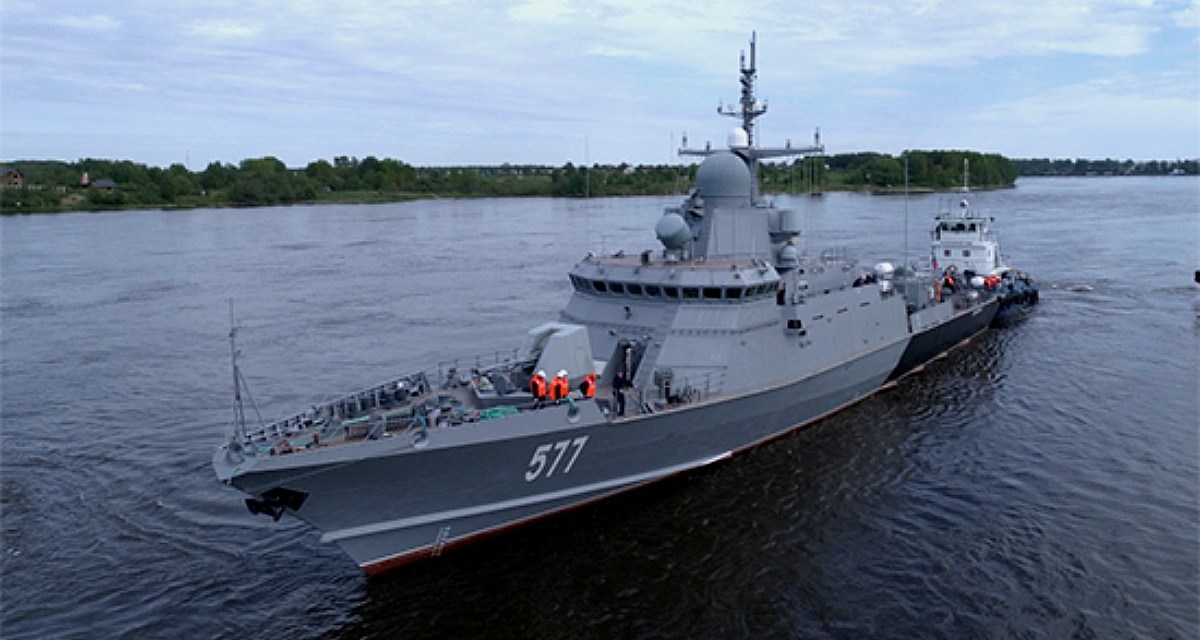
More than a decade ago, Russia enabled its naval forces to conduct deep precision strikes from inland waterways inside its territory. At the core of this posture are small corvettes designed for navigating rivers and lakes but equipped with a vertical-launch system configured to employ land-attack cruise missiles. One variant is even believed to carry a nuclear warhead, conferring a unique substrategic capability. Russia has already demonstrated this capability’s utility through strikes delivered from the Caspian Sea against targets in Syria and in Ukraine. Since 2023, preparations have been underway to incorporate Lake Ladoga—strategically located near the Gulf of Finland, as well as Russia’s borders with NATO members Finland and Estonia—as a protected launch area, underscoring Moscow’s focus on targets across the Baltic Sea region.
Compared with rocket launchers on land, corvettes armed with land-attack cruise missiles (LACMs) appear less threatening and thus less escalatory, largely because each can fire only a small salvo of eight missiles and reloading is logistically demanding. Their true combat power lies in the complexity-causing uncertainty they generate: operating on inland waterways makes them hard to detect, creates novel attack vectors absent from existing defense planning, and preserves nuclear flexibility. This makes them a tool of subtle deterrence.
Until recently, effective countermeasures have been lacking. However, a Ukrainian operation in the fall of 2025 indicates that this could be starting to change.
The Challenge of Terrestrial Antisurface Warfare
Shortly before midday on October 4, 2025, the Ukrainian Special Operations Forces Command announced via social media that its personnel had struck a Russian warship during the early hours of the same day.
Although the report has not been independently verified, it is noteworthy for three key reasons.
First, the targeted vessel was reportedly a LACM-armed corvette.
According to Kyiv, the damaged warship was the Grad, a corvette of the Buyan-M class (sometimes referred to as Swijazhsk-class). These vessels, together with those of the visually and functionally similar—but slightly newer—Karakurt class (also known as Uragan-class), are the centerpiece of Russia’s ability to conduct deep precision strikes from inland waters. With fifteen Buyan-M-class corvettes already in service and sixteen of the Karakurt class projected after ongoing builds conclude, they represent the most numerically surface combatant classes in the Russian Navy.
The heavy investment in both is no accident: Their low procurement and upkeep costs make them attractive for a resource-constrained military branch, and—more importantly—before the collapse of the Intermediate Range Nuclear Forces Treaty in 2019, they provided a clever way to circumvent the agreement’s restrictions on deploying missiles with ranges between five hundred and five thousand kilometers. This was because the treaty applied only to ground-based systems, leaving air- and sea-launched missiles untouched—in the latter case mainly due to technical, operational, and verification-related reasons. Given the limited capacity of Russia’s long-range aviation, the armed forces have leaned increasingly on naval platforms to field weapons for nonnuclear kinetic strikes. In the West, this shift is often described as “Kalibrization” of the Russian Navy, highlighting how the Kalibr family of missiles has become essential to Russia’s deep precision strike toolkit.
In the initial phase of the Ukraine invasion, Russia employed Buyan-M– and Karakurt-class corvettes to launch LACMs (along with other warships with the same capability). The use of Kalibr missiles, which can carry either conventional or nuclear warheads, was widely perceived as nuclear signaling, though its effect against Kyiv proved short-lived. Ukrainian forces have also struck back, damaging several LACM-equipped vessels in the Black Sea, especially with uncrewed surface vehicles since October 2022, with an increase from spring 2023. As a result, and because of limited missile production capacity, Russian strikes from the Black Sea have declined to an average of only one or two per month, according to the Ukrainian Navy. Although these attacks remain a real threat, they are militarily minor and largely aimed at producing psychological effects through selective destruction—an approach in Russian military theory described as “strategic operation[s] for the destruction of critically important targets.”
The recent focus on the Grad, however, indicates that Ukraine continues to take this Russian capability seriously.
The second reason the operation is noteworthy is because it targeted the ship at Lake Onega.
For a long time, Ukraine’s efforts against Russian naval vessels centered on the familiar Black Sea battlespace. Ukraine claimed that the operation in October, however, occurred more than 1,500 kilometers to the north at Lake Onega.
Situated northeast of St. Petersburg, it is Europe’s second-largest inland water body, exceeded only by Lake Ladoga to its west. Both are entirely landlocked within Russia and part of a vast waterway network west of the Urals known as the Unified Deep Water System of European Russia or UDWS.
Built in the twentieth century by integrating the Volga River with surrounding rivers and lakes through the construction of multiple canals, the UDWS connects the Baltic Sea and the White Sea in the north with the Caspian Sea and the Sea of Azov in the south. This merging was intended, on one hand, to enhance the socioeconomic inclusion of remote parts of the Soviet Union and, on the other, to serve strategic purposes. As a result, small vessels can move between northern and southern Europe without transiting the Atlantic.
The Soviet Union utilized the UDWS militarily and maintained several naval shipyards along the Volga, including one in Nizhny Novgorod that built nuclear- as well as diesel-electric-powered submarines. To this day, Russia maintains an inland naval shipbuilding capacity on the Volga in Zelenodolsk, where the construction of Karakurt-class corvettes is ongoing.
After the collapse of the Soviet Union in 1991, the importance of the UDWS declined, reflected in reduced cargo traffic and a drop in Russian investments in infrastructure. Yet even before Russia’s occupation and annexation of Crimea in 2014 and subsequent full-scale invasion in 2022, its relevance began to rise again, driven by the growing role of the so-called Middle Corridor as an alternative trade route between Europa and Asia.
The contemporary role of the UDWS is primarily a military one. It derives from Turkey’s move to invoke the Montreux Convention shortly after the beginning of the full-scale invasion. Since that time, Ankara denies passage through the straits to warships belonging to the belligerent parties. Consequently, Russia is unable to reinforce or remove major surface combatants in the Black Sea. The UDWS remains the sole avenue for fleet support, though it is limited to vessels capable of navigating inland waterways.
Given these circumstances, attacking parts of the UDWS to limit Russia’s use of it seems a logical course of action. In August 2025, an American think tank advanced this idea among several recommendations, suggesting the destruction of specific locks along the Volga–Don Canal. Ukraine has not undertaken such actions, however. One explanation is that affecting civilian maritime infrastructure—which also includes laying naval mines in rivers—would violate international law and could jeopardize Western political backing while inviting further Russian escalation. Moreover, blocking that canal would not eliminate the threat posed by LACM-armed corvettes, as they could still be employed on either side of it.
Beyond chokepoints such as locks, the UDWS suffers from another strategic disadvantage: its sheer size. Monitoring and securing such a vast waterway network is inherently difficult. Ukraine has now exploited this condition by striking at a location that Russia likely did not anticipate: Lake Onega.
The third reason the operation is significant is that the warship was struck during a transit.
In its statement, the Ukrainian Special Operations Forces Command indicated that the Grad had been on the way from the Baltic Sea toward the Caspian Sea. Such a transit is not unusual: The Russian Navy routinely redeploys warships between its dislocated fleets to fill vacancies or to strengthen regional postures. Media attention recently focused on the Karakurt-class Amur, for example, after it was reported at the end of October 2025 that it had been moved from the Caspian Sea to the Baltic Sea.
As far as public sources indicate, outside of the strike against the Grad Ukraine has not yet taken action against warships operating within the UDWS itself; instead, countermeasures have focused on adjacent waters. Kyiv’s modus operandi there has been the shelling of fixed targets, primarily militarily and economically relevant ports. In the Sea of Azov, this repeatedly included Berdiansk on the northern shore and Kavkaz on the southern shore along the Kerch Strait. In the Caspian Sea, the Russian naval base Kaspiysk was struck in November 2024. In all these cases, the attacks appear less aimed at destroying infrastructure or ships—though both are likely desirable side effects—than at generating a sense of uncertainty, signaling that even positions in relatively secure waters are exposed to risk.
What was missing in both bodies of water and the connecting waterways was the extension of this effect to ships at sea. The contrast is evident in the Black Sea, where Ukraine has pursued a dual-track approach: On the one hand, it has regularly targeted Russian-controlled maritime infrastructure from the air with missiles and drones since the start of the war. On the other, it has constrained the freedom of movement of Russian warships at sea, indirectly through mines and directly through land-based anti-ship missiles and uncrewed surface vehicles. As a result, the Black Sea Fleet faces persistent uncertainty both in port and underway.
Engaging ships navigating rivers and lakes is technically demanding. In effect, it means terrestrial antisurface warfare—a procedure that sounds contradictory at first glance. The challenge begins with intelligence, surveillance and reconnaissance, extends through target acquisition and achieving weapons effects over long distances, and culminates in the need for an appropriate warhead capable of penetrating a ship’s hull or superstructure to inflict meaningful damage. Because neither Ukraine nor its allies had reason to prioritize such missions in the past, both capability and operational experience have lagged. This, in turn, may have fostered a sense of relative security on the Russian side.
By employing special operations forces, Ukraine may have identified a means to overcome the spatial and technical challenges outlined earlier. Although smaller in scale and with less strategic communications, the action echoes Operation Spiderweb in June 2025, which was primarily directed against the Russian Air Force.
Learning from Ukraine
Thus far, Ukraine has not publicly disclosed how it succeeded in striking the Grad. Likewise, there has been no information released by Russian sources, so the extent of the damage remains unknown.
Despite these circumstances, the idea of special operations forces targeting a vessel transiting on inland waterways is strategically worth discussing, particularly for the defense of the Baltic Sea region: As mentioned earlier, since 2023, Russia has been examining how to operate Buyan-M– and Karakurt-class corvettes from Lake Ladoga—as long as the lake remains navigable and unfrozen. So far, NATO does not appear to be exercising new procedures to counter this threat.
The Ukrainian press release states that its special operations forces hit the Grad on the starboard side at the level of the propulsion compartment. Since the explosive charge was apparently insufficient to sink the corvette, a man-portable weapon was likely used. Several known methods are possible for achieving this—for example, an improvised explosive device emplaced in the water, a model kit-sized one-way attack uncrewed surface vehicle, an antitank or even antiship missile fired from a concealed shoreline position, or an aerial attack using first-person-view drones.
The question now is how Russia will respond: Will it treat the incident as a one-off event or as a persistent threat? From a Ukrainian perspective, the latter would be preferable. However, Russia is unlikely to forgo the continued use of the UDWS.
This raises the further question of how it might defend against additional, similar operations. The simplest measure would be to keep ships’ crews at force protection stations for the duration of a transit or to embark infantry tasked with this role. Another conceivable approach would be a phased form of route clearance, conducted either by personnel from the inland waterway authorities or with the assistance of aerial drones accompanying and monitoring the transit.
Any Russian effort to strengthen defenses around the UDWS can be interpreted as an implicit admission that the network is no longer perceived as secure—regardless of how effective those measures may be in practice. For Ukraine, this creates a favorable asymmetry, allowing it to perpetuate a sense of insecurity with limited additional effort. Yet this approach carries an enduring constraint: the need to confine attacks to military installations and avoid civilian infrastructure, a distinction blurred by the inherently dual-use nature of the UDWS. Such targeted attacks could be directed either at warships transiting the area once again or at Russian border guard outposts along the waterways.
Establishing a form of sea denial in the UDWS and preventing Russia from rotating LACM‑armed corvettes would have primarily political effects. Toward Russia, Ukraine would demonstrate its ability to operate unhindered in Moscow’s strategic depth and to inflict damage there; toward its allies, Kyiv would signal a responsible approach in this domain and an intention to avoid further escalation. NATO states should therefore study the October 2025 operation closely and equip their special operations forces to be able to conduct similar actions.
Strong deterrence requires an ability to hold at risk capabilities that an adversary values. As Moscow further seeks to enhance its ability to launch cruise missiles at land targets from its inland waterways, it is imperative that NATO states demonstrate a means of countering it. That should begin with exercises and rehearsals—for example on the Rhine or the Danube—and should continue with deliberate media communication. The time to do so is now.
Commander Helge Adrians is an active German Navy officer. Since 2024, he has served as a visiting fellow in the International Security Division of the German Institute for International and Security Affairs in Berlin (Stiftung Wissenschaft und Politik, SWP).
The views expressed are those of the author and do not reflect the official position of the United States Military Academy, Department of the Army, or Department of Defense, or that of any organization the author is affiliated with, including the German Ministry of Defence, German Armed Forces, German Navy, and the German Institute for International and Security Affairs.
Image credit: Mil.ru, via Wikimedia Commons
_2019.jpg)