
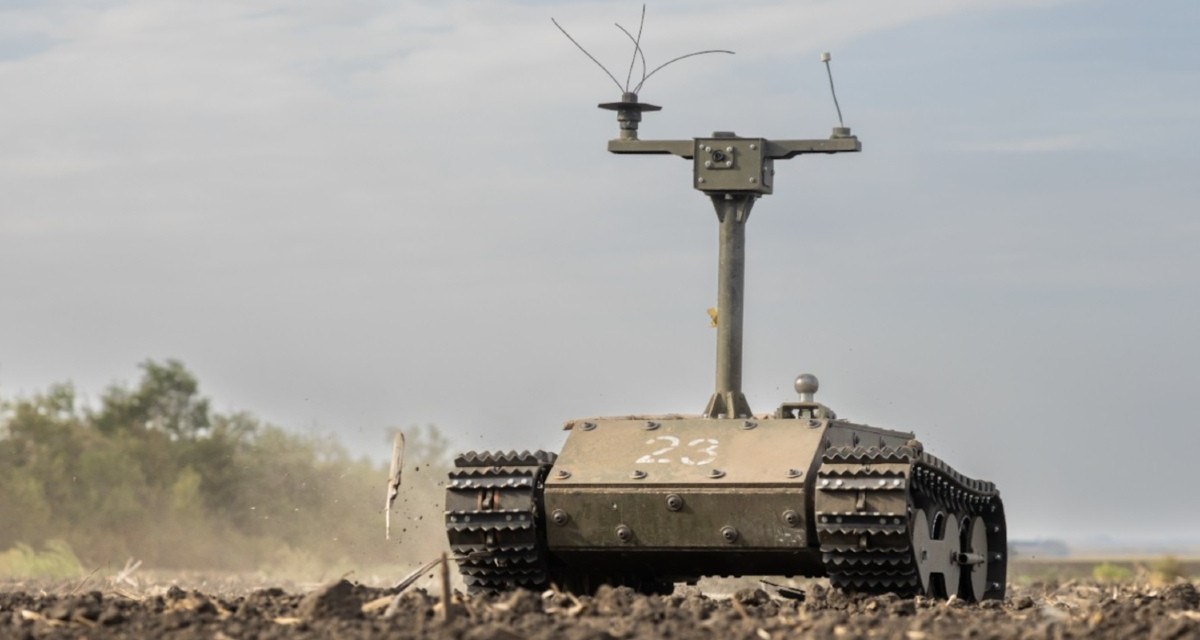
Although footage of aerial drones skimming over Ukraine’s front lines dominate widespread depictions of the ongoing war in the country, the use of unmanned ground vehicles crawling through mud and snow has increased significantly. In the past two years, Kyiv has moved from one-off battlefield experiments to fielding thousands of these vehicles, which perform logistics, engineering, and infantry support tasks. Some even drive explosives into Russian positions as kamikaze robots. Ukraine’s front lines are no longer just a contest of soldiers, armor, artillery, and first-person-view drone pilots; they have become a test range for unmanned ground vehicles operating in challenging terrain under constant fire.
In Ukraine’s emerging operational concept, the goal is not to replace soldiers but to keep them out of kill zones whenever possible. The Ukrainian General Staff reports that robotic platforms have reduced personnel casualties by up to 30 percent—a metric that, if sustained, translates directly into more infantry available for offensive operations and a slower rate of force degradation over time. Unmanned systems sit at the center of that approach, and for unmanned ground vehicles, or UGVs, in particular, the metrics that matter are critical: which platforms accomplish the mission and make it back to Ukrainian lines, how many soldiers each one requires for operation and maintenance, and whether they plug into the same drones, jammers, and supply lines that already keep infantry alive.
Ukraine’s path from a handful of garage-built UGVs to industrial-scale fleets is replete with instructive examples for the US military. As Ukraine’s experience shows, operating them under constant aerial surveillance and electronic attack is far harder than viral clips suggest, and any force that seeks to integrate these vehicles into operations must overcome this challenge. Ultimately, what the US military needs is an integration plan—an operational robotic strike group concept. To develop it requires designing priorities, maintenance concepts, and concepts of employment to produce useful, and expendable, robots instead of expensive mascots. The lesson for US forces is not that robots are the future, but that only some robots change the fight: those built to be expendable in extremis, simple enough for exhausted soldiers to operate, and tightly networked with existing drone, electronic warfare, joint programs, and logistics systems. In a future conflict, the rest will sit in storage yards.
Mission Sets and Scale
Understanding what UGVs do on the battlefield helps clarify both their strengths and their vulnerabilities. Ukrainian forces now employ UGVs across three overlapping mission sets: logistics support, engineering tasks, and fire support. In the 3rd Assault Brigade of the Ukrainian Armed Forces, UGVs conduct 80 percent of logistics operations, reducing human exposure while sustaining supply flows along the line of contact. In the heavily contested cities of Pokrovsk and Myrnograd, UGVs handle 90 percent of logistics operations. Whereas soldiers are limited in how much weight they can carry on top of their combat loads, UGVs from the brigade can deliver as much as 450 pounds on one mission. Driven by the demonstrated successes of these systems, Ukrainian troops are fielding UGV companies as components of dedicated unmanned systems battalions. A growing domestic industry is racing to keep pace: Dozens of firms now produce hundreds of distinct UGV variants. In 2025, the Ukrainian industry delivered fifteen thousand unmanned ground vehicles to frontline units, up from two thousand in 2024.
Beyond supply runs, UGVs are increasingly handling one of the most dangerous missions on the battlefield: casualty evacuation. In one widely cited case, Ukraine’s 1st Medical Battalion used a Maul UGV to retrieve a wounded Ukrainian soldier sixty-four kilometers inside Russian-held territory. The robot returned under repeated drone strikes and survived at least one mine blast. The wounded soldier survived inside a polypropylene armored capsule designed to protect against drone-dropped munitions and artillery fragments.
Engineering support is the second major task for Ukraine’s UGVs, which offer payload capabilities not found in other unmanned systems. Units use UGVs to lay and clear mines, emplace obstacles, move electronic warfare and surveillance gear into position, and, increasingly, to function as one-way attack munitions that blow gaps in Russian trench lines and tree-line bunkers using antitank mines and other significant charges. Because these platforms can carry far larger explosive payloads than a quadcopter, a single inexpensive UGV, pushed a few hundred meters, can act as a guided demolition charge, destroying fortified positions while freeing artillery and mortars for deeper targets that truly require indirect fire. In support of mobility operations, Ukrainian firm Rovertec produces the Zmiy demining platform for roughly $20,000—a fraction of what analogous US systems cost. A single Zmiy UGV clears seven thousand square meters per day and can pace infantry assaults at four kilometers per hour, thereby supporting breakthrough operations.
The third task for UGVs in Ukraine is to support infantry operations. For example, the 3rd Assault Brigade’s UGV company deployed a UGV that held a fighting position for over a month, shielding Ukrainian infantry from repeated attacks. Additional anecdotes have highlighted UGVs with mounted machine guns, grenade launchers, and rockets supporting infantry attacks against Russian positions. However, mission diversity and the usefulness of UGVs on the battlefield are only one part of their success; operating these systems under fire is critical and far more difficult than the viral clips suggest.
The Hidden Difficulty of Operating a UGV
US forces have long struggled with depth perception and communications when operating UGVs, especially in explosive ordnance disposal (EOD) units. Before Ukraine’s UGVs filled social media feeds, American EOD teams had already learned the difficulty of driving a robot over broken ground while watching a video feed and coordinating with the rest of the team. During my 2013 deployment to Afghanistan, I operated a Talon robot daily. On one counter–improvised explosive device (IED) mission, I spent nearly forty minutes inching the robot down a shallow ravine toward a suspected pressure plate IED. The robot had four cameras, but none provided a clear top-down view of what the tracks were about to hit, so every few meters, I stopped, swapped feeds, and tried to reconstruct a three-dimensional picture from four grainy images. Meanwhile, the rest of the team—and our security element—sat exposed while I crept the robot forward. The only way to gain situational awareness was to raise a Gyrocam mast on our mine-resistant ambush-protected vehicle, turning the entire vehicle into a sensor.
During use, communication between the operator and the robot also failed regularly, especially when we lost line of sight around buildings and ditches—the single most common cause of mission failure for our team. In these cases, the team leader had to approach and disarm the IED by hand, a scenario we desperately tried to avoid. That experience underscored that onboard sensors can fail to provide adequate depth perception for human operators and highlighted the criticality of resilient communications and networked systems for successful UGV operations. Addressing these characteristics is what separates useful UGVs from costly paperweights.
Communications
The challenges of operating UGVs under fire have forced Ukraine to rethink how these systems communicate, integrate, and sustain operations. Battlefield innovation is essential, but the next critical leap may come from secure, resilient communications that bind UGVs into broader combined arms networks and the joint force. Ukrainian forces now control UGVs and aerial drones using multiple methods—Starlink satellite links, radio frequency line-of-sight radio, fiber-optic cables, and aerial relay nodes—depending on range, terrain, and electronic warfare conditions. Despite multiple communication options, Ukrainian operators still struggle to maintain reliable links due to intense Russian jamming and electronic fratricide, which degrades radio control. Starlink terminals often provide data transfer rates as little as 10 megabits per second, resulting in poor video quality that inhibits battlefield effectiveness. To enhance survivability, the US military can learn from Ukraine’s experience and develop a doctrine that treats UGVs not as stand-alone platforms but as nodes within a larger system of aerial drones, electronic warfare, and forward defenses.
Networked Systems
To improve command and control, platform survivability, and communications resilience, the US military can experiment with networked robotics—systems that are more capable when integrated than when operating alone, and that can overcome navigation and communications challenges. In a robotics strike group concept, UGVs could draw navigation and targeting data from overhead quadcopters providing overwatch, thereby reducing blind spots and extending operational range beyond what any single UGV can achieve in isolation. UGVs are often large enough to carry electronic warfare equipment, further aiding the destruction of enemy systems and increasing the likelihood of mission success. Because Russian drones are what destroy most Ukrainian UGVs, embedding counterdrone platforms within the robotic strike group—UGVs carrying their own small quadcopters or directed-energy weapons like high-energy lasers and high-powered microwaves for local air defense—can extend mission survivability and ensure success. Of note, Ukraine is combat testing systems such as the Sky Sentinel that demonstrate the effectiveness of AI-enabled gun turrets in defense.
US robotics concepts should emphasize networks, such as dedicated unmanned short-range air defense assets that operate alongside longer-range drone interceptors within the robotic strike group, thereby creating layered protection for unmanned teams on the battlefield. These systems could operate as mutually supporting elements—one UGV hauling cargo or evacuating a casualty, another providing local, layered air defenses by employing electronic warfare protection and launching quadcopters to screen for incoming threats, and another providing local air defense with AI-assisted turrets and directed-energy platforms. No single platform, however capable, can achieve this level of resilience—but a modular robotics strike group can be tailored to specific threats and missions by plugging in different combinations of logistics carriers, electronic warfare platforms, directed energy, interceptor launchers, and fire-support vehicles as threat and environmental demands dictate. For the US military, the challenge is not merely to build better UGVs but to design the doctrine, software architectures, and data links that enable UGVs, aerial drones, jammers, and infantry to function as an integrated combined arms team from the outset.
Networked systems require software and algorithms to function—and Ukraine is generating the raw material to build them at scale. In terms of data and AI, Ukraine sits on a trove of combat data that no lab can replicate—millions of hours of battlefield footage capturing modern war in real time. With appropriate data hygiene protocols, the United States can partner with Ukrainian forces to access this data and use it to train AI models under authentic combat conditions. Doing so could accelerate US progress by several years and reduce research and development costs by billions of dollars.
Sustainment
Frontline UGV workshops are not a luxury in modern high-intensity conflict—they are a combat necessity. Ukraine’s experience demonstrates that even the most advanced unmanned systems lose their tactical value if they cannot be rapidly repaired, modified, and returned to operation within hours rather than days, weeks, or months. US maintenance models that rely on UGV manufacturer- or depot-level repairs thousands of miles from the front would cripple combat units in high-intensity conflicts. During the wars in Iraq and Afghanistan, EOD teams routinely shipped broken Talon and PackBot robots back to the manufacturers in Massachusetts, thousands of miles from the front. While acceptable in a counterinsurgency fight, this model would not serve in high-intensity combat operations. Ukraine’s frontline workshops—fixing systems in hours, not weeks—show why forward, decentralized sustainment is now a warfighting best practice. Already, the US military is experimenting with new models to push these responsibilities closer to the front lines. Looking at Ukraine provides helpful lessons for further developing these concepts.
The Ukrainian robotics workshop plays a critical role at all stages of deployment, making specific modifications to platforms upon their arrival at a unit to enhance their survivability in the unit’s area of operations. Ukrainian brigades embed ten- to twelve-person engineering workshops directly within their unmanned systems battalions. These workshops can diagnose technical failures, fabricate replacement parts on demand, respond to new Russian electronic warfare threats by changing frequencies and software configurations in real time, and adapt commercial munitions for drone delivery—all without routing requests through distant depots or manufacturers. The result is a closed feedback loop between operators and engineers that keeps drones in action even as supply lines are disrupted, and enemy countermeasures evolve daily.
For UGVs, the maintenance challenge is even more acute than it is for aerial drones because UGVs face harsher mechanical stresses—mud, rough terrain, mine blasts, and direct fire—that rapidly degrade tracks, motors, and control systems. Mobile repair vehicles, such as those developed by the Lithuanian Riflemen’s Union at approximately $36,000 per unit, offer a cost-effective model: Two technicians, a 3D printer, welding equipment, and two days of autonomous operation enable critical UGV repairs within kilometers of the front line. Without this forward-positioned maintenance infrastructure, even the most capable UGVs become disposable, one-shot systems rather than reusable assets, and units quickly exhaust their stockpiles. For US forces preparing to operate thousands of miles from manufacturers in contested environments where resupply timelines stretch into weeks, Ukraine’s model of decentralized, mobile, and highly responsive workshops offers a blueprint for sustaining unmanned operations at the pace required by modern warfare. Empowering US soldiers and Marines to modify their own unmanned systems requires breaking with a maintenance model that pushes repairs hundreds or thousands of miles from the front. These systems should be designed for maintainability at the outset, which necessitates that the Army and Marine Corps require developers to produce UGVs with a right to repair model that allows soldiers to fix them in the field, versus the traditional contractor model, where field service representatives assume the profitable role of providing maintenance and repair contracts.
As one possible effort, the Army and Marine Corps could designate company‑level personnel for short tactical electronics courses that teach them to diagnose, repair, and modify drones and UGVs in the field. Graduates would hold an additional specialty as unit‑level unmanned systems electronics experts, thereby narrowing the gap between operators and maintainers. Workshops could also field small maintenance robots to support frontline units, with troops using virtual and augmented reality tools to keep those systems running under fire. Some of the manpower savings from using robotics could be reinvested in forward sustainment without enlarging the force.

The use of UGVs across the battlefield is not a hypothetical future possibility; it is happening in Ukraine now. Successful implementation by US forces, however, will require the deliberate integration of US technology, doctrine, and sustainment. The US military cannot afford to treat Ukraine’s UGV revolution as a distant curiosity. Both Ukraine and Russia are now mass-producing UGVs for missions that, just a decade ago, required human involvement and entailed high levels of risk to personnel—missions like forward logistics resupply, casualty evacuation, mine clearance, and direct infantry support. The lesson is not that robots will replace infantry, but that robots can assume some missions in which exposure to enemy fire guarantees losses, thereby freeing human formations to maneuver, decide, and fight where judgment and initiative still matter most.
As the US military continues its pivot toward high-intensity conflict, it should internalize two core principles from Ukraine’s experience with UGVs. First and foremost, build for communication and integration: UGVs that do not plug seamlessly into existing drone networks, electronic warfare stacks, and combined arms coordination are almost certain to remain niche tools rather than force multipliers. Second, advance sustainment models optimized for unmanned systems: Without embedded workshops, mobile repair capability, and decentralized modification authority at the brigade and battalion levels, even the best robots become disposable, one-shot systems rather than reusable assets. Ukraine’s front lines are already teaching these lessons in blood and steel; the question is whether the US military will absorb them now or relearn them under fire.
Jorge Rivero is a Russian researcher at the Institute for Defense Analyses in Alexandria, Va. He is a retired Marine, a Russian foreign area specialist, and an explosive ordnance disposal technician. Jorge holds a master of arts degree from the Bundeswehr University in Munich and from the George Washington University. He is also an MIT Seminar XXI fellow. His work focuses on the Russian military, Russian strategic weapons, and robotics in warfare.
The views expressed are those of the author and do not reflect the official position of the United States Military Academy, Department of the Army, or Department of Defense.
Image credit: armyinform.com.ua