Editor’s note: This article is the sixth in an eight-part series led by retired General James Mingus, the thirty-ninth vice chief of staff of the Army, on transforming the Army to meet the challenges of tomorrow’s battlefield. You can read other articles in the series here.
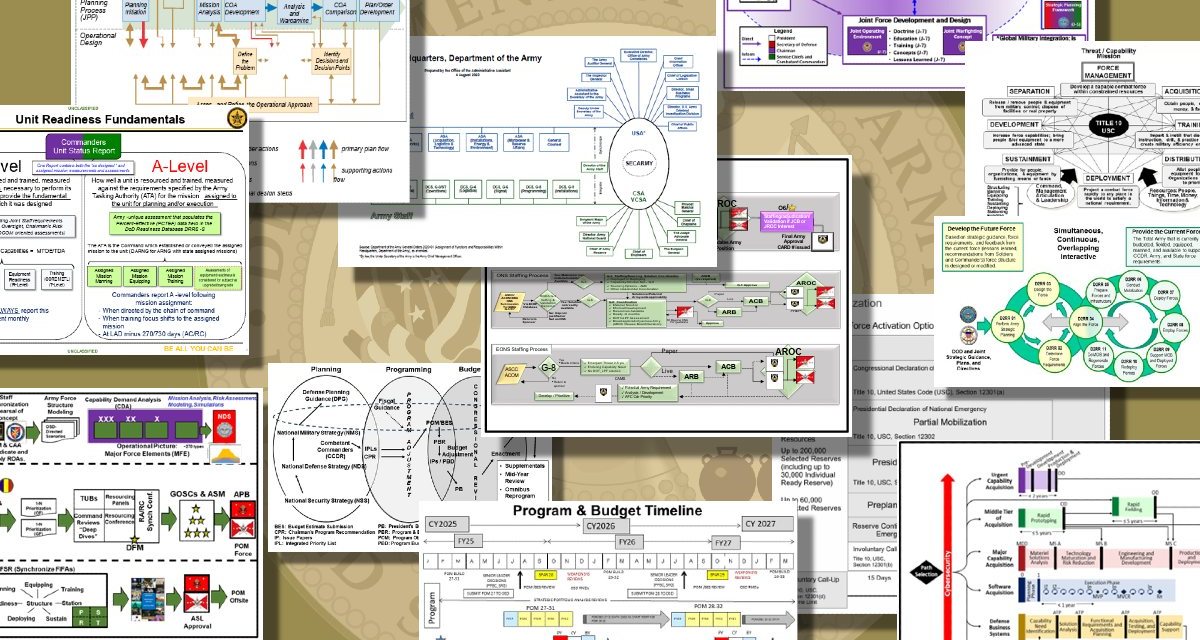
Starting in 1997, every major at the Army’s Command and General Staff College received a multihour course on “How the Army Runs,” accompanied by a five-hundred- page tome. Within minutes of departing Ft. Leavenworth, nearly all officers had flushed that high-level, complicated staff knowledge from their brains, abandoned their copies of the book to a moving carton, and went back to leading troops—and then ten years later they arrived at the Pentagon and wished they had paid more attention.
But even if they had retained the book knowledge, the way the Army actually runs changes with constantly shifting policies and regulations. The basic framework for how the Army runs is over fifty years old, but the way we design, develop, and employ the force has changed—and the pace continues to accelerate. Continuous transformation requires streamlined, flexible, automated processes that allow the Army to design and build the force we need today, informed by experimentation in the field, as well as plan for the force required to stay ahead of rapidly advancing threats we cannot forecast. Getting this right is one of the most important tasks we can accomplish for our Army.
Figuring Out How the Army Should Run
This past year we stood up the How the Army Runs (HTAR) operational planning team (OPT), which includes military and civilian experts from across the Army staff as well as Transformation and Training Command, the Army Reserve, and the Army National Guard. This team is charged with designing a process for the Army to execute agile, integrated, outcome-driven force design, force development, and force employment processes that enable continuous transformation and deliver war-winning capabilities. No small task, this will entail both process improvement and culture change across the Army. If the HTAR OPT succeeds, this new, streamlined, and adaptable process will provide leaders with better awareness and understanding of today’s decisions and their long-term impacts.
One of the greatest challenges is developing a process that is understandable without a multiday course. If a process is not simple or intuitive, individuals will be wed to the steps of the process instead of thinking of creative ways to adapt to the specific situation. Total Army Analysis (TAA), which was previously a multiyear process, must account for the force we need to fight tonight, while also accounting for threat tactics and technology that hasn’t even been developed yet. Our labs and analytic centers are key players in this effort, and we must better organize them to ensure they are properly aligned to priority efforts and, most importantly, utilize common data platforms that allow them to share data across all time horizons. Next Generation Constructive, a cloud-based wargaming simulation, which will replace the current twentieth-century technology, is a great candidate for a common platform to test new capabilities, like the PrSM (Precision Strike Missile) Increment 4, in both analytic simulations as well as Warfighter exercises, before we ever field it to the force.
Another complicated effort the HTAR OPT has tackled is PPBE (planning, programming, budgeting, and execution) reform. Rather than allocating funds separately for training, installations, and equipment across the Army as we’ve traditionally done in pegs (TT peg, II peg, EE peg), we will centrally program funds for capabilities to ensure we are capturing all the costs from acquisition to operations to sustainment. This prevents us from accelerating the fielding of a high-tech aircraft like Future Long Range Assault Aircraft, but not building the appropriate hangar to house it when it arrives.
Accelerating TAA and reforming PPBE requires that we centralize and manage expanding amounts of data. Fortunately, technology and business systems have evolved to enable us to analyze data at higher rates with more accuracy. Therefore, as we streamline how the Army runs, we will also slim down our defense business systems and ensure we automate better processes with more advanced technology. With Next Generation Command and Control as our communications backbone, we will also merge our administrative data with our warfighting systems, so that commanders have all the logistics and personnel data at their fingertips to make quick, informed decisions whether in the field or in the office.
Moving from Analog Stovepipes to Digital Lakes
The days of the five-hundred-page volume that calcified outdated processes are over. You can automate a bad process and do it faster but it doesn’t change the outcome. By the end of this year, majors at the Command and General Staff College will learn how the Army runs utilizing a large language model on Vantage, which will be continuously updated with the most current policies and processes. The model will not only answer their questions about how the Army runs today, but will also point the user to where the data/information lives and who to contact if they need more information. Sharing and operating with live data will be a major cultural change for those of us in the Pentagon, but the benefits in terms of speed, visibility, and accuracy outweigh any individual’s discomfort. As we move our disparate data sources into a single digital lake, it’s time for everyone to learn how to swim.
Retired General James Mingus served as the thirty-ninth vice chief of staff of the Army.
Colonel Christina Bembenek is a military intelligence officer and the director of the vice’s initiatives group.
The views expressed are those of the authors and do not reflect the official position of the United States Military Academy, Department of the Army, or Department of Defense.