In 2025, a NATO exercise in Estonia revealed the structural vulnerability that modern mechanized forces can no longer afford to ignore. During the Hedgehog 2025 exercise, a Ukrainian team of roughly ten people acting as the opposing force, using frontline drone tactics, simulated massive destruction—what exercise participants described as two battalions’ worth of armored vehicles—in a single day. The significance of the result does not rest on the number of simulated kills itself, but on what made such an outcome possible: namely, sustained aerial reconnaissance, swift integration of sensor-to-shooter systems, and the absence of effective countermeasures by maneuvering armored units.
For the Korean Peninsula, such a lesson should not be treated as a European anomaly, but as an immediate planning concern. North Korean personnel who have been sent to Europe in order to either participate in or observe combat are unlikely to return without operational insights. Even limited exposure to drone intelligence, surveillance, and reconnaissance (ISR), AI-assisted targeting cues, loitering munitions, and cloud-enabled battle management systems could accelerate Pyongyang’s adaptation cycle. If these lessons are properly absorbed and applied by North Koreans, South Korea’s tank-centric defense concept could face a level of vulnerability that has not been experienced since the Cold War. In particular, the risk would drastically amplify in a dual contingency scenario that involves Taiwan. These lessons apply not only to the Republic of Korea Army, but also to US Army armored and mechanized formations deployed in South Korea and elsewhere.
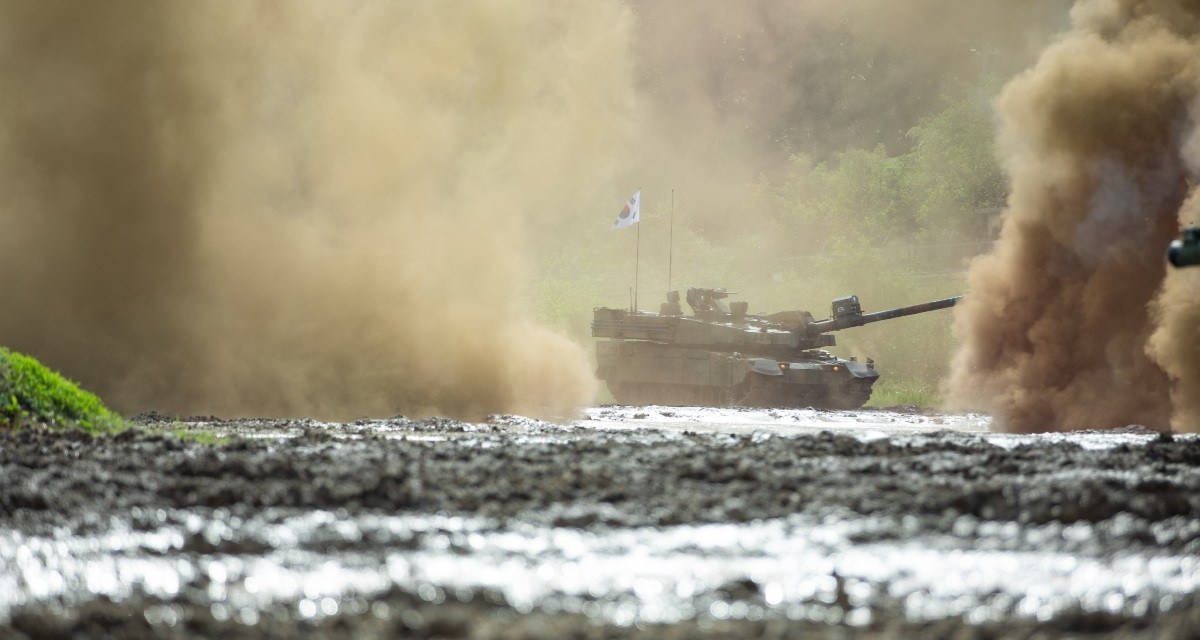
Currently, South Korea possesses one of the most capable armored forces in the Indo-Pacific region. The Republic of Korea Army fields approximately 2,300 to 2,500 tanks and relies heavily on armored maneuver in order to deter and counter a North Korean offensive. The main bulk of these tanks include advanced K2 Black Panther tanks, increasingly concentrated in mechanized divisions and armored brigades, alongside K1 variants—K1A1, K1A2, and K1E1. Meanwhile, legacy M48 Patton tanks are gradually being phased out, while a small number of T-80Us remain in service.
The units equipped with these tanks constitute the core of South Korea’s forward-deployed armored defense north of Seoul. Mechanized divisions and armored brigades are designed to deter North Korea’s advancement in historically important locations, including Kaesong, Cheorwon, and the western corridor toward the Han River, and to execute a rapid counteroffensive maneuver. A single armored brigade typically fields over one hundred tanks, while a forward-deployed division concentrate two to three hundred. Within the first seventy-two hours of a major contingency, multiple mechanized divisions and armored brigades—equivalent to several hundred tanks—could operate within the effective range of North Korea’s surveillance and strike systems.
Despite this armored capability, the question raised by the changing character of the battlefield is whether these tanks can survive and effectively maneuver in an environment characterized by sustained aerial transparency.
Ukraine’s drone warfare has demonstrated that the decisive effect lies less in the individual platform’s lethality than in continuous and network-centered reconnaissance. Persistent ISR blurs the traditional distinction between the front line and rear areas. Assembly areas, refueling points, and artillery positions turn into observable nodes within a constantly updating network. Under such circumstances, disproportionate operational disruption could be imposed—through mobility kills, command-and-control degradation, and logistics paralysis—even by a limited number of loitering munitions that are guided by real-time ISR.
North Korea does not possess Ukraine’s industrial drone ecosystem or its battle-tested cloud infrastructure at this juncture. Nevertheless, it does have a strong incentive to learn fast. Expansion of cooperation with Russia, together with battlefield observation on the European front, offers a path to accelerate doctrinal adaptation: Commercial quadcopters could be massively militarized; loitering munitions could be reverse-engineered; AI-assisted targeting does not necessarily need to be sophisticated—it just needs to shorten the sensor-to-shooter timeline.
If North Korea integrates its drone ISR with special operations forces and long-range firepower, the implications for South Korean armored formations would be substantial. Tank units that execute counterattacks would encounter constant surveillance, especially in altitude bands below one thousand meters where traditional air defenses are thinnest. Logistics convoys necessary to sustain armored counteroffensive would become objects of tracking and strike operations. Under sustained ISR, temporary concealment would quickly be neutralized. Meanwhile, even limited mobility kills—damaged optics, disabled tracks, and disrupted fuel vehicles—could reduce combat efficiency without massively destroying armored platforms.
Such vulnerability would magnify under a dual contingency scenario. Wargaming conducted by the Atlantic Council—the Guardian Tiger I and II exercises—highlighted the plausibility of opportunistic North Korean escalation during a conflict over Taiwan. In such a scenario, the United States would likely deploy ISR assets and precision-guided munitions—both finite resources—to the Taiwan theater. At the same time, China’s missile and aerial activities in the Yellow Sea could complicate US reinforcement as well as resupply to the Korean Peninsula. South Korean armored formations, together with US Army units operating under the Combined Forces Command in wartime, would therefore shoulder a greater share of the immediate conventional defense burden.
North Korea does not need to achieve decisive armored superiority. Degrading South Korea’s counteroffensive tempo, cohesion, and survivability would be sufficient. If even 20–30 percent of forward-deployed tanks are temporarily suppressed, mobility killed, or logistically constrained, the accumulated operational effect could be consequential. Concentration—traditionally central to armored shock—would instead invite attrition along a transparent front line.
The solution is neither to abandon tanks nor to assume incremental improvements in armor protection would be sufficient. The key lesson from Ukraine is that survival depends not only on passive protection but also on information denial and low-altitude airspace control.
For the United States and South Korea, this requires structural adaptation rather than marginal procurement. Counterdrone capability should be organic to maneuver formations and not a centralized asset employed reactively. Division-level armored formations should integrate electronic warfare, short-range air defense, and anti-ISR capability as standard components. Persistent displacement, deception, and dispersion should substitute for large, static assembly areas that are increasingly untenable under sustained ISR.
To be sure, South Korea has already begun adaptation through the establishment of the Drone Operations Command in 2023, reflecting institutional recognition of the evolving threat. Yet just over two years later, the South Korean government decided to disband the organization due to overlapping roles among military branches. As a result, integration of counterdrone and anti-ISR capabilities at the division levels remain uneven.
These adaptations have direct implications for the US Army units stationed in South Korea. US armored and mechanized units assigned under USFK should assume that the next major conflict on the Korean Peninsula will unfold under constant aerial surveillance from the early stages of the war. Training for combined arms maneuver should therefore center on operating under degraded electromagnetic conditions, disrupted logistics, and constant ISR pressure—conditions that the Guardian Tiger exercises suggest are likely to materialize in a dual contingency scenario.
Tanks remain relevant and effective military assets on the Korean Peninsula; their firepower, mobility, and shock effect still matter in terrain characterized by narrow corridors and swift maneuver opportunities. Nevertheless, on a transparent front line, armor without effective control of the airspace below one thousand meters is increasingly vulnerable.
If North Korea internalizes lessons from Ukraine while the United States is simultaneously engaged over Taiwan, South Korea’s forward-deployed armor could face its greatest challenges not at the point of contact, but from above.
Dr. Ju Hyung Kim currently serves as a president at the Security Management Institute, a defense think tank affiliated with the South Korean National Assembly.
The views expressed are those of the author and do not reflect the official position of the United States Military Academy, Department of the Army, or Department of Defense.
Image credit: Staff Sgt. Reginald Harvey, US Army