You step off in the dark, and you can feel it before anyone says a word.
Two of your platoon’s gunners are quiet in that focused way you like. One driver is already short-tempered. A vehicle commander is running ammo, comms, and contingencies in his head while trying to keep the crew steady. Everyone says they’re fine. Everyone says they slept.
The platoon leader is fired up. This is gunnery. He’s got a plan, a timeline, and just enough caffeine to believe the platoon can squeeze in one more rep “while we’ve got momentum.” You’ve seen this movie before.
As the platoon sergeant, you’re watching the edges fray. During gunnery week, fine usually means exhausted. And you’re the one who has to make the call: push harder now, or protect the crews so they have something left when it actually counts on the final qualification test—Table VI.
Most leaders make that decision on instinct—who looks smoked, who’s pounding energy drinks, who still sounds sharp on the radio. Meanwhile, we track everything else with precision: maintenance status, ammo counts, qualification scores, and timelines. The human system, the part that actually sees, decides, and executes under stress, still gets reduced to a gut check.
Over the past several years, the Army has begun applying data analytics to tactical training through efforts like “moneyball for gunnery,” focusing on scores, repetitions, and training design. Why can’t we extend that logic one step further? If we believe in measuring what matters, the human system cannot remain the blind spot. Tactical biometrics offer a way to close that gap.
Watches, rings, and other devices that record biometric data—known as wearables—can quantify sleep, recovery, and physiological stress in near-real time, turning I think my crews are tired into a measurable readiness signal. In a live-fire environment where small degradations compound into missed shots and failed qualifications, that difference matters.
Linking biometric indicators collected during a Stryker gunnery to concrete outcomes, first-time qualification, and overall scores can test a simple question: If we can measure human readiness, can we better predict and improve crew lethality?
The Human System as the Last Unmeasured Variable and Why It Matters
The word biometrics might bring to mind something highly technical—from fingerprints to facial recognition to iris scans. But it can also be simpler—data collected by wearables to track sleep, recovery, and physiological stress. This is data athletes and the general population have long relied on for performance and health tracking, but when collected from soldiers during real training events, it enables better understanding for leaders—and more effective training. It is also exactly the kind of technology the Army is already experimenting with during large-scale exercises and operational training.
Not motivation. Not toughness. Just how taxed the body actually is.
This focus on physiological readiness is not new. Nearly fifty wearable-based fatigue and physiological monitoring efforts have already been documented across the Army, Navy, Marine Corps, and Air Force, with projects centered on sleep tracking, stress indicators, and recovery under sustained operations.
Military medicine research similarly highlights how wearable devices give leaders a clearer, real-time picture of warfighter readiness and performance beyond self-reporting measures.
Building on these efforts, we led a brigade-level pilot during high-tempo training and gunnery in 1st Stryker Brigade Combat Team, 4th Infantry Division and collected wearable data from hundreds of soldiers across ranks and battalions. Supported by the Defense Health Agency, we tracked how readiness changed as units approached execution and how that readiness related directly to performance on the range.
It allowed us to do two things. First, identify consistent patterns in soldier sleep, stress, and recovery during intense training cycles. Second, link those readiness patterns directly to lethality outcomes at gunnery, giving leaders a clearer picture of how the human system shapes performance when it matters most. Most importantly, these insights translate into decisions about tempo, recovery, and repetitions that can directly maximize lethality during training.
Pre-Combat Checks: What the Data Reveals About Crew Readiness
Before linking readiness to gunnery performance, it is worth understanding the condition crews are bringing into execution.
Across high-tempo training cycles, wearable data revealed consistent patterns in sleep, stress, and recovery that mirror what leaders intuitively observe but rarely quantify. Soldiers consistently slept less than matched civilian populations, with shorter total sleep duration and reduced time in restorative sleep phases. In practical terms, most crews were arriving at major training events already physiologically taxed.
This matters because sleep is not just rest. It is when the body recovers from stress, consolidates learning, and restores cognitive capacity. Essential sleep stages such as deep sleep and REM sleep play distinct roles in physical recovery, memory consolidation, and cognitive performance. When sleep cycles are shortened or disrupted, the restorative value of sleep is reduced, a problem the Army is already addressing through sleep readiness initiatives within the Holistic Health and Fitness framework.
When sleep debt accumulates across days and weeks, attention, reaction time, and decision-making degrade in measurable ways, increasing the likelihood of errors under stress. Those degradations are easy to miss in daily routines but become costly in complex, time-compressed environments like gunnery.
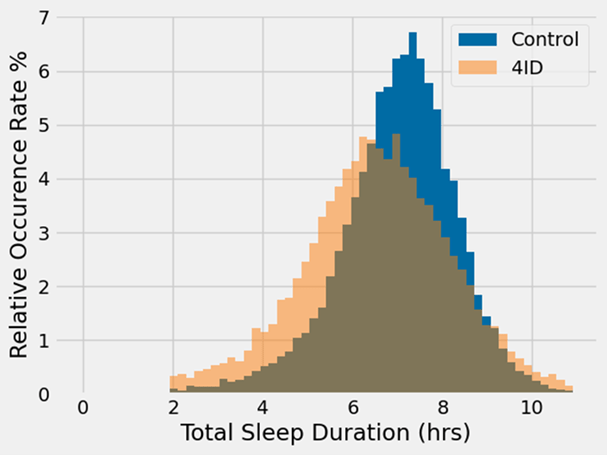
The story does not stop at total sleep time. Soldiers also experienced significantly reduced REM sleep compared to civilian controls.
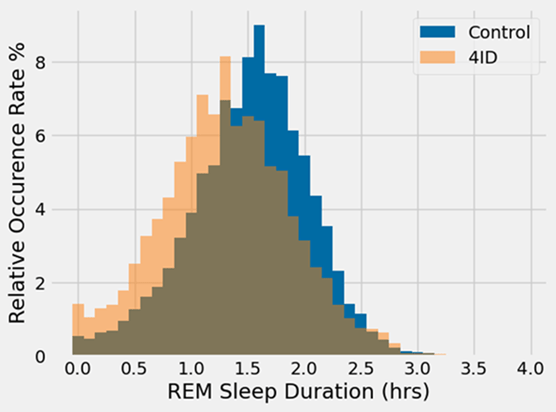
REM sleep is particularly important because it supports cognitive recovery and learning consolidation. In practical terms, many soldiers are not just sleeping less, they are missing the most restorative portions of sleep that underpin attention, memory, and rapid decision-making under stress.
The key question for commanders is simple: Do these biometric signals actually matter once crews roll onto the range? That’s where the biometric data from gunnery comes in.
What Gunnery Training Does to the Human System
Baseline fatigue is only part of the story. The demands of gunnery itself place sustained physiological load on crews that continues to erode readiness through execution. Using wearables, we tracked unit-level physiological readiness continuously through gunnery, giving leaders direct visibility into the health and readiness of their formations.
As live-fire events approached, physiological stress steadily increased across formations, reflecting long days, compressed timelines, and sustained cognitive demand. Sustained stress has a cumulative wear-and-tear effect on the body, known as allostatic load, which degrades both cognitive and physical performance over time.
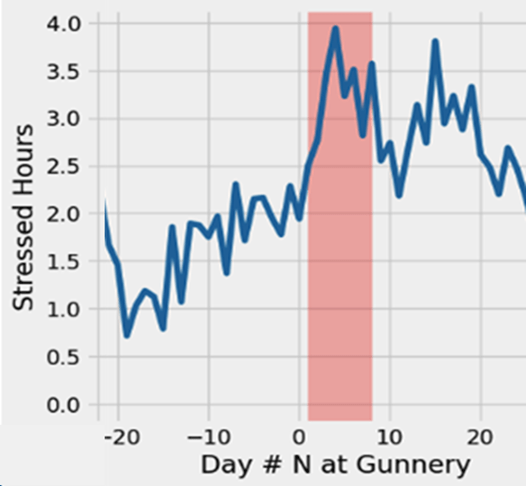
At the same time, overall readiness declined as cumulative fatigue outpaced recovery. Stress and disrupted sleep reinforce one another, helping explain why readiness continued to slide during high-tempo execution rather than stabilizing once training began.
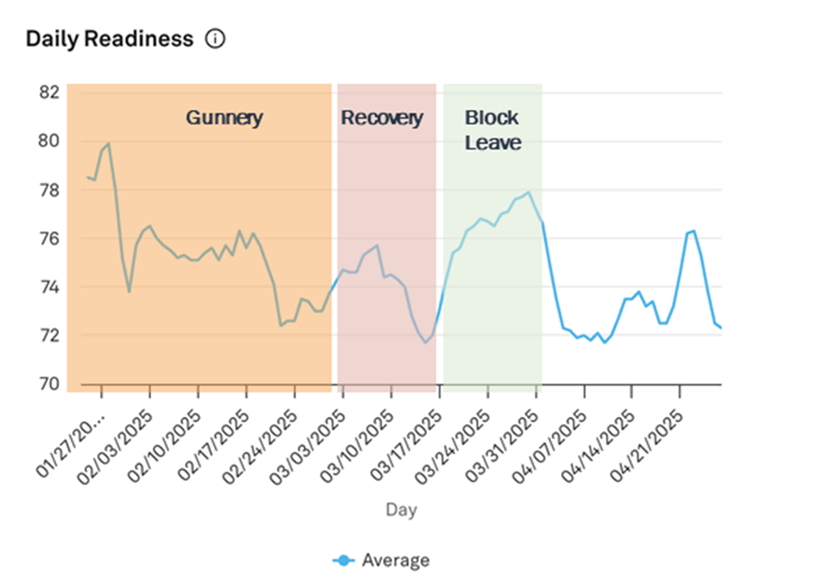
Rather than rebounding immediately when gunnery concluded, readiness often remained depressed and only recovered after extended block leave. In effect, gunnery does not simply test readiness at a single moment. It actively consumes it over time.
This pattern is not just theoretical. In military populations, sleep deprivation and sustained fatigue are linked to measurable declines in both cognitive and physical performance, exactly the capacities crews rely on during complex, time-compressed tasks like gunnery.
For leaders, this reflects a familiar tension. Each repetition builds proficiency, but each repetition also draws down physiological capacity. Without visibility into the human system, it is difficult to know when additional reps are sharpening crews and when they are quietly degrading performance.
The wearable data makes that tradeoff visible, turning fatigue from a gut feeling into a measurable readiness factor.
When Readiness Meets the Range: What Gunnery Results Reveal
Once the physiological picture is clear, the next question is straightforward: Does the condition crews bring into execution actually shape performance at gunnery?
The answer is yes.
We examined this relationship using both traditional linear regression and machine learning methods designed to capture more complex, real-world performance patterns. Our focus was on two readiness indicators: sleep and heart rate variability (HRV).
These findings reflect operational analytics conducted to inform training decisions in real time, not a multiyear academic study. While the analysis is ongoing and will continue to be refined, the patterns are already strong enough to guide how leaders think about readiness and lethality during gunnery.
HRV measures the variation in time between heartbeats and reflects how well the body is balancing stress and recovery. Higher HRV generally indicates stronger physiological resilience and readiness to perform under pressure, which is why it has gained attention as a broad health and performance indicator. Sleep captures total rest as well as time in restorative stages like deep sleep and REM sleep that support cognitive performance and learning.
We evaluated performance using two outcomes leaders already rely on at Table VI: first-time qualification and overall gunnery score.
Linear Regression: HRV Shows Clear Effects, Sleep Does Not
In traditional linear regression models, HRV emerged as a consistent and statistically significant predictor of both first-time qualification and gunnery score. Crews arriving with stronger HRV signals, indicating better recovery from cumulative stress, were measurably more likely to qualify on their first attempt and tended to shoot higher overall.
By contrast, aggregate sleep measures did not reach conventional statistical significance in these linear models once traditional training variables such as prior table performance and repetitions were included. In a purely linear framework, sleep appeared to play a more limited independent role.
Machine Learning Reveals the Hidden Structure of Sleep and Readiness
Linear models assume simple, additive relationships. Human performance under fatigue rarely follows straight lines.
To capture nonlinear effects and interactions, we applied ensemble machine learning methods including random forests and gradient-boosted trees (XGBoost). These models are specifically designed to identify complex patterns where variables combine in ways traditional regression cannot easily represent.
In these models, deep sleep and REM sleep consistently emerged as high-importance predictors of both qualification and score, alongside HRV. While total sleep time alone appeared weak in linear analysis, the quality and structure of sleep proved highly informative once nonlinear relationships were allowed.
Put simply, sleep did not act in a smooth, linear way. Its effects depended on thresholds, interactions with stress and recovery, and cumulative fatigue patterns, all of which machine learning models were able to capture.
Across models, incorporating biometric indicators such as HRV, deep sleep, and REM sleep materially improved predictive accuracy compared with models relying only on traditional gunnery metrics like prior table scores and repetitions.
Readiness Completes the Performance Picture
Two crews can arrive equally trained, with similar experience and prior performance, yet execute very differently depending on physiological readiness at the moment of gunnery.
HRV reflects how well crews have recovered from sustained stress. Deep and REM sleep reflect whether the body and brain have restored the systems needed for focus, learning, and rapid decision-making under pressure.
Linear models show that recovery matters. Machine learning reveals that sleep quality and readiness interact in complex ways that strongly shape lethality.
Training builds skill. Readiness determines how fully that skill shows up when it counts.
What This Means for Training Design and Command Decisions
The takeaway from biometric readiness data is not that training should slow down or become risk averse; gunnery still requires repetition, pressure, and execution under fatigue. The lesson is that human performance as it relates to soldier and unit readiness is a resource that can be deliberately managed rather than unknowingly depleted.
Efforts like moneyball for gunnery have already shown how data-driven analysis can improve lethality by optimizing repetitions, sequencing, and training design. Tactical biometrics apply the same logic to the one variable that has historically been assumed rather than measured: the human system executing under stress.
How can the findings of this experiment inform the way leaders approach training?
First, readiness data can help them sequence training more intelligently. Rather than assuming every crew benefits equally from additional repetitions, biometric signals can indicate when crews are still building proficiency and when fatigue has begun to degrade performance.
Second, recovery windows matter more than most schedules account for. Sleep quality and physiological recovery directly shape execution outcomes. Small adjustments to start times, rest periods, and training density can preserve readiness without sacrificing training value. Protecting sleep is not about comfort. It is about maintaining lethality.
Third, readiness context allows leaders to distinguish between training gaps and readiness constraints. A crew that struggles while physiologically recovered likely needs more repetitions or better instruction. A crew that struggles while depleted may need recovery more than correction. Without biometric context, leaders risk misdiagnosing problems and quietly burning down readiness while appearing productive on paper.
Finally, modern analytics and machine learning tools offer a path toward practical decision support by integrating biometric signals with traditional training metrics to anticipate performance risk before execution breaks down.
The goal is not perfect optimization. It is better tradeoffs.
Toward Readiness-Informed Lethality
For decades, the Army has measured what is easy to observe: rounds fired, repetitions completed, and scores achieved. These metrics remain essential, but they capture only part of what determines performance under pressure. Biometric readiness data offers a way to measure the human system with the same rigor applied to equipment and training outputs. Sleep quality, recovery, and physiological stress are not soft variables. They are measurable inputs into lethality.
This approach does not replace existing training doctrine. It strengthens it. To move beyond pilot efforts, the Army will need modest but deliberate institutional investments: treating wearables as training enablers rather than wellness tools, integrating readiness data with training systems in a secure and scalable way that respects privacy, and building small analytic teams that turn raw data into actionable insight for commanders. Raw data alone does not create understanding. The goal is not new dashboards or new forms of individual monitoring, but clearer decisions that link human readiness directly to training design and execution.
The combination of wearable data and modern analytics points toward a future where data-informed leaders proactively manage readiness rather than react after failure. Most importantly, this preserves leadership judgment. Tactical biometric data does not tell commanders what decision to make. It reveals when decisions carry hidden physiological risk. The payoff is not more dashboards. It is clearer decisions.
And this is not theoretical. The brigade-level biometric pilot demonstrated that units can issue wearables at scale, sync them reliably, and use them during high-tempo training without disrupting execution. It also showed that leadership engagement matters. When leaders explained the purpose of the data and treated it as a readiness tool rather than surveillance, soldier buy-in followed.
Gunnery will always be hard. At the end, the decision still rests where it always has, with leaders on the ground.
The platoon sergeant is still watching crews climb back into their vehicles before dawn. The platoon leader still wants one more rep. The standard still does not change. What can change is how clearly leaders see the risk they are accepting and how to build the most lethality so they win the next real-world fight.
Lieutenant Colonel Jon Bate is a US Army infantry officer serving in the Joint Staff J5. He previously commanded 2nd Battalion, 23rd Infantry Regiment, 1st Stryker Brigade Combat Team, 4th Infantry Division. He has served in the 101st Airborne Division, in the 1st Armored Division, and as an assistant professor of economics in the US Military Academy Department of Social Sciences. A Goodpaster Scholar in the Advanced Strategic Planning and Policy Program, he holds a master in public policy from the Harvard Kennedy School and PhD in political science from Stanford University.
Lieutenant Colonel Stephanie Hightower serves as a physician at Tripler Army Medical Center in Hawaii, under US Army Medical Command and the Defense Health Agency (DHA). Prior to this assignment, she served as a practicing pulmonologist and intensive care physician at Walter Reed National Military Medical Center, where she also led organizational wellness initiatives within the DHA. A Fulbright Scholar, she holds a master of science in global health from the University of Oxford and an MD from the George Washington University School of Medicine and Health Sciences.
Dr. Rebecca Rough serves as the chief innovation officer for the Defense Health Agency, leading the development and piloting of cutting-edge solutions that enhance the quality, safety, and efficiency of the Military Health System. A biomedical engineer by training, Dr. Rough has driven medical technology innovation and programs spanning R&D, emerging technology implementation, and enterprise scaling across healthcare and bioscience fields.
The views expressed are those of the authors and do not reflect the official position of the United States Military Academy, Department of the Army, or Department of Defense.
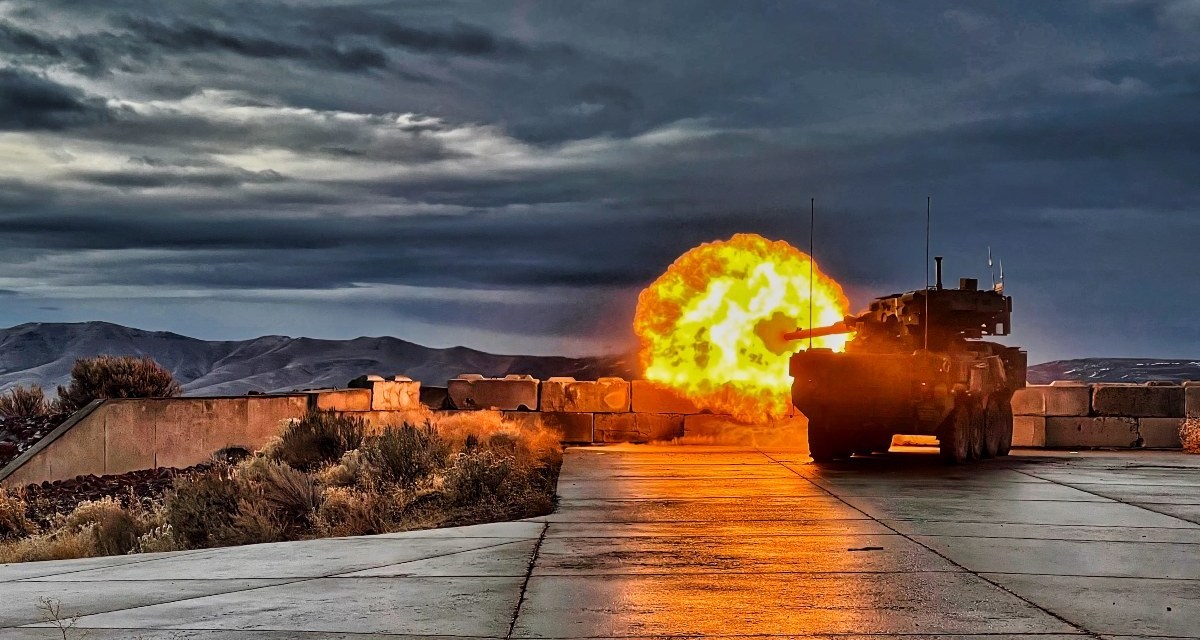
Image credit: 1st Lt. Alex Windmiller, US Army