Editor’s note: This article is the seventh in an eight-part series led by retired General James Mingus, the thirty-ninth vice chief of staff of the Army, on transforming the Army to meet the challenges of tomorrow’s battlefield. You can read other articles in the series here.
The battlefield in America’s next war will offer no sanctuary. The war won’t be fought from forward operating bases equipped with elaborate gyms, contractor-provided dining facilities, or coffee shops. The battlefield will be austere, harsh, and unrelentingly violent, with victory only possible by combining physical strength, endurance, and a will to prepare.
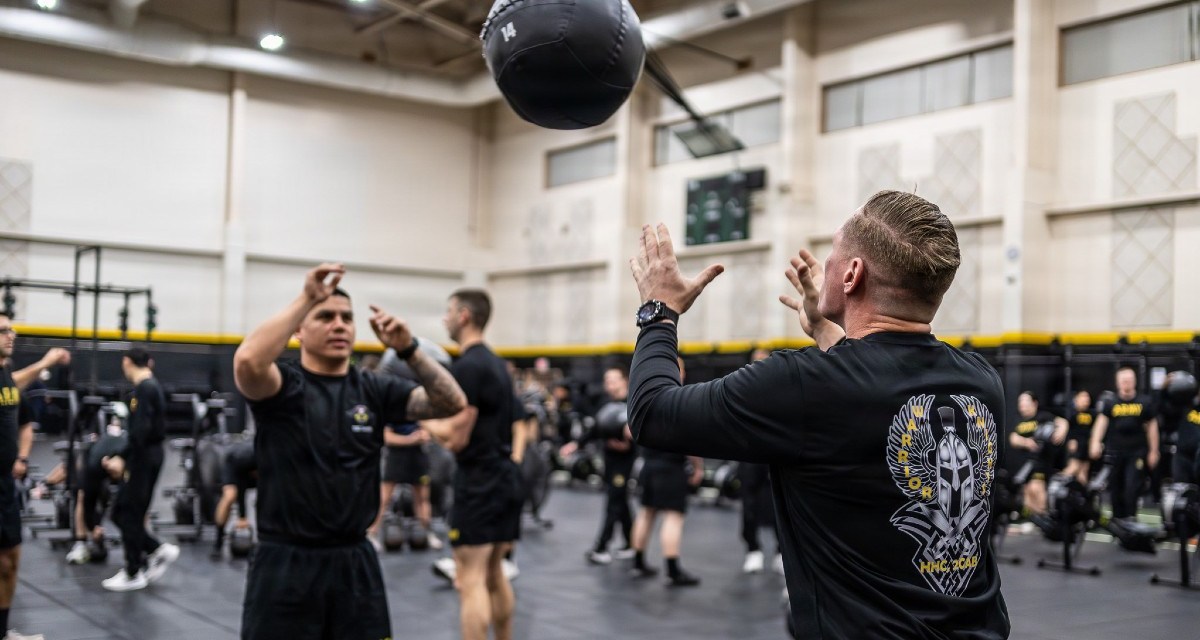
The Army’s Holistic Health and Fitness (H2F) program is the bedrock upon which this preparation begins. Winning America’s next war requires an Army that can get to the fight, win the fight, and get home from the fight—a mission profile that demands not just fit soldiers built for endurance, but warrior athletes built for endurance and able to leverage strength, speed, and power, and grounded in sound sleep and nutrition.
Culture Shift Begins with Mindset Shift
For the last several decades, the Army took pride in fielding formations rooted in a physical fitness culture relying heavily on push-ups, sit-ups, and miles of running and ruck marching. Physical training began predictably after saluting the flag at 0630 and ended promptly when the basic exercises, calisthenics, and formation run were complete. It was one-dimensional, unimaginative, boring, and, ironically, lazy. Army fitness during this period was solely focused on physical endurance.
In the early 2000s, however, Army fitness began to change, led by special operations units like the 75th Ranger Regiment, which began experimenting with trending fitness regimens like Gym Jones, CrossFit, and Mountain Athlete. By combining emerging principles from several of these programs, special operations units began designing their own programs, such as the Ranger Athlete Warrior program. The rest of the active Army quickly started to model these programs, and the first H2F pilot kicked off in 2018.
Advances in exercise science and twenty years of war helped reframe the Army’s fitness mindset to encompass mental, physical, nutritional, and sleep dimensions. This mindset shift forms the basis of the H2F culture, changing how we train and care for soldiers. The focus is now on building strength and resilience like professional athletes—or more fittingly, warrior athletes. Where mission endurance was the goal before, tactical athleticism is now the goal, with an emphasis on strength, speed, power, and agility.
You Can’t Fake Results
A key part of any fitness program is the ability to measure its effectiveness, and in only a few short years, the return on investment for the H2F program has been profound. Currently sixty-six brigades have an H2F performance team, which consists of twenty-two professionals: a program director, dietitian, physical therapist, and occupational therapist; seven strength and conditioning coaches; four athletic trainers; one cognitive performance specialist; and six military personnel. By 2029, the program will expand to cover the entire active Army, as well as four states of Army National Guard and two Army Reserve commands.
According to analysis from the US Army Research Institute of Environmental Medicine, if H2F had been implemented across the entire Army, over a five-year period it would have added 1,080 deployable soldiers to the fighting force. If that’s not compelling enough, also consider these complementary H2F data points compiled by the Center for Initial Military Training Research and Analysis team after analyzing data from 2019 to 2023:
- 61 percent decrease in musculoskeletal injury referrals
- 44 percent decrease in behavioral health profiles
- 79 percent decrease in substance abuse cases
- 22 percent decrease in fitness test failures
- 33 percent increase in expert rifle marksmanship qualification
Expanding the Tools
As part of continuous transformation, the Army is looking for unique ways to leverage technology to enhance the H2F program. Several units are experimenting with wearables like rings and watches that measure sleep efficiency, heart rate variability, and blood oxygen saturation—providing rich data to inform approaches to physical, nutritional, and sleep aspects of fitness. Today, entire Army divisions are turning physiological data into leader decision-making information. A company commander who knows his or her soldiers’ sleep scores, for example, is equipped with data to combine with other information to help select the most well-rested platoon to lead a dangerous mission. Individual soldiers will also learn the correlations that exist between their fueling, recovery, and performance habits, which will help in multiple facets of their personal lives.
The Army is also continually working to improve facilities and services that support H2F. Most units now have access to twenty-four-hour functional fitness gyms on post and many units utilize fitness containers—effectively, gyms in a box. Plans are also in place to build additional facilities to ensure soldiers at every post have adequate equipment to train. To improve nutrition, the Army is experimenting with campus-style dining facilities that will supplement, and in some cases replace, traditional dining facilities—affording soldiers a myriad of quick, 24/7 accessible healthy food options. A no excuse not to work out and no excuse not to eat healthy mentality now abounds across the Army.
Soldiering has no offseason and no time-outs, and wars wait on no one. When America calls, the Army responds. Unlike professional athletes who can vary training volume, intensity, and specific exercises over planned cycles or offseasons, a practice known as performance periodization, soldiers have no such luxury. Tactical athleticism via compound periodization is the goal for soldiers—ensuring peak performance at all times by developing key physical attributes (e.g., strength, endurance, and power) year-round to maximize efficiency, prevent burnout, and improve overall warfighting readiness. The H2F tools highlighted above aid in measuring and maximizing this readiness.
What’s Next?
Imagine two Army squads ascending Colorado’s Pikes Peak carrying fifty-pound fighting loads. Squad A trained to get to the top through push-ups, sit-ups, and miles of running. The soldiers of Squad B are warrior athletes who took the H2F approach. When Squad A’s soldiers finally struggle to the top, they’re just happy to be mission complete and they flop on the ground. The soldiers of Squad B assault the mountain, and when they get to the top, they still have enough juice to rip the arms off their adversaries and steamroll into the next mission. In their post-hike squad photo, they’re all standing tall—straight backs, satisfied smiles, and trap muscles extending inches above their shoulders so they almost appear to have no necks. For them the mission is just getting started, and their smirks seem to say, “Is that it? What’s next?”
Welcome to the No Neck Army.
Retired General James Mingus served as the thirty-ninth vice chief of staff of the Army.
Colonel Graham White is an infantry officer and the executive officer to the vice chief of staff of the Army.
The views expressed are those of the authors and do not reflect the official position of the United States Military Academy, Department of the Army, or Department of Defense.
Image credit: KCpl. GeonWoo Park, US Army