Throughout the sanguine annals of military history, very few truths have endured. However, one comes close: Advances in offensive technology eventually demand corresponding innovations in defense.
Today, drone-enabled attacks across Ukraine, Russia, and the Middle East offer a grisly warning that has redefined the meaning of the rear area, once thought to be secure. Inexpensive long-range drones have struck targets and caused casualties. The lecture halls of the battlefield have always been staffed by unforgiving professors, and once again they are teaching us in blood. While certainly the rear area has not completely disappeared, the sanctuary long associated with it has been degraded. These attacks are not indicative of failure, as no base is ever completely invulnerable. However, we must examine the time we find ourselves in, as militaries worldwide are racing to integrate drones into their land, sea, and air forces.
The age of the drone might be best compared to the age of gunpowder, when military forces struggled for years to wield chemical-fueled firepower not only in battle but also against fortresses. Gunpowder eventually forced armies to rewrite the grammar of violence on land, sea, and in sieges.
After the fall of the Roman Empire and the loss of large, well-trained legions, local rulers instead put their faith in castles to provide for regional defense. However, the advent of gunpowder artillery altered the stopwatch for attacking fortresses, making what once took months possible in weeks, days, and sometimes hours.
As stone fortresses were reduced to rubble from the cacophonic screams of ever more powerful cannons, many contemporary Renaissance thinkers realized that the answer was not simply a thicker version of the wall they already possessed. It became clear that the cannon had profoundly manipulated the existing rules of warfare, such that the architecture of defense demanded not only innovation but also imagination. It is from that bloody process of experimentation that the trace italienne, the Italian form most commonly known as a star fort, was born. The introduction of the trace italienne brought a defensive system designed to deny artillery the rapid decision it had briefly promised.
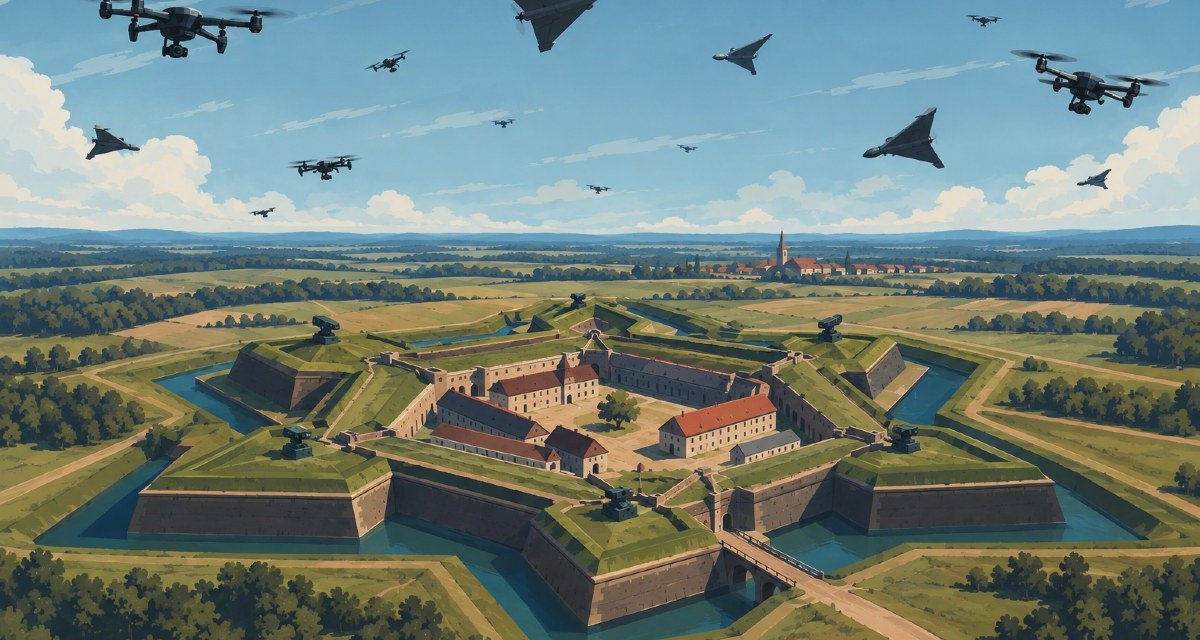
Today, we must respond to new drone-enabled threats against our own rear areas. It is time to make our own trace américaine, a distinctly American defensive architecture built around hardening, depth, and interlocking fields of fire. The evolution should not be just the ability to defend against the drone, but also to fight back.
It is important to note that in the age of gunpowder, the cannon did not make the fortress irrelevant. Rather, it made the old way of fortresses nearly obsolete. The age of drone-enabled combat may now be doing the same to us today with respect to our airbases and rear areas. Today’s danger is not merely that drones can strike our bases, but also that we may be building these bases according to assumptions that the drone is slowly grinding away. It is for us to imagine a new way of defending our vulnerable rear areas.
How Gunpowder Altered the Grammar of Violence in Defense
The introduction of gunpowder to battlefields in Europe did not transform battlefields or sieges overnight. European armies required decades and centuries to adapt to the shift from muscle-powered to chemically fueled firepower. As always, weapons arrive on the field of battle with instruction manuals, but not the institutions, formations, or even the fortifications to best employ or survive against them. In land combat, gunpowder spurred new tactics and formations, such as the Spanish tercio. On the high seas, naval warfare evolved from a contest dominated by closing, ramming, and boarding toward one increasingly decided by cannon fire. As the democratization of gunpowder altered the formations and practices of battle on land and at sea, the next phase of the gunpowder revolution also affected siege warfare.
Fortresses from antiquity to the late medieval era plagued commanders and proved quite difficult to take. From Caesar’s circumvallation of Alesia in 52 BCE to the castles of medieval Europe, hunger, disease, and time could accomplish what muscle-powered missiles often could not. However, firepower, delivered by bombards and later cannons, transformed the stopwatch of siege from months to weeks and, at times, even hours. Christopher Duffy, in his work Siege Warfare: The Fortress in the Early Modern World 1494–1660, tells the story of how stone that had provided sanctuary could now be pulverized into rubble, and at an accelerating pace.
The employment of cannon was decisive at the sieges of Harfleur in 1415, Constantinople in 1453, and Krems in 1477.Yet even after these dramatic events, there was still little evidence that Europeans fully understood that artillery had fundamentally altered the relationship between attack and defense. This failure to rapidly imagine a new grammar of violence serves as an important warning for contemporary military thinkers in the embryonic stages of drone-enabled combat. Sometimes it takes several catastrophes and defeats to make the implications impossible to ignore, as military institutions throughout history have stubbornly ignored threats to their established practices. However, smoldering rubble is considerably more difficult to ignore.
Eight Hours that Killed the Fortress
For Renaissance Europe, Charles VIII of France’s cannon-enabled invasion of Italy provided horrifying evidence that the timeframe and rules of siege warfare had evolved. Within his siege train, Charles VIII carried a new generation of mobile artillery that fired iron shot and could be emplaced and fired with horrific efficiency. Duffy recounts contemporary descriptions of cannon accomplishing in hours what previously required weeks to months. In February 1495, Charles VIII arrived before the border fortress of Monte San Giovanni Campano with roughly forty horse-drawn bronze guns.
Charles’s artillery breached the fortress in only eight hours, and the French army stormed through and massacred the garrison. Military thinkers throughout Europe, such as Machiavelli, and even artists like Michelangelo, soon wrestled with the challenge of designing fortifications capable of withstanding artillery fire.
It appeared that the advent of gunpowder forever changed the character of warfare. Fortresses that had defined military power for centuries became, almost overnight, expensive places to die. It appeared that the cannon had not merely introduced another weapon onto the battlefield. But rather, it murdered the assumptions upon which the old defensive system had been built.
Europe did not answer the cannon with a better cannon, nor did it do so quickly. Italian engineers spent decades groping toward a solution. At Pisa in 1500 the defenders threw up earthen retrenchments behind the breach, and the assault failed. At Padua in 1509, Venetian defenders employed low earthen works against a powerful imperial siege force. Over the decades, the defense began learning how to survive. The cannon had taken only hours to demonstrate the problem. However, it would take generations of experimentation to build the answer.
The Fortress Struck Back
The trace italienne, dreamed of and built by Italian engineers, was a weapons system infused with architecture. The Italians stopped building upward and instead started building outward, with angular bastions projecting from the walls, providing deadly interlocking fields of fire. Beyond them came ditches, glacis, and ravelins that not only delayed an attacker but also provided defenders with more opportunities to rain fire upon them. The trace italienne formed a mutually supporting defensive system designed to counter the besieger’s guns. By the end of the sixteenth century, decades of experimentation had matured into what Duffy describes as the “New Italian School.” The Italians had invented a deadly geometry that forced the attacker to pay in time, treasure, and blood for every meter of ground.
Surviving the Drone Is Not Enough
The first Europeans confronted by the increasing threat of artillery did not immediately produce the star fort. Instead, their early adaptations were often designed simply to survive, as walls were reinforced with earth. In doing so, they were learning how to absorb the cannon before they understood how to fight back against it.
Duffy makes an especially important observation about this transitional period. As late as the 1480s, European military architects had not fully appreciated that artillery could transform the active defense of fortresses. The enduring challenge was not simply to construct something capable of absorbing enemy cannon fire. Eventually, the Italians realized that the fortress could no longer remain a passive shield but had to become a weapon in its own right.
The distinction matters today as our objective cannot simply be to survive the drone. Rather, we must build positions capable of fighting it. For the American military experience during the post-9/11 wars, decades of attacks by vehicle-borne explosives, rockets, mortars, and insurgents shaped the physical architecture of our installations. Today the drone demands a new lethal geometry. In the current age of precise mass afforded by cheap drones, accompanied by missile barrages, it appears that the fiscal cost of offense is also lower than that of defense. Shahed drones cost around $35,000, and defending them with $4 million Patriot missile interceptors exacts a painful toll on the defense. The rear-area base of the drone age cannot simply hide behind its walls. Instead, we must hunt from outside and within them. Today’s rear-area bases can no longer be merely defended; they must become bristling weapons of firepower.
The New Trace Américaine
Recovering the logic of the star fort will take imagination and innovation, as we must remember that the Italians did not defeat the cannon with a single new wall or weapon. Instead, they built a system, and we must do the same. We can take inspiration from several defining features of the star fort to identify key ways to rethink rear-area defense.
First, think in terms of interlocking fields of fire. The genius of the trace italienne was that the fortress itself bristled with firepower, with bastions protecting one another, and an attacker escaping one field of fire entered another. Defending rear areas against drone threats must do the same. Rather than relying primarily on a handful of defensive systems to protect hundreds of soft targets, we should increase the number of bastions not just on base perimeters but within the heart of the base and on several buildings to deliver both kinetic and nonkinetic effects. The deeper a drone penetrates the base, the more of the base’s defensive systems should engage it. Any drone that is lucky enough to cross the perimeter should discover that it has flown into the bristling teeth of the trace américaine.
Second, develop a modern ravelin. The trace italienne did not begin at the fortress walls, but beyond them. Its ravelins, which were detached, triangular fortifications positioned beyond the main walls, extended the defense outward, forcing attackers to fight through another layer before they could reach the fortress itself. The trace américaine could push that principle into the sky with persistent defensive drones patrolling the approaches to a base, extending their sensors outward to detect and track approaching threats. Some might patrol and return, while others could become expendable interceptors. Additionally, we may consider developing our own modern counterdrone gun bastions outside the base perimeter to begin attacking hostile drones before they reach the base or airfield perimeters.
Third, dig. Throughout military history, digging into the earth itself has proven excellent cover from ever more lethal firepower. As belligerents such as the North Vietnamese or Hamas utilized tunnels to escape from overwhelming firepower, we must take a page from this playbook. Our important and vulnerable command-and-control, ammunition, fuel, maintenance, and communications nodes should, when practicable, increasingly disappear beneath the earth. We might have to ask what actually needs to remain above ground at all. Today the drone has given our adversaries extraordinary eyes; one of our first responses should be to give those eyes less to see and fewer targets to strike.
Fourth, build the fortress engineers. The trace américaine will require more than a new defensive weapons architecture; it may also require innovations to our military engineering capability. We may need to evolve beyond traditional backhoes and bulldozers by equipping engineers with boring machines, trenchers, autonomous excavators, and rapid concrete delivery systems to turn an exposed base into a hardened position. Five centuries ago, the great fortresses required generations of specialized engineers to build. The drone age needs its own fortress builders.
Fifth, take airpower underground. We should also be willing to reconsider one of the strangest assumptions of modern airpower: that the most expensive weapons in the American arsenal spend their most vulnerable hours sitting above ground. Where geography, geology, and mission permit, the trace américaine should look downward. Switzerland and Taiwan have demonstrated that combat aircraft can be sheltered within subterranean or mountainous complexes, alongside portions of the infrastructure required to maintain them and return them to the fight. If the drone has made the open sky increasingly dangerous, some of our airpower must learn to disappear beneath it.
Finally, make deception architecture. The trace américaine must also manipulate what the enemy believes he sees. Into this hornet’s nest of defensive architecture and firepower we should also design deception, for the inevitable drones that still make it through our wall of fire. In our construction, we should build false aircraft shelters beside real ones as well as decoy command posts and barracks.
Perhaps most importantly, we may need to stop thinking about the base as a collection of buildings surrounded by defensive systems. Rather, the base itself must become the defensive system. The genius of the trace américaine cannot be the drone, the jammer, the interceptor, or the bunker. It must be the system that makes them fight together.
Rob the Drone of Its Easy Victory
None of this will make a military installation invulnerable, nor should that be the standard by which we measure success, as no fortress ever was free from vulnerabilities. As we look to the success of the trace italienne, we see it robbed the cannon of its easy victory. The new system of fortifications restored the offensive-defensive paradigm.
We may never stop every drone, and we do not have to. The measure of success cannot simply be whether a system is capable of a 100 percent intercept rate. It must be able to absorb the blow, continue its mission, and fight back. Five centuries ago, gunpowder did not end the fortress. It killed one kind of fortress and forced humanity to invent another. The drone may now be demanding the same of us.
The garrison at Monte San Giovanni Campano stood behind walls that had reportedly once survived a seven-year siege. They had every reason to believe those walls would protect them until the guns came up the road. Eight hours later, their world was gone. We have already seen the drones coming, and we do not need to wait for our own eight hours to change the walls.
Antonio Salinas is an active duty US Army officer, a professor of strategic intelligence at National Defense University, and a PhD student in the Department of History at Georgetown University. Salinas has twenty-eight years of military service in the US Marine Corps and Army as an infantry officer, an assistant professor in the Department of History at the US Military Academy, and a strategic intelligence officer, with operational experience in Afghanistan and Iraq. He is the author of Siren’s Song: The Allure of War, Boot Camp: The Making of a United States Marine, and Leaving War: From Afghanistan’s Pech Valley to Hadrian’s Wall.
The views expressed are those of the author and do not reflect the official position of the United States Military Academy, Department of the Army, or Department of Defense.