
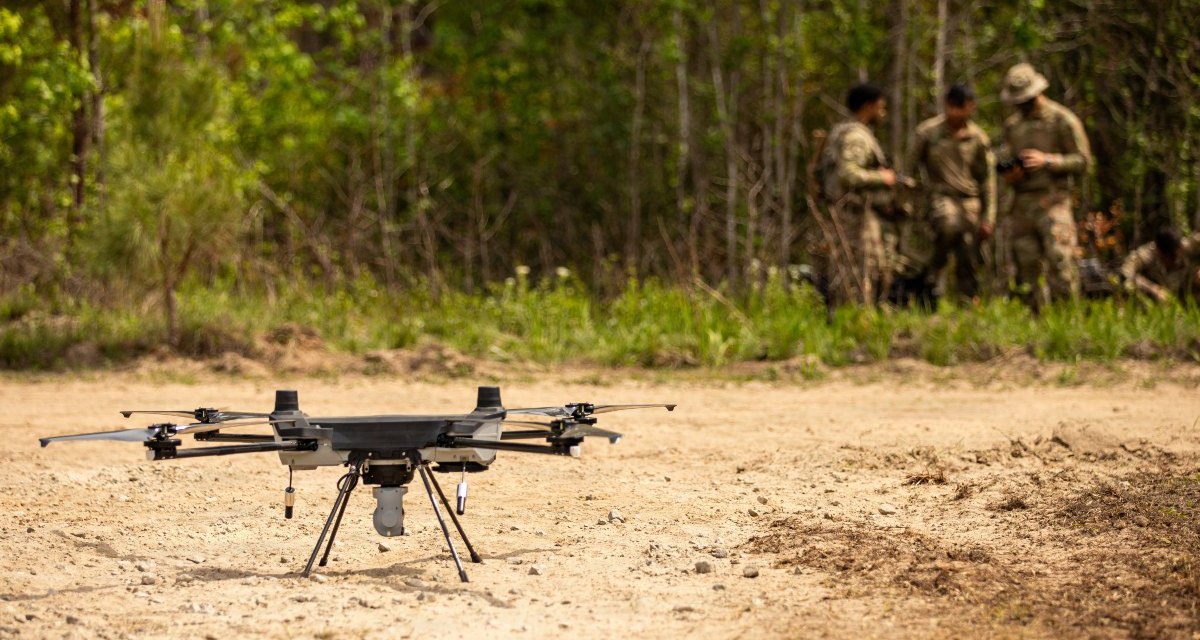
Since World War II, the US Army has built its combined arms approach around the complementary employment of armor, infantry, artillery, and engineers. That foundation remains sound. Yet contemporary conflicts demonstrate that land warfare now occurs under persistent observation, extended engagement ranges, and constant pressure from inexpensive unmanned systems and electronic warfare.
The Army should not discard its established operational framework in response. It should instead evolve combined arms by defining the relationships, roles, and interdependencies between manned formations and unmanned systems. Drones and sensors should not be treated as independent or specialized capabilities. They should be understood as integral elements of a combined arms network that enhances the force’s ability to move, strike, and protect.
A modern family of unmanned systems can extend the reach and effectiveness of traditional combined arms formations. At the battalion, brigade, and division levels, these systems can help commanders develop situational understanding, create temporary positions of relative advantage, and seize, retain, and control terrain. Their value lies not in replacing armor, infantry, or artillery, but in making those formations more survivable, responsive, and lethal across the intelligence, movement and maneuver, fires, protection, command and control, and sustainment warfighting functions.
What Is New Is Old—In Concept
The Army has repeatedly adapted its organizations and methods as technology changed the character of warfare. The current challenge is therefore not simply to acquire more drones. It is to determine how unmanned systems fit within the enduring logic of combined arms.
The modern battlefield is increasingly transparent. Small unmanned aircraft, ground sensors, commercial technologies, electronic warfare systems, and rapidly disseminated targeting information can expose formations that previously relied on distance, terrain, concealment, or tempo for protection. This operating environment places a premium on resilient command and control, distributed operations, deception, disciplined signature management, and the ability to make decisions before an adversary can exploit newly available information.
The key to doing so is integrating a new technology—aerial and ground drones—into an old concept of combined arms, thereby maximizing the advantages of both. That integrated combined arms system must be diverse in capability, sustainable at scale, and embedded with existing formations. Most importantly, it must reinforce—not displace—the shock, protection, and decisive effect that armored, infantry, and artillery formations provide.
An evolved framework should therefore account for a family of unmanned platforms and sensors that collectively improve how formations move, strike, and protect.
The Deadly Seven
One useful way to organize this discussion is through a proposed family of seven unmanned capabilities. Collectively, they form a construct that should not be understood as a doctrinal endpoint, but rather as a starting point for analyzing the complementary effects required across echelons.
1. First-Person-View Drones
First-person-view (FPV) drones provide formations with a relatively low-cost means of achieving precision effects at short range. When employed in sufficient numbers and integrated with reconnaissance, targeting, and maneuver, FPV drones can support attacks against priority targets and impose costs on enemy formations.
Their principal value is not as a stand-alone platform. FPV drones should be integrated into platoon-, company-, battalion-, and brigade-level operations as a responsive component of the fires and protection systems. They can help formations exploit fleeting opportunities, disrupt enemy movement, and extend the reach of small-unit leaders.
2. Intelligence, Surveillance, and Reconnaissance Drones
Intelligence, surveillance, and reconnaissance drones enable commanders to understand the operational environment, identify enemy activity, and maintain contact across extended distances. At the tactical level, they can improve route selection, support target development, confirm effects, and help commanders assess enemy dispositions.
These systems principally support movement by reducing uncertainty. Better observation enables formations to maneuver with greater purpose, avoid unnecessary exposure, and allocate combat power more effectively.
3. Bomber Drones
Bomber drones provide a means to deliver a larger volume of munitions with precision against select targets. A key distinction is that bomber drones are not plentiful and attributable, but rather, reusable and focus on higher-tier enemy targets. With volume and altitude as key capabilities, bomber drones can neutralize defensive positions in greater efficiencies than single FPV attacks.
When integrated with conventional fires and maneuver, they can disrupt enemy forces, suppress positions, and create opportunities for follow-on attacks.
Their value lies in complementing—not replacing—artillery, mortars, and direct-fire systems. Bomber drones offer commanders another option for shaping the fight, especially when responsive effects are needed against targets that may not justify or permit the employment of more traditional munitions.
4. Sensor Drones
Sensor drones expand the commander’s ability to detect and interpret battlefield conditions. They help identify emissions, electronic-warfare effects, acoustic signatures, thermal indicators, and other evidence of enemy activity.
Integrated with intelligence, surveillance, and reconnaissance systems, sensor drones can improve the commander’s understanding of both enemy capabilities and environmental conditions. This information supports more responsive movement, fires, protection, and command-and-control decisions.
5. Relay Drones
The employment of unmanned systems at scale depends on resilient communications. Relay drones can help establish or extend communications pathways when terrain, distance, enemy jamming, or dispersed operations degrade conventional networks.
These systems are the connective tissue of an evolved combined arms framework. They can help preserve the links among commanders, manned platforms, unmanned platforms, and supporting elements. By improving communications resilience, relay drones enable formations to maintain command and control and make decisions at the speed required by modern combat.
6. Resupply Drones
Resupply drones can reduce risk in the delivery of critical supplies to dispersed forces in contested environments. They are particularly relevant when traditional resupply methods face observation, direct fire, mines, or other threats that make routine sustainment operations hazardous.
They will not replace ground-based sustainment formations. However, they can provide a complementary option for delivering small quantities of essential supplies, including ammunition, medical matériel, batteries, and other time-sensitive items. Their primary contribution is to improve the survivability and responsiveness of sustainment under contact.
7. Deception Drones
Deception drones can compel an adversary to reveal capabilities, expend munitions, misallocate reconnaissance assets, or divert attention from the main effort. On a transparent battlefield, deception is increasingly necessary to preserve freedom of action.
These systems can support signature management and create uncertainty in the enemy’s targeting process. Their effect is indirect but important: They impose decision costs on the adversary and complicate its ability to identify units’ actual disposition and intentions.
Integrating the Family into Move, Strike, and Protect
The value of these systems lies in their aggregate effect. Intelligence, surveillance, reconnaissance, and sensor drones improve understanding and support movement. FPV and bomber drones contribute to strike by creating responsive, distributed effects. Relay, resupply, and deception drones improve protection by preserving command and control, sustaining dispersed formations, and complicating enemy targeting.
Together, these capabilities can improve the tempo and quality of tactical decision-making. They can help formations identify threats earlier, shorten sensor-to-shooter timelines, reduce unnecessary exposure, sustain forces under contact, and create more options for commanders.
This is the essence of evolved combined arms: not a collection of new platforms, but the deliberate arrangement of manned and unmanned capabilities to create complementary effects.
Proceed—But with Caution
The Army should pursue this evolution with discipline. First, it should avoid treating unmanned systems as exquisite solutions to every tactical problem. Brigade combat teams require drones that are affordable, producible at scale, maintainable, and replaceable in combat. A force built around a limited inventory of costly systems will struggle to sustain operations against an adversary with higher magazine depth of inexpensive drones.
Second, the Army must develop a parallel and integrated counter–unmanned aircraft system capability. As US formations improve their use of drones, adversaries will do the same. The ability to move, strike, and protect in a drone-saturated environment will depend on detecting, disrupting, deceiving, defeating, and recovering from enemy unmanned systems.
Third, the Army should assess this framework in a joint context. Army formations must be lethal, agile, and deployable in support of joint campaigns. An evolved combined arms approach should complement joint sensing, targeting, fires, sustainment, and command-and-control systems rather than become an isolated Army initiative.
Fourth, installations and training centers must adapt. Units need opportunities to train across extended distances, under persistent observation, with degraded communications, electronic warfare, nonstandard munitions, and realistic unmanned-system threats. Training infrastructure cannot remain static while the operational environment changes.
Finally, the Army should develop a coherent governing logic for industry, force design, doctrine, and training. The Combined Arms Center, Transformation and Training Command, Centers of Excellence, operational units, and industry should examine which unmanned capabilities belong at each echelon, how they are sustained, how they are integrated into formations, and how they contribute to combined arms effects.

The Army should not bind future thought to yesterday’s platforms or organizational assumptions. Nor should it abandon the enduring logic of combined arms in pursuit of technological novelty. The central task is to integrate unmanned systems into the established framework that has long enabled Army formations to create and exploit relative advantages in combat.
The Army must devote sustained intellectual and institutional effort to defining this emerging family of combined arms. It should resource formations with the unmanned capabilities necessary to move, strike, and protect at the speed and scale of twenty-first-century battlefields.
Combined arms has always been about the masterful arrangement of combat power. In the next fight, that arrangement must include an integrated, resilient, and scalable relationship between soldiers, manned platforms, and unmanned systems.
Colonel Bryan J. Bonnema is the commander of 1st Armored Brigade Combat Team, 3rd Infantry Division.
Lieutenant Colonel Moises Jimenez is the commander of 2-5 CAV, 1st Armored Brigade Combat Team, 1st Cavalry Division in May 2025.
The views expressed are those of the authors and do not reflect the official position of the United States Military Academy, Department of the Army, or Department of Defense.
Image credit: Sgt. 1st Class Rakeem Carter, US Army