The United States invests billions of dollars in advanced weapons. And yet it could still be unable to generate combat power at the rate a campaign requires—because of low-visibility frailties in the munitions industrial base.
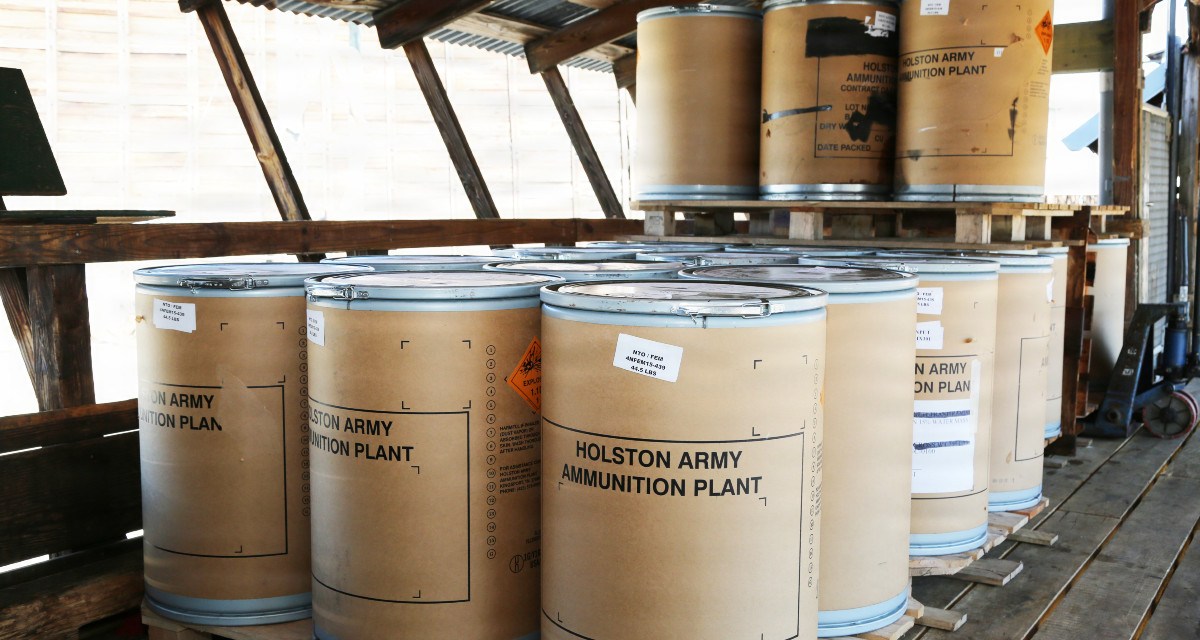
RDX is a useful example to view this left-of-boom supply chain issue. The explosive has been the standard filler for American ordnance since Werner Bachmann’s team at the University of Michigan cracked a faster synthesis route in 1941, and the Army went into mass production soon after at the Holston Ordnance Works in Kingsport, Tennessee. Eighty years later, the same site is still the only place in the country that makes it. Two active wars have drawn stockpiles down fast enough to put real strain on that single site.
America’s capacity to sustain munitions at wartime rates is a prelogistics issue.
RDX is denser, more energetic, and more chemically durable than TNT, but it is also more sensitive to shock and friction, which is why no service has ever loaded it into a shell by itself. RDX carries more energy per unit volume than TNT and detonates faster, close to 8,750 meters per second at full density compared with roughly 6,900 for TNT. RDX also holds up in long-term storage better than TNT does, which matters for a stockpile meant to sit safely in a magazine for thirty or forty years. Because it is more easily set off by impact or friction than TNT, Composition B cuts it with TNT to lower that sensitivity without losing much energy and C4 suspends it in a plasticizer and binder for the same reason.
Understanding the inputs behind RDX is essential for finding ways to better secure this supply chain. Hexamine, also sold as methenamine, comes out of ammonia and formaldehyde chemistry built mainly for camp stove fuel tablets and pharmaceuticals, so its market was never sized for a defense surge. Nitric acid runs through ammonia synthesis to natural gas and is also a core fertilizer input. Acetic anhydride is the hardest link in the chain, watched internationally because it is also a key precursor for heroin, so expanding its supply on short-notice runs into export controls. Basic chemical manufacturing behind all of these feedstocks, ammonia, methanol, and the broader nitrogen chain has also shifted toward China and the Gulf, where feedstock and construction costs are lower, and China alone now produces close to a third of the world’s ammonia.
Ammonia itself is a widely produced global commodity, with substantial output in the United States, India, Russia, the Middle East, and China, so that shift is not by itself a wartime choke point, and the United States does not source its hexamine or nitric acid from rival states. The reality is that the pool of ordinary industrial chemicals a wartime surge could draw on, inside the United States and among its treaty allies, has thinned over three decades. The tougher constraint, however, sits further down the chain, in the smaller set of chemicals genuinely concentrated in a handful of countries.
Commercial RDX production once existed at five civilian plants in the USA, with a combined national capacity of roughly 119 million pounds a year in 1980. By 2006 all of that had come down to one site, Holston, producing under seven million pounds. Congress tried to build a backup during the last Cold War surge, funding a new RDX line at the Louisiana Army Ammunition Plant near Shreveport in the late 1980s, but that plant wound down through the 1990s and never became a lasting second source. The Army has since studied expanding Holston itself, most recently through a proposed second production complex referred to internally as Plant X.
As of the late 1980s, Holston produced all of the RDX and HMX consumed in the United States and roughly 90 percent of what the country’s allies used. Since 2022 the Army has funded a nitration facility upgrade and other explosives capacity expansion work at the plant, and the stated Army goal is to more than double current RDX output by July 2028. Outside analysts doubt that timeline is realistic, since two of the missile programs driving demand, the Guided Multiple-Launch Rocket System and the Precision Strike Missile, are already competing for whatever capacity Holston can add.
An Army assessment completed in late 2025 named RDX Type II as one of three energetic compounds the country still cannot fully produce domestically. A surge in requirements between 2016 and 2020 outstripped Holston’s output and forced the service to qualify a second source it has not publicly named. In March 2026 the service announced a roughly $903 million “center of excellence” at Blue Grass Army Depot in Kentucky, meant to modernize explosives production methods that in places still date to the 1940s and to be operating before 2031.
The Ukraine war made clear how much of this industrial preparation has to happen years before a war begins. The Army set a goal in 2024 of raising 155-millimeter shell output from roughly fourteen thousand rounds a month to one hundred thousand by October 2025. As of March 2026, it was still producing only about thirty-six thousand a month, and the Pentagon’s inspector general placed much of the blame on a $469 million metal parts plant in Mesquite, Texas that had not shipped a single usable projectile body after two years. That one plant accounted for thirty thousand rounds of the monthly shortfall, and only one of the three other plants making 155-millimeter bodies, in Wilkes-Barre, Pennsylvania, was on pace to meet its own target. Part of the trouble at Mesquite was a manufacturing partnership with the Turkish contractor Repkon, since the joint program executive for armaments and ammunition has explained that “we just don’t make a lot of stuff in the US anymore” in the way of the specialized flow-forming equipment those plants need. General Dynamics is now investing $200 million of its own money to sever that Repkon partnership and rebuild the line.
The United States went without a dedicated domestic TNT producer for most of four decades. Production at Virginia’s Radford Army Ammunition Plant ceased in July 1986, and a small automated line there briefly resumed production in early 2005 before that capability again lapsed, leaving the country buying most of its TNT from allies for the rest of the period. Only now, with Repkon USA under contract to build a plant in Graham, Kentucky, is dedicated TNT production coming back onshore, but through a subsidiary of the same Turkish company the Army is trying to disentangle from Mesquite.
Europe entered the current wave of rearmament with a single major TNT producer left on the continent, down from seven such plants during the Cold War. Poland’s Nitro-Chem, in Bydgoszcz, now supplies the US military under a contract worth roughly $310 million as well as Germany, Britain, France, and Ukraine, and in March 2026 it agreed to build a second production line that would double its roughly ten-thousand-ton annual output over three to four years. France’s Eurenco, majority owned by the French state, with plants in France, Belgium, and Sweden, remains the continent’s largest overall maker of RDX and HMX.
Russia has taken the opposite approach, investing roughly $189 million in a new RDX line at the Sverdlov Plant’s Biysk Oleum facility in Siberia, sited more than 1,800 miles east of Moscow and beyond the reach of the Ukrainian drones that have hit other Russian arms plants, with an estimated capacity of six thousand metric tons a year, enough to fill more than a million 152-millimeter shells. Asia, led by China, produces more than half of the world’s acetic acid, the feedstock family behind acetic anhydride, and India is the other major legitimate producer of that chemical, operating its exports under an international licensing regime built to keep it out of illicit heroin production. In short, other countries’ chemical industries can now set the ceiling on how fast any country’s munitions base can move.
Congress has directed billions in Defense Production Act and supplemental funding into munitions capacity since 2022, and more is likely coming. RDX’s own chemistry has barely changed since 1941. What has changed, repeatedly and expensively, is the industrial base asked to turn that chemistry into ordnance at wartime scale, rapidly and under conditions the peacetime economy was never built to sustain. Sustaining combat power at the operational level depends less on how many munitions a service can afford to buy than on whether the country retains, or can quickly rebuild, the least scalable link anywhere in the chain that turns raw chemistry into ordnance. For RDX today that link runs through a single site in Tennessee and a handful of precursor chemicals whose markets were never built for war.
Morgan Bazilian is professor and director of the Payne Institute for Public Policy at the Colorado School of Mines. He was previously lead energy specialist at the World Bank. He has published over 230 papers in learned journals and was a Fulbright Fellow. He was a founding Borad member of the Atlantic Council’s Veterans Advanced Energy program.
Matt Isler is a retired Air Force brigadier general and fighter pilot who currently serves in the defense industry. Matt commanded an F-15 squadron and a training wing, and was a deputy commander for land forces in Iraq and a deputy commander for air forces in the Middle East.
The views expressed are those of the authors and do not reflect the official position of the United States Military Academy, Department of the Army, or Department of Defense.