For the first time in its history, the United States must plan to deter and potentially fight two nuclear peer adversaries simultaneously. Russia’s persistent nuclear modernization and China’s accelerating strategic buildup together create a complex and fraught environment that existing policy assumptions have not confronted. Into this environment arrives the B-21 Raider and its associated family of systems, platforms with potentially revolutionary conventional and nuclear capabilities that offer planners new tools for horizontal escalation, precision strikes across contested geographies, and the kind of flexible, survivable conventional dominance that previous bomber generations could not reliably provide. And yet the institutional logic governing how the United States employs its bomber force may prevent the B-21 from being used to its full potential. The nuclear reserve requirement, an ingrained assumption that a meaningful portion of the bomber force must be held back for nuclear contingencies during a peer conflict, risks kneecapping one of the most capable conventional instruments in the American arsenal. But a careful reading of escalation theory, principally the ideas put forth by Thomas Schelling and Robert Powell, suggests that fully committing the B-21 to the conventional fight need not reduce deterrence. In fact, it may strengthen it.
The B-21 and the Bomber Paradox
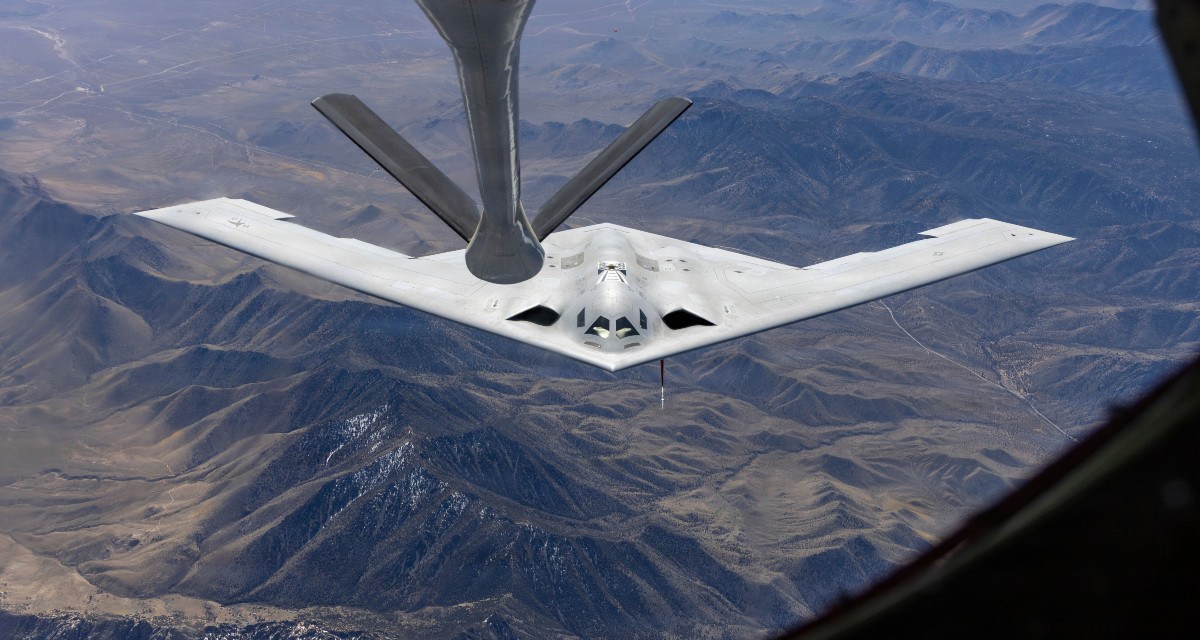
The B-21 Raider, paired with the F-47 and other current and future joint and coalition forces, is specifically suited to countering adversaries that field antiaccess and area-denial capabilities. As peer competitors invest heavily in layered air defenses designed to deny US forces freedom of action, the B-21 family offers lethal, persistent spectrum dominance in pursuit of air superiority, enabling joint forces to deny adversaries territorial gains and to retain the initiative. The ability to strike across contested geographies makes the B-21 family a new and potentially foundational instrument for escalation management.
US Strategic Command retains ultimate control of the nuclear-capable bomber force, and history suggests that this control is accompanied by a persistent reluctance to fully commit bombers to the conventional fight. During the Korean War, Strategic Air Command commander General Curtis LeMay resisted deploying B-29s to the theater, arguing that doing so whittled away the nuclear deterrent force. The pattern repeated itself in Vietnam, where Strategic Air Command retained operational control of all B-52s and only reluctantly subordinated a portion of them to theater commanders. These institutional impulses persist today, and in the event of a peer conflict, they risk yielding the opposite of their intended deterrent purpose. Just as importantly, the institutional effect of planning to withhold the B-21 has a myriad of implications for the credibility of extended deterrence, including in the exigencies short of a large-scale conflict that remain far more likely than conventional war between nuclear peers.
But the B-21 is not simply another bomber; it is designed to lead the combined air forces in the most contested environments imaginable. Withholding the B-21 from that role in the name of nuclear reserve does not merely reduce conventional striking power; it risks undesired escalation in a large-scale conflict. The bomber paradox is that withholding the B-21 to guard against nuclear escalation may produce the very outcome it was meant to prevent. The platform best suited to managing escalation and keeping a large-scale conflict below the nuclear threshold may be partially withheld from the conventional fight in the name of nuclear deterrence. If the conventional fight goes badly because the most capable tool was held back, the conditions for nuclear escalation become considerably more likely, not less.
The Assumed Need for Nuclear Reserves
The decision to hold bombers back as a nuclear reserve is rarely debated, as it is an ingrained assumption of force planning. This is, however, a misunderstanding of what constitutes deterrence, exacerbated by a failure to reckon with what a fully employed B-21 family of systems would mean to the outcome of a large-scale conventional fight. US Strategic Command’s purpose and motivation are not wrong in principle: Presenting the most lethal and credible nuclear fighting force is foundational to deterrence, and the bomber leg remains a fundamental part of that presentation. But the argument that B-21s must be held in nuclear reserve to satisfy that requirement does not survive scrutiny. While the B-21 is a critical part of the future triad, its significant nuclear capability is only a portion of the bomber leg and only a subset of the B-21’s vast capability. Since the B-21 can rapidly transition from conventional to nuclear missions, its demonstrated readiness is a major component of its credibility. Due to its dual-role nuclear/conventional nature, a fully and effectively utilized B-21 fleet is much more of a deterrent in combat than it is sitting on a ramp.
In terms of future triad redundancy, legacy bombers will still exist well into the B-21’s fielding and carry the new Long-Range Standoff weapon. F-35s certified to carry the B61-12 gravity bomb provide a theater nuclear option that is credible against regional adversaries, and the submarine force already carries the W76-2, a deployed low-yield warhead, on the Trident D5. The Navy is also developing a nuclear-armed sea-launched cruise missile, a low-yield option for Virginia-class submarines with an initial operational capability targeted for 2034. The Ground-Based Strategic Deterrent, when fielded, will modernize the intercontinental ballistic missile leg of the triad entirely. Taken together, the imminent future triad constitutes a flexible, tailored nuclear deterrent that provides options, increases credibility, and reduces the risk of escalation to nuclear use. The B-21 does not need to remain on the ramp to make that deterrent credible. If a conventional conflict starts, it needs to be in the fight.
The very structure of the triad means that releasing the B-21 for conventional use does not hollow out the nuclear deterrent; it both leverages and bolsters the flexible options that have been the foundation of US deterrence policy since 1973. Given the B-21’s potentially revolutionary conventional capability, a closer look at escalation theory is necessary to consider whether fully employing it in the conventional fight might itself constitute a more powerful deterrent than holding it in reserve on a ramp.
Theoretical Framework: Thomas Schelling and Robert Powell
A word is owed on the choice of theorists on whose work this analysis is based. Albert Wohlstetter’s work focused on survivability and second-strike stability, and Bernard Brodie’s on the political utility of nuclear weapons. Herman Kahn’s elaborately staged escalation ladder, while influential in defense planning circles, suggests a theoretical specificity for a complex and highly reciprocal escalation process that inherently cannot depend fully on predictability or even rationality: It is instead a tool for exploring the extremes of what adversaries may consider, and what capabilities may be able to deter those considerations. Alternatively, Robert Powell’s framework seeks to apply sequential modeling in a way that is directly applicable to the coupling of conventional and nuclear decision-making, and thus directly applicable to the specific argument advanced here. Thomas Schelling was among the first to bring game-theoretic thinking to nuclear bargaining and to provide the conceptual vocabulary deterrence practitioners routinely use. Powell extended that foundation with formal sequential modeling, allowing Schelling’s intuitions to be examined with greater rigor. For this argument, no other pairing addresses the problem of conventional-nuclear coupling as directly.
That said, Kahn’s underlying insight deserves acknowledgment, even where his taxonomy resists direct application. Kahn argued credible deterrence requires not merely the possession of nuclear weapons but a perceived capability and willingness to prosecute a nuclear war to its brutal conclusion, and to win it, or at least to ensure the other side could not. This is the mindset that informs how many senior planners and policymakers still think about the nuclear reserve requirement: If you cannot credibly threaten to fight and win a nuclear war, your deterrent loses its edge. The argument that follows does not dispute this. It argues instead that B-21s operating aggressively in the conventional domain demonstrate that willingness more effectively than when sitting on a ramp. Schelling and Powell help explain why.
Schelling’s Foundation
Schelling, in his 1966 work Arms and Influence, treats escalation as a legible, manipulable bargaining process. His core concept is “competition in risk-taking.” Leaders do not need to guarantee nuclear use; they need to make it sufficiently plausible to coerce. Brinkmanship is a tool, not an accident. Rational actors deliberately approach a threshold to coerce, and the concept that the situation might become uncontrollable makes the threat more genuine. The threat that leaves something to chance can, paradoxically, be more effective than a guaranteed one.
Underpinning all of this is Schelling’s foundational distinction between brute force and the ability to hurt. Brute force overcomes an adversary militarily; the ability to hurt generates coercive leverage. This is generally the logic on which traditional triad justifications rest: Survivability, redundancy, and second-strike assurance are all imperatives that flow directly from Schelling’s logic. The triad is, on this account, a structural guarantee that the ability to hurt is never fully negated. Therefore, any suggestion that leaders should reconsider the allocation of triad resources, as this article does, must account for whether such an adjustment would retain Schelling’s coercive elements.
Introducing Powell
In his works, 1990’s Nuclear Deterrence Theory and 1999’s In the Shadow of Power, Powell approaches escalation from a formal game-theoretic foundation, accepting the rational actor assumption but asking what rational actors actually do under conditions of nuclear crisis. His basic model is deceptively simple: Two states in a dispute face a sequence of decision nodes. At each stage, the state whose turn it is can either back down, without necessarily conceding the dispute, or escalate. Escalating carries an exogenous probability of nuclear war: a volatile chance that the confrontation slips into catastrophe regardless of either side’s intentions. That probability rises with each successive escalation step. Rational actors on both sides know this, and they weigh the expected utility of pressing forward against the growing risk of crossing the nuclear threshold, which has an upper-bound risk of mutual destruction. The result is a competition not only in military capability but in risk tolerance, in which side finds the next increment of danger more bearable than the cost of backing down.
Powell’s Key Payoffs
Applying Powell’s framework to the bomber problem yields two conclusions that run counter to the conventional wisdom driving the assumed need to reserve bombers. The first concerns the nature of nuclear escalation itself. Powell’s model makes explicit what some ingrained deterrence mentalities obscure: A rational adversary does not automatically enter the nuclear calculus simply because conventional conflict has intensified. There is a discrete and conscious decision point, what Powell treats as the crisis initiation threshold, at which a state must actively choose to begin weighing the expected utility of nuclear options. This decision is not mandated by the logic of conventional escalation. It must be made deliberately, with full awareness of the objectives and costs involved, by a leadership that has concluded the situation warrants it. Escalation to nuclear use is a choice, not a gradient correlated to conventional escalation, even if the emotions of a stressful conventional conflict will inevitably influence decision-making. The confluence of rationality and human complexities underscores why, perhaps, the most significant factor when determining escalation is not just the ability to hurt—although that is critical—but the proper signaling of objectives to preserve strategic deterrence despite conventional escalation that, while expected, is not entirely predictable.
This leads to the second payoff, which is even more consequential for this argument. Powell’s framework makes clear that what governs an adversary’s decision at each node is not the scale of conventional violence per se, but the perceived objective behind it. A conventional campaign clearly aimed at limited military goals, even one prosecuted with devastating effectiveness by B-21s operating freely, does not automatically trigger a nuclear calculus if the adversary does not, for instance, perceive the regime as threatened. Conversely, a campaign prosecuted timidly, one that stalls and prolongs a conflict because its best conventional tools were withheld, may produce exactly the perception of desperation that pushes an adversary toward the nuclear threshold. Self-deterring planners who hold B-21s in reserve against a nuclear contingency assume it is prudent when the reality is the opposite. They are paying a concrete conventional price to hedge against a risk that, in Powell’s terms, is governed less by the intensity of conventional operations than by what those operations are perceived to be trying to achieve.
A More Nuanced View on Deterrence and Warfighting
When examined through both Schelling’s ability to hurt and Powell’s sequential escalation model, the case for withholding B-21s from the conventional fight in the name of deterrence collapses. Schelling’s core requirement, that the ability to hurt remain credible and survivable, is amplified by the demonstrated capability and readiness of B-21s employed in a conventional conflict. Powell’s framework suggests that a rational adversary will still face the same grim expected-utility calculation at every decision node, regardless of whether B-21s are on nuclear alert or are prosecuting the conventional campaign, provided the conventional campaign is not perceived as threatening regime survival.
This leads to the article’s central affirmative claim: B-21s dominating the conventional fight are a more powerful deterrent than B-21s sitting on a ramp.
An adversary watching B-21s range freely across a contested theater, striking targets with precision and impunity, is watching a demonstration of exactly the capability that would be turned to nuclear purposes if the threshold were crossed. The platform’s conventional dominance is a de facto nuclear signal. It communicates, more viscerally than any declaratory policy, that the United States possesses and is willing to use instruments of overwhelming lethality. That is Kahn’s willingness requirement, Schelling’s ability to hurt, and Powell’s perception management, satisfied simultaneously by a single operational choice: to unleash the B-21.
B-21s reflexively held back by institutional habit are simply masquerading as deterrence logic. The same platform that dominates the conventional fight simultaneously remains on nuclear standby in a way that nearly assures it need not be recalled to a nuclear footing if circumstances demand it. This reality even adds a signaling option: The act of recall would itself constitute a powerful coercive signal of precisely the kind Schelling and Powell describe—a deliberate, visible movement toward the nuclear threshold that communicates resolve in ways an adversary could not dismiss.
Recommendations
The most immediate question this article raises is not declaratory but doctrinal. US Strategic Command should examine whether the nuclear reserve requirement for B-21s reflects a genuine deterrence necessity or an inherited planning assumption that has not kept pace with the changing force structure. The case for keeping B-21s off the conventional battlefield is considerably weaker than institutional habit suggests.
It might seem the cleanest solution to the bomber paradox would be a B-21 fleet large enough to overwhelm any conventional target set while simultaneously keeping a meaningful number on nuclear alert. That fleet would be expensive, and procurement debates will determine whether it is achievable. But the more fundamental point is that procurement alone does not resolve the problem. Even a larger B-21 fleet, if governed by the same planning assumptions that currently restrict bomber employment, will reproduce the paradox at a greater scale. The doctrinal question must be answered first. And that question is made more urgent by a genuine two-peer nuclear environment. The United States faces simultaneous conventional and nuclear deterrence requirements against both Russia and China, with a bomber fleet a fraction of the size it operated in Vietnam. In that environment, the institutional habit of treating the most capable conventional platform as a nuclear reserve is not a conservative choice. It is a strategic liability.
Air Commodore Hannah Jude-Smith, AM, is a graduate of the Australian Command and Staff College’s Art of War Program, and has a master of military and defence studies from the Australian National University, and a master of arts (international relations) from Deakin University. She has led tactical, operational and strategic teams, including on operations, and commanded the Australian Air Force intelligence squadron. Air Commodore Jude-Smith is currently a senior leader in Australia’s National Intelligence Community.
Lieutenant Colonel Shane “Axl” Praiswater, US Air Force, PhD, is a graduate of the Office of the Secretary of Defense’s Strategic Thinkers Program at the School of Advanced International Studies, Johns Hopkins University, and earned his doctorate through Pepperdine University. He is currently a B-21 initial cadre command pilot with over two thousand hours in multiple platforms, including during Operation Inherent Resolve, where he led mission planning for all bomber sorties and flew combat missions. His most recent peer-reviewed publications can be found in the Royal United Services Institute Journal, the Journal for Deradicalization, and the Palgrave Encyclopedia of Leadership and Change.
Lieutenant Colonel Brian “Bud” Leitzke, US Air Force, is an F-15E evaluator pilot and commander of the 333rd Fighter Squadron. He taught at the US Air Force Weapons School and has over 2,600 flight hours, including more than 600 combat hours in Operations Enduring Freedom, Inherent Resolve, and Poseidon Archer. He is a graduate of the Strategic Thinker’s Program at the School of Advanced International Studies, Johns Hopkins University, and earned his doctorate in defense and strategic studies from Missouri State University.
The views expressed are those of the authors and do not reflect the official position of the United States Military Academy, Department of the Army, or Department of Defense, or that of any organization the authors are affiliated with, including the Department of the Air Force and the Royal Australian Air Force.
Image credit: Todd Schannuth, US Air Force (image altered for security)