
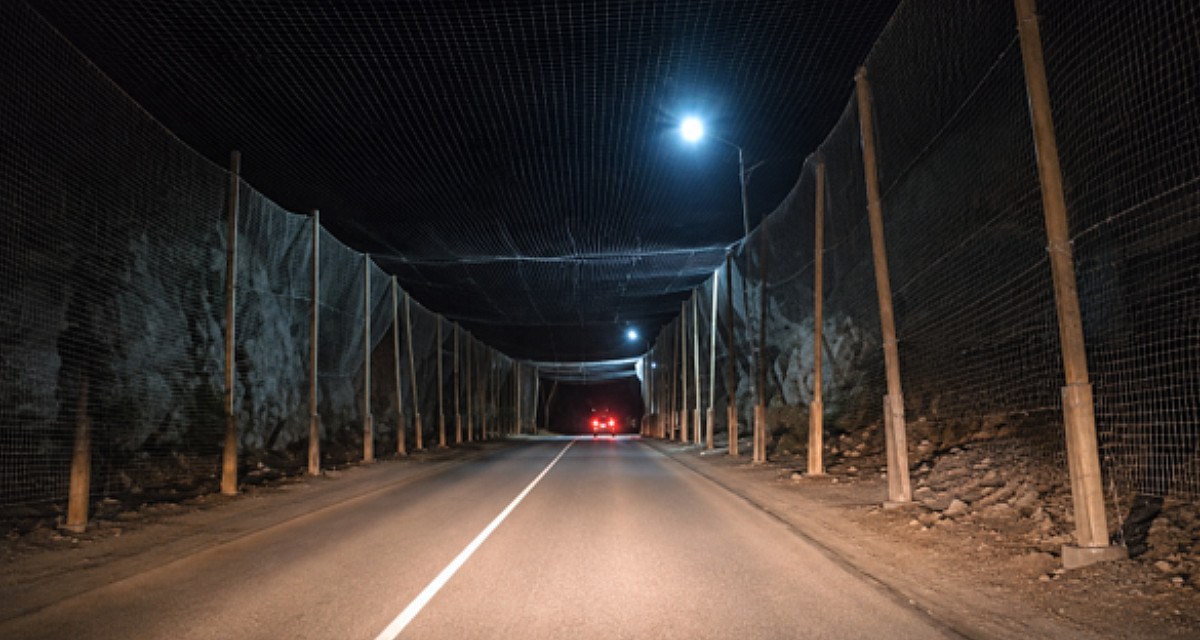
Several months ago, during an assignment at Security Assistance Group–Ukraine, I was traveling with a US embassy security team, en route to meet senior Ukrainian leaders. Near the city of Izium in eastern Ukraine, our convoy drove under netting that covered long stretches of road: wooden poles, improvised frames, and mesh stretched above the road and down the sides. Those structures showed what a modern battlefield does to movement once cheap drones become persistent and lethal. UNITED24 Media later reported similar netting throughout Izium, with roads covered for kilometers to protect vehicles from first-person-view drones.
The lesson for the US Army is not that nets solve the drone problem. They do not. The lesson is that active C-UAS (counter–unmanned aircraft systems) measures cannot carry the entire survivability burden. Guns, missiles, electronic warfare, lasers, and interceptor drones matter, but they will not be everywhere, at every echelon, all the time. Passive defense—netting, hardening, overhead cover, concealment, deception, dispersion, and disciplined displacement—has to become normal.
That pivot toward low-tech solutions may sound like a step backward. It is not. Passive defense does not mean a return to the static character of trench warfare and is not a substitute for maneuver. It is a practical response to a battlefield where detection is constant, precision attack is cheap, and exposed units can be found and struck in minutes.
Ukraine Is a Snapshot, Not a Script
The lessons of Ukraine should not be drawn from a single phase of the war as if it were a frozen case study. Rather, the war offers a moving snapshot of adaptation under pressure. Russia has improved, but slowly and at extreme cost. Ukraine has also adapted, and the result is a battlefield where both sides constantly test detection, protection, deception, and strike in near real time.
The most important point is not that passive defenses help a force hide indefinitely. They do not. The point is that passive defense allows forces to endure, regenerate, move, refuel, reload, and keep fighting. In a drone-saturated fight, passive defense is no longer merely a hedge against precision strike. It is a daily requirement for surviving persistent small-unit observation and attack.
Ukraine’s antidrone netting campaign makes that visible. Business Insider reported that Ukraine has installed 822 kilometers of antidrone protection along frontline roads in 2026, using wooden or metal frames and mesh to create tunnel-like defenses. The point is not elegance. The point is buying time, reducing exposure, and complicating the attacker’s approach.
Active Defeat Is Necessary, but Insufficient
The Army is right to invest in active defeat. Drones must be detected, tracked, identified, disrupted, and, when necessary, destroyed. But the economics of the fight are brutal. A cheap drone does not have to destroy a formation to matter. It only has to find it, fix it, force it to displace, or compel it to burn scarce interceptors and attention.
The cost curve favors the attacker. The Associated Press reported that Ukrainian low-cost interceptor drones can cost roughly $1,000 to $2,000, a dramatic improvement over firing multimillion-dollar air defense missiles at relatively cheap one-way attack drones. That helps the defender, but it does not erase the larger problem: Even low-cost interceptors require trained crews, sensors, integration, ammunition depth, and the right geometry at the right time.
Meanwhile, the attacker keeps adapting. Reuters reported that Russian fiber-optic first-person-view drones have struck Ukrainian electrical substations by bypassing electronic warfare defenses and attacking through physical protection measures. In one reported pattern, one drone damaged protective netting and another exploited the breach. That is the warning. Nets are not magic, and neither is electronic warfare. The answer is layered defense, not faith in a single layer.
FARPs Are the Test Case
Forward arming and refueling points, or FARPs, are among the clearest places where the Army must rethink passive defense. A FARP concentrates fuel, ammunition, aircraft, ground crews, vehicles, radios, generators, heat, noise, movement, and predictable patterns. That is not merely a sustainment node. In a drone-saturated environment, it is an attractive target package.
Publicly released combat footage has already shown what happens when rotary-wing aircraft are found on the ground. Army Recognition republished Russian Ministry of Defense footage from March 2024 showing Ukrainian Mi-8 helicopters at a landing area near Novopavlivka being struck after detection. Euromaidan Press reported that Ukrainian drones later hit Russian Mi-28 and Mi-17 helicopters at a forward field airstrip in Voronezh Oblast during refueling and inspection more than 150 kilometers from the front. Different sides, same lesson: Aircraft on the ground are vulnerable when their refueling, rearming, maintenance, and movement patterns become visible.
The traditional static FARP is therefore a bad default in a modern drone fight. That does not mean aviation stops refueling forward. It means forward refueling has to become harder to find, harder to target, harder to exploit, and faster to move. FARPs need overhead concealment and fragmentation protection where time allows, rapid teardown drills, deceptive site layouts, decoy signatures, preplanned alternate points, and a habit of moving before the enemy’s sensor-to-shooter loop closes.
The Budget Problem Is Real
Part of the challenge is cultural. The Army likes systems that look like programs: sensors, launchers, radars, vehicles, software, and named capabilities that fit neatly into requirements documents. Passive defense is less glamorous. It looks like mesh, poles, anchors, Hesco barriers, dirt, timber, concrete, thermal blankets, camouflage, decoys, repair kits, and a tired soldier with zip ties. That is exactly why it is easy to underfund.
The POM (program objective memorandum) cycle is the Army’s formal process for building future budget requests. It is not designed to move cheap, ugly survivability measures quickly across the force. A unit can often identify a passive defense need faster than the institution can validate, fund, procure, distribute, and train it. That mismatch matters. If passive C-UAS protection remains a local improvisation project, some units will adapt and others will be caught in the open.
The answer is not to turn netting into a billion-dollar acquisition program. The answer is to make passive C-UAS survivability a standing requirement with simple standards, modular kits, training support, and command emphasis. It should be boring, repeatable, and inspected.
Build Passive Defense into the Force
So, what should the Army do now to improve its passive defense capabilities?
First, the Army should treat passive C-UAS as part of force protection and survivability, not as an engineering afterthought. Command posts, logistics nodes, ammunition transfer points, motor pools, casualty collection points, and FARPs should be planned under the assumption that small drones will observe them. Site selection should account for overhead exposure, thermal signature, movement patterns, repairability, deception, and displacement timelines.
Second, the Army should build passive defense packages that can be issued, moved, repaired, and employed by units. A useful kit does not need to be elegant. It needs netting, poles, anchors, repair material, camouflage, thermal masking, decoy material, simple emplacement guidance, and a way to move it quickly. Units should rehearse building and tearing down these systems under realistic time pressure, not wait to discover the process during combat.
Third, passive defense has to be trained against real drones. Units should test whether their camouflage works from above, whether their movement patterns are obvious, whether a drone can follow a route into a site, and whether decoys draw attention away from what matters. A unit that has never watched itself from a drone feed does not understand its own signature.
Fourth, active and passive defenses must be planned together. Nets can channel drones into better detection zones. Deception can buy time for interceptors. Hardening can reduce damage when defeat fails. Displacement can deny the enemy a second strike. Passive defense should not compete with active C-UAS. It should make active C-UAS more effective and less brittle.
Make Survival Normal Again
The Army does not need to relearn passive defense because technology failed. It needs to relearn passive defense because technology has made exposure more lethal.
The Army should keep buying guns, sensors, electronic warfare systems, interceptors, and directed-energy weapons. It should also buy more nets, more hardening, more decoys, more repair material, and more training time. That is not less modern. It is what modern survival looks like.
Ukraine’s experience does not provide a perfect script for the US Army. It does provide a warning. Passive defense is not defeatism. It is the foundation that lets forces endure, regenerate, move, and keep fighting when the sky is full of cheap eyes and cheap explosives. The Army should not wait for war to make that lesson expensive.
Chief Warrant Officer 3 James L. Andreasen is an AH-64E Apache instructor pilot and aviation mission survivability officer at Fort Rucker, Alabama, where he serves as an instructor in the Air Cavalry Leaders Course. Following a six-month assignment with Security Assistance Group–Ukraine, he continues to contribute to the development of the UAS Advanced Lethality Course and supports Army aviation modernization efforts focused on unmanned systems integration.
The views expressed are those of the author and do not reflect the official position of the United States Military Academy, Department of the Army, or Department of Defense.
Image credit: James L. Andreasen