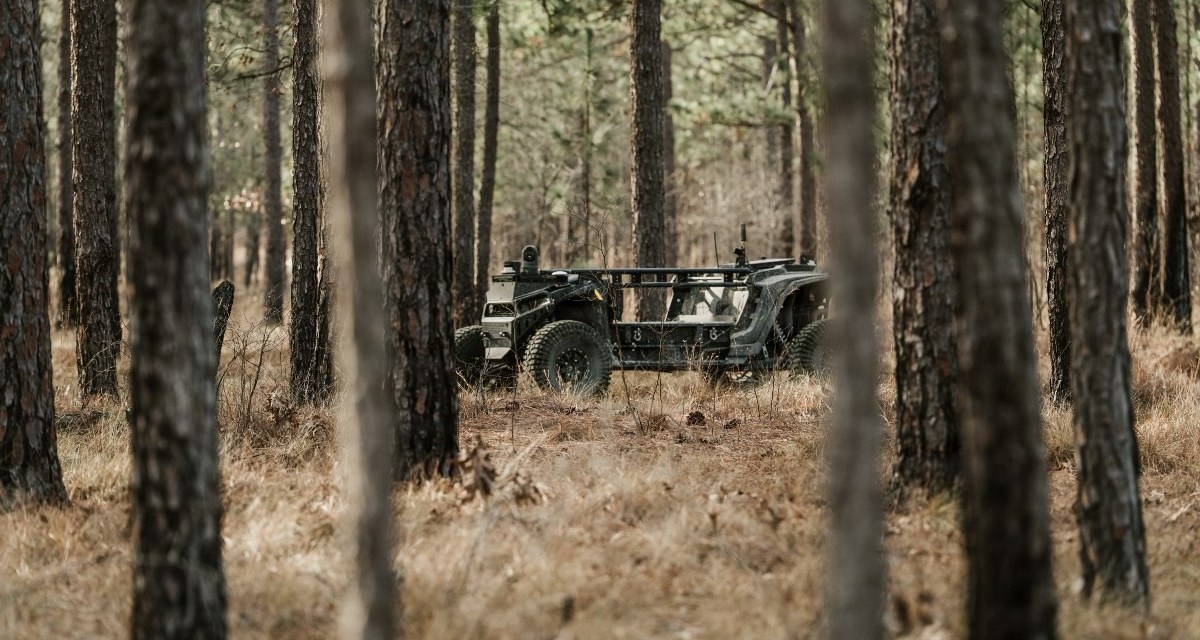
Earlier this year, deep in an expansive training area, soldiers loaded an autonomous ground vehicle, entered a grid, and watched it depart on its own. No one stood behind it with a controller. No one drove it like a toy. It simply took a basic task that normally consumes soldiers’ time and attention and executed it autonomously. That was the moment the capability became real. For leaders who had heard about ground autonomy in briefings or seen it discussed in abstract terms, this was different. It was not just an interesting machine or another promising technology. It was a practical tool accomplishing a practical task in the field.
That moment during Panther Avalanche—a large-scale live-fire training event—matters because the Army often gravitates first to the most visible or dramatic uses of new technology. Autonomous ground vehicles can support reconnaissance, weapons integration, breaching, and other combat applications. But the more important lesson from 3rd Brigade, 82nd Airborne Division’s training cycle and Joint Readiness Training Center rotation was that these systems can also take on the routine, unglamorous tasks that consume manpower, strain formations, and expose soldiers to risk. In that context, sustainment was not the only mission that mattered. It was the mission that most clearly demonstrated immediate operational value.
3rd Brigade, 82nd Airborne Division showed that repeated use in support of team sustainment offers clear operational utility: faster distribution, reduced exposure of soldiers, reduced driver burden, and a smaller-footprint option for moving critical supplies in the kinds of environments where traditional sustainment platforms can be more vulnerable or less practical.
Just as importantly, repeated use began to build trust. That trust did not come from a single demonstration or a polished briefing. It came from soldiers and leaders watching the systems perform simple tasks reliably enough that they began to treat them less as a novelty and more as a useful tool. That lesson extends beyond one brigade and beyond one formation type. It matters to the Army sustainment enterprise, to mobile brigade combat teams, and to other tactical formations including artillery, engineer, and armored units that must move supplies under pressure while preserving combat power. The broader implication is straightforward: The Army should stop treating autonomous ground vehicles as an interesting future concept and start treating them as a real sustainment capability that can be employed now, improved through use, and integrated across formations over time.
In 3rd Brigade, 82nd Airborne Division, the practical value of these systems came into focus not because they replaced every existing platform or solved every sustainment problem, but because they performed basic transport tasks well enough to matter. They reduced distribution time, eased the burden on soldiers, and created a smaller-footprint option for moving sustainment forward. Those gains are not glamorous, but they compound over time in combat formations by preserving manpower and giving leaders more freedom to focus on the fight.
That logic extends beyond airborne formations. Brigade support battalions, logistics support battalions, artillery units, engineer formations, armored units, and other tactical organizations all face versions of the same problem: how to move supplies under pressure without wasting combat power on predictable, recurring tasks.
The case for employing autonomous ground vehicles in sustainment rests on measurable operational effect. In 3rd Brigade, 82nd Airborne Division, one of the clearest indicators came when repeated use of the ULTRA, an autonomous ground vehicle developed by Overland AI, for team sustainment reduced distribution time on the drop zone by 52 percent. In another case, bundle recovery timelines were reduced from twenty-four hours to eight hours. Across the rotation, the systems executed more than fifty autonomous runs, including several missions that exceeded nine kilometers.
The operational value also became clear in moments of real friction. During the rotation, an autonomous ground vehicle conducted a contested eight-kilometer resupply mission to a sniper team that had gone thirty-six hours without food. One platform was even used as a decoy to reduce risk during the mission. That episode showed that the value of these systems is not limited to making routine distribution more efficient. They can also extend sustainment under pressure, in conditions where sending soldiers forward is harder, riskier, or less practical.
The broader lesson is that autonomous ground vehicles do not need to replace every legacy platform to matter. They only need to take enough of the right tasks off soldiers and leaders to create meaningful gains in speed, flexibility, and exposure reduction. In 3rd Brigade, 82nd Airborne Division, they did exactly that.
If sustainment was the clearest immediate use case, trust was the condition that made broader adoption possible. New technology does not become part of a formation’s thinking because of a briefing slide or a single demonstration. It becomes useful when soldiers and leaders see it perform reliably enough that they begin to factor it into real decisions. During Panther Avalanche, trust was built through repetition.
That process mattered because adoption depended on more than senior leader interest. Soldiers learned how to task and operate the systems quickly enough that the capability was not confined to a handful of specialists. Exposure created buy-in. As more soldiers and leaders saw the systems work in practice, demand for their use increased across the formation. That is one of the clearest indicators that a capability is moving from novelty to utility. For the Army, that may be the most important adoption lesson of all: Confidence in autonomous ground vehicles will not come primarily from concepts or forecasts, but from repeated use that gives soldiers and leaders reasons to trust the capability enough to employ it.
The next step for the Army is not simply to keep experimenting with autonomous ground vehicles at the margins. It is to begin scaling the sustainment use case in ways that allow units to feel the real operational effect. A handful of systems can prove a concept, generate interest, and build trust. But small numbers can also limit how much a formation can learn. Four autonomous ground vehicles were enough to demonstrate value. They were not enough to reveal what happens when a brigade begins to employ them as part of a broader sustainment scheme rather than as a promising add-on.
That distinction matters because the effect of autonomous ground vehicles is unlikely to be linear. A brigade with four systems can assign a few tasks, reduce some burden, and identify practical use cases. A brigade with twenty begins to change the dynamics of sustainment itself. At that scale, leaders can distribute the systems across echelons, build them into recurring logistics workflows, support multiple units at once, and experiment with different task organizations. Brigade support battalions and logistics support battalions could employ them for routine distribution. Maneuver battalions could use them for team sustainment and lower-signature resupply. Other formations, including artillery, engineer, and armored units, could begin adapting them to their own recurring sustainment demands. The point is not that one number is universally correct. It is that scaling matters because it determines whether the Army is truly evaluating a capability or merely sampling it.
The Army sustainment enterprise, therefore, should treat autonomous ground vehicles less as a niche technology and more as an emerging tool for preserving manpower, reducing exposure, and extending operational reach. That means moving beyond one-off demonstrations and toward larger-scale fielding with operational units that can stress the systems, adapt tactics and procedures, and identify where the substitution is most valuable. The question is no longer whether these systems can contribute to sustainment. 3rd Brigade, 82nd Airborne Division already showed that they can. The question now is how quickly the Army is willing to scale the capability and learn from real unit employment.
To be clear, Panther Avalanche did not reveal everything the Army needs to know about autonomous ground vehicles in sustainment. Important questions remain about payload, scale, transportability, substitution ratios with legacy platforms, and how well these systems perform in heavily wooded, muddy, or deeply rutted terrain. Those are real constraints, and skeptics are right to raise them. But they are no longer reasons to wait. They are reasons to employ the capability now, at greater scale, and learn from real use in the units that would actually depend on it.
Right now, the Army still tends to treat autonomous ground vehicles as an experiment outside normal formations rather than as a capability that could reshape how brigades distribute sustainment capacity. That is a doctrine and organization problem as much as a materiel one. If the Army wants to understand the real value of these systems, it should begin embedding them habitually within brigade support battalions and logistics support battalions, then expand outward as units learn. The immediate benefit would not simply be ownership on a table of organization. It would be better day-to-day integration into routine distribution workflows and a more realistic basis for understanding what brigade-scale employment actually requires. The Army is unlikely to discover the right quantity, task organization, or echelon of employment through small pilots alone. It will learn those things through repeated unit employment, where leaders can see what changes when autonomous ground vehicles are part of normal sustainment operations rather than a side experiment.
The same is true of training, maintenance, and support. If the service is serious about integrating autonomous ground vehicles, it will need to decide who operates these systems, who trains them, and whether operation becomes a collateral duty inside existing formations or a more formalized skill set. It will also need to address maintenance and sustainment of the systems themselves. A brigade support battalion can incorporate a new capability more easily than it can absorb unclear responsibilities for software troubleshooting, field maintenance, and recovery when a system breaks down forward. Those are not arguments against wider fielding. They are the kinds of DOTMLPF-P questions that only become answerable through sustained unit employment rather than isolated demonstrations.
Autonomous ground vehicles will not replace every truck, trailer, or manned platform, and commanders should not pretend they will. Units will need to learn where these systems are most effective, where their limitations are most acute, and how to mitigate those limitations through task organization, route selection, load planning, and scale. But the Army is unlikely to answer those questions by keeping the systems at the margins. It will answer them by putting more of them into formations, forcing the institution to adapt, and letting tactical units refine the concept through use.
For the Army, the next step should be clear: Employ autonomous ground vehicles immediately for sustainment, beginning with brigade support battalions and logistics support battalions, while expanding use across tactical formations that face recurring distribution and resupply demands. Sustainment is the clearest immediate entry point, but the implications will not remain confined to sustainment. As trust, scale, and familiarity grow, these systems will also influence how formations think about protection, mobility, mission command, and other warfighting functions that depend on preserving manpower and creating more options for commanders. If the Army continues to treat them as novelties or keeps them confined to small-scale experiments, it will delay a capability that has already shown practical value. If it scales them in real units and lets soldiers work with them on practical sustainment problems, it will not only improve logistics. It will preserve manpower, reduce exposure, and give commanders more options in the kinds of contested environments the Army expects to fight in next.
Marc Dibernardo has served for more than twenty-three years in the Army and is currently the command sergeant major of 82nd Brigade Support Battalion, 3rd Brigade Combat Team, 82nd Airborne Division.
Dave Rowland is a retired US Army colonel who served in and deployed with airborne, Ranger, and Stryker units. He last served as commander of the 3d US Infantry Regiment (“The Old Guard”). He is the author of Green Light, Go! The Story of an Army Start Up.
The views expressed are those of the authors and do not reflect the official position of the United States Military Academy, Department of the Army, or Department of Defense.
Image credit: Spc. Nicole Miller, US Army