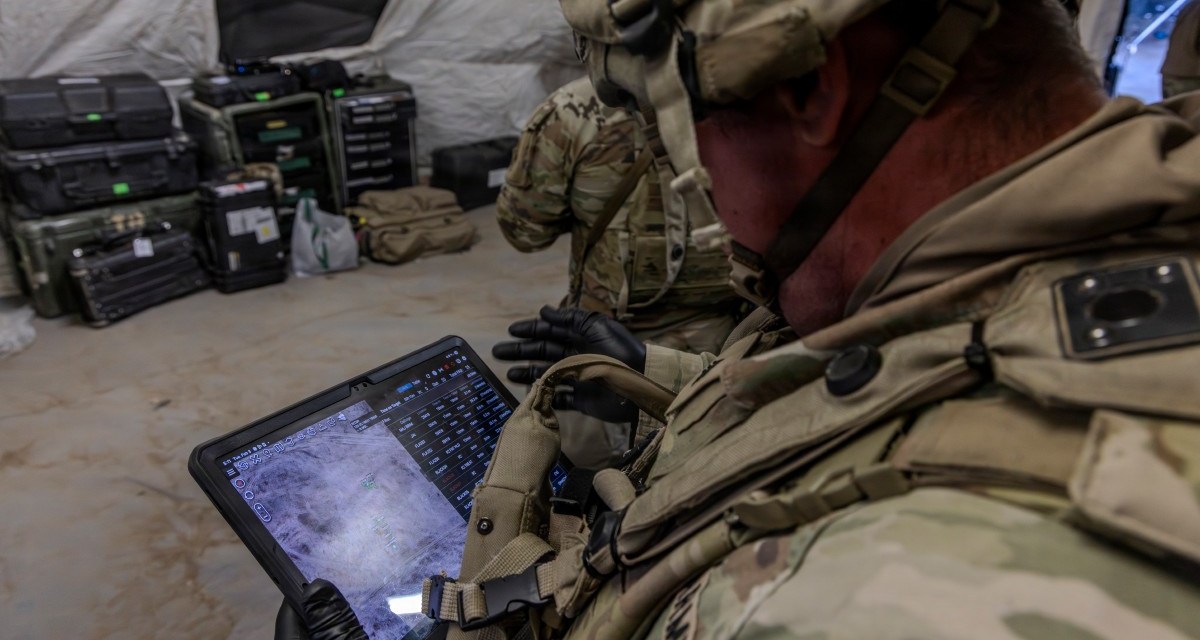
The feed is clean. The target is confirmed. The pattern of life matches. There is no disagreement between sensors. No competing reports. No ambiguity left in the picture.
The element on the ground is set. Authority has already been pushed forward and the decision belongs to the leader holding it.
Higher is watching in real time, and the operations center is tracking the same feed. Messages begin to stack. Confirm. Clarify. Stand by. Another voice joins. Then another. None of them change the situation. All of them change the moment.
The window starts to close.
The leader is not waiting for information. He is waiting to see if anyone stops him.
He waits too long.
Across the Department of Defense, the pursuit of decision advantage has become the defining modernization effort of the decade. Through initiatives like joint all-domain command and control, AI-enabled data filtering, and refined commander’s critical information requirements, the logic is straightforward: Reduce uncertainty, present a clear operational picture, and decision speed should increase.
The premise is sound. Lift the fog of war, and action should follow. But on the modern battlefield, that equation begins to break down. Even when intelligence is clear, targets are confirmed, and the window for action is open, hesitation persists.
The transparent battlefield creates a problem of excess. We did not eliminate the fog of war. We digitized it. More information compressed the decision space and created internal conflict, ultimately risking cognitive fratricide. But that risk also carries a corollary along with it—a different, separate problem that flows from the same battlefield conditions. What happens when the fog lifts, the picture is clear, and hesitation still remains?
We have engineered clarity. We have not accounted for what clarity does to the person being watched. Clarity solves the information problem. It exposes a behavioral one.
We are not just increasing clarity. We are increasing visibility. And in doing so, we introduce a tradeoff we rarely acknowledge. The more we see, the harder it becomes to act.
The Ecosystem of Hesitation
This is not entirely new. Senior leaders have always observed and intervened. Aides on horseback ferried information across battlefields. Reports were delivered by telegraph, then radio, then email. But these reports were fragmented, leaving commanders to manage incomplete and competing information. Moreover, they were delivered sequentially and locally.
What has changed is the scale, persistence, and simultaneity of observation across every echelon at once, and the predictable behavioral consequences that follow. What was once episodic is now continuous. What was once delayed is now immediate.
The commander on horseback received information after it had already been filtered by time and distance. Reports arrived incomplete, delayed, and often too late to shape the decision itself.
Today, observation arrives in real time and without separation. Modern commanders receive information as the decision is being made—and so does everyone above them.
This is the environment of the observed leader.
At the tactical edge, the shift is subtle but real. Leaders stop acting directly on intent and begin seeking confirmation before acting. This pattern reflects a shift from execution to alignment. Subordinates do not pause because the situation is unclear. They pause to ensure their action matches what they believe higher headquarters expects to see.
Observation is not passive. It is an active force shaping the decisions it is meant to inform.
A squad leader receives the task. The situation is clear. The route is known. The authority is already delegated. There is no new information to wait for.
He pauses anyway.
He keys the radio. Requests confirmation. Waits for a response that does not change the plan.
Higher responds. Execute.
He moves.
Nothing about the decision changed. Only the time it took to make it.
At higher echelons, the instinct to intervene is not a breakdown of discipline. It is a rational response to visibility. When a developing situation appears incomplete or imperfect, the pressure to act is immediate. The system creates an expectation that if something can be seen, it can be corrected, shifting the commander’s role from underwriting risk to managing it in real time.
The tactical operations center amplifies this dynamic. Staff elements, operating with high levels of information but removed from physical risk, do not simply relay information. They shape tempo. Requests for updates, clarification, and confirmation introduce constant background pressure. Attention divides between execution and explanation. The leader on the ground is forced to fight two fights at once: the problem and the audience watching it.
Underlying all of this is the evaluation environment. Doctrine emphasizes initiative and prudent risk, but the system rewards visible compliance. As Leonard Wong and Stephen Gerras have noted, institutional dynamics reinforce that reality. The transparent battlefield did not create it. It made it immediate. Decisions are no longer judged after the fact. They are judged as they happen.
In a fully visible environment, decisions are shaped not only by what is effective but also by what can be explained. Over time, this pattern does more than slow decisions. It changes the leader.
Leaders who operate under persistent observation begin to adjust not just what they do, but how they see their role. Decisions are no longer something they own. They are something they manage in view of others. Waiting becomes safe. Acting becomes exposed.
Leaders do not lose authority. They stop experiencing it.
The behavior is not irrational: Under persistent observation, a leader is not managing one risk but two—the tactical risk of the decision itself and the reputational risk of how that decision will be seen. In previous environments, those risks were separated by time. The decision came first. The evaluation came later. Now they happen at once.
A leader who tries to fully manage both in the same moment often ends up managing neither.
And while trying to manage both, the window closes.
The Cost of Latency
This internal friction does not occur in isolation—it unfolds in direct competition with an adversary. While US forces invest in systems designed to increase clarity and precision, adversaries prioritize speed and tempo. They do not require a perfect understanding to act. They require opportunity.
This creates a critical asymmetry. While one force refines the picture, the other exploits time. When a decision is deferred for confirmation, when a leader pauses instead of acting, time is transferred to the adversary. That time cannot be recovered.
Adversaries that understand this dynamic do not need to disrupt systems—they can exploit behavior. Visibility itself becomes a lever. Generate activity that draws attention. Create situations that invite observation. The more visible the moment, the more pressure is exerted on the decision-maker within it.
The result is not confusion. It is delay.
Tempo is not lost all at once. It is lost in small moments. A message answered instead of a decision made, confirmation requested instead of an action taken. A pause that seems insignificant in isolation but compounds across the fight.
Our adversaries do not need us to misunderstand the battlefield. They only need us to be late.
This hesitation is not just a training problem. It is an acquisition problem. The modernization efforts driving joint all-domain command and control and AI-enabled command systems are built on a simple premise: Better information produces faster decisions. That premise is not wrong, but it is incomplete.
Billions of dollars invested in clarity cannot recover the seconds lost to a leader waiting to see if anyone stops him. The behavioral problem driving that hesitation was never part of the system design and cannot be solved by refining the feed.
This is not an argument against modernization. It is an argument that modernization, as currently designed, does not account for the full problem.
Reclaiming Tempo
Mission Command depends on disciplined initiative—the assumption that leaders will act within their commanders’ intent without waiting for permission. Persistent observation complicates that assumption. When every decision is visible as it unfolds, the conditions that enable disciplined initiative begin to erode.
The 2026 National Defense Strategy identifies warrior ethos as a strategic priority. The warrior ethos demands decisive action in the face of uncertainty. The observed battlefield is producing something different: careful action under scrutiny. Those are not the same behavior. If we are serious about the warrior ethos as a strategic requirement, we must be equally serious about the conditions that make it possible.
If hesitation is shaped by how leaders behave under observation, it will not be solved through better information alone. Filtering data is necessary, but it is not sufficient. Clarity does not remove pressure. It concentrates it. Commander’s critical information requirements and disciplined information flow remain essential, but they do not address how leaders behave when decisions are being observed as they are made.
Commanders must deliberately control their presence in real-time feeds. The ability to see does not require intervention. During training and operations, leaders should establish periods when subordinate elements operate without continuous observation, then assess the impact on tempo and initiative. Observation, when left unmanaged, becomes intervention by default.
Staff must function as a buffer, not a conduit for constant interruption. Once intent is issued and execution begins, requests for updates or clarification should be disciplined and deliberate. Every message carries weight. Every interruption divides attention. Preserving cognitive bandwidth is not a courtesy. It is a requirement for decision speed.
Finally, expectations must be made explicit before execution begins. Intent describes what matters, but it does not always define who must decide. Leaders must clearly state which decisions are expected to be made without seeking confirmation. Knowing one is allowed to decide is not the same as knowing one is expected to decide.
Tempo is not recovered through better information. It is preserved through disciplined observation, controlled communication, and leaders who act within intent without waiting to be seen doing it.
Reclaiming Decision Advantage
For decades, the US military has worked to reduce uncertainty on the battlefield. Advances in sensing, communication, and data processing have brought that objective within reach. Leaders now operate with levels of clarity that were previously unattainable. But improved clarity has not eliminated hesitation. In many cases, it has intensified the conditions that produce it.
The modern battlefield does not simply present information. It exposes decisions. Leaders are no longer operating in a state of partial uncertainty. They are operating under persistent observation, where actions are visible as they unfold and evaluated in real time.
The pursuit of decision advantage assumes that better information will lead to faster action. That assumption is incomplete. Information shapes understanding. Behavior is shaped by context, pressure, and perceived consequences.
We can refine systems. We can filter data. But we cannot ignore the conditions under which decisions are made. The challenge is no longer just understanding the battlefield. It is building leaders who can act inside it.
Clarity is not the endpoint. It is the environment. And in that environment, speed will belong to the force that can act decisively while being seen.
Sergeant 1st Class Jerae Perez is the station commander of the Bessemer Army Recruiting Station and serves as a 42T talent acquisition specialist in US Army Recruiting Command. He has over fourteen years of service focused on leadership development and the human side of talent acquisition. Sgt. 1st Class Perez holds a master of science in human resources and organizational development from the University of Louisville and is pursuing a doctor of education in leadership and learning in organizations at Vanderbilt University.
The views expressed are those of the author and do not reflect the official position of the United States Military Academy, Department of the Army, or Department of Defense.
Image credit: Staff Sgt. Dane Howard, US Army