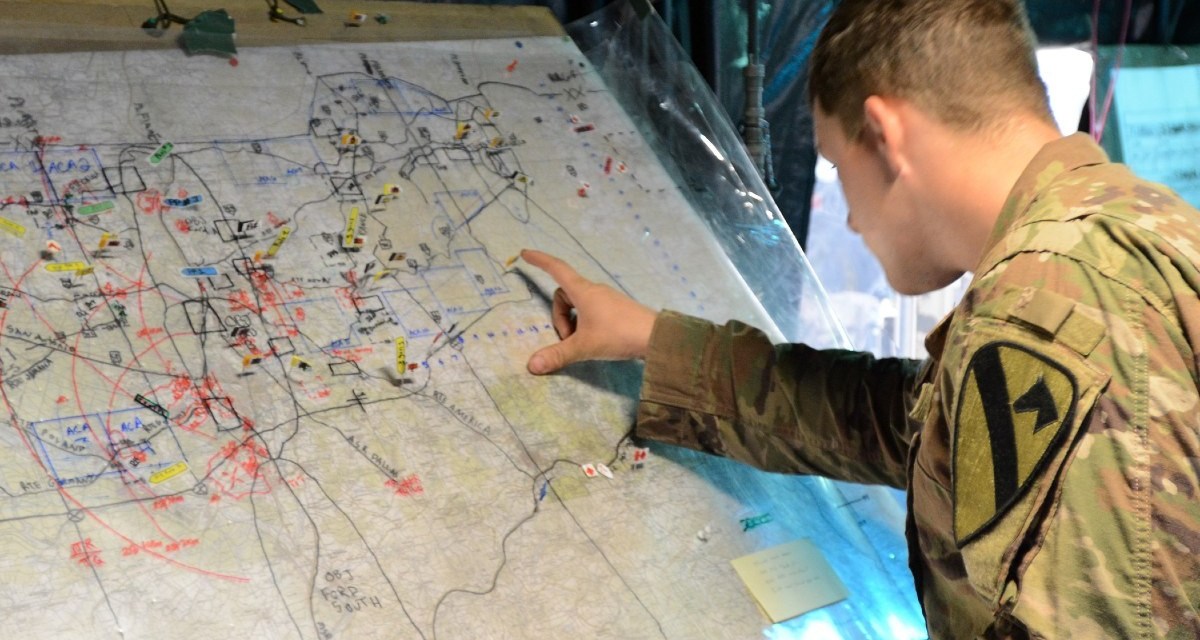
A division main command post sits dispersed across a wide support area. A division support battalion prepares to move. An engineer asset shifts to support a different brigade. A signal package moves with it. A sustainment node displaces. A release point changes. A route now carries a different mix of tracked vehicles, fuelers, wreckers, cargo trucks, air defense platforms, and command-post vehicles. A commander can move those icons on a screen in seconds. But the division must move the force on roads, through checkpoints, across support areas, and into assembly areas in the right sequence and with enough control to arrive ready for the next phase of the operation.
In large-scale combat operations against a near-peer adversary, one of the hardest command problems unfolds before the first major battle. Divisions and corps must take forces dispersed for survival and sequence, move, control, and assemble them into formations that can fight on a campaign timeline and under enemy threat. That work places an extraordinary planning burden on headquarters because the force does not move as a single body. It moves through support areas, command posts, checkpoints, release points, roads, and assembly areas that must remain synchronized closely enough to preserve tempo and coherence before the fight begins. The painful work of uncoiling a division, and of setting the conditions for that uncoiling at corps, is a campaign problem whose failure can leave the force late, fragmented, and degraded before the main battle starts.
The Campaign Begins Before the First Battle
The Army has been training many of the pieces of this problem. Warfighter exercises train corps and division staffs in command and control during large-scale combat operations. Combat training center rotations expose brigades and supporting units to tactical movement under pressure. But there is a clear gap between those pieces and the full operational problem. As Dr. Stewart Bentley recently noted, warfighter exercise timelines often include no deployment process and combat training center after-action reviews focus on warfighting functions after units cross the line of departure. The Army is practicing the fight that follows movement far more rigorously than the act of assembling the force for that fight.
That gap deserves command attention because the timeline is unforgiving. Bentley’s article describes a 2023 staffing exercise in which an Army National Guard division estimated it would need forty-seven to fifty days from mobilization day to ready-load date, plus another fourteen to twenty-one days for transshipment to theater, and that estimate assumed an uncontested homeland environment. Those figures sit at the strategic and operational level of movement, but they illuminate a larger truth. Large formations do not appear ready for battle on demand. They require time, sequencing, lift, control measures, and repeated coordination long before the first major engagement.
The Center for Army Lessons Learned handbook on mission command in the division and corps support area says corps and division commanders lack the doctrine, manning, and equipment to operate three dispersed command posts and leverage mission command across support and consolidation areas. The handbook states that recent corps and division warfighter exercises rediscovered the need for a support area command post and found doctrine out of line with that requirement. It also states that the support area command post must plan and execute movement control, terrain management, area security, and sustainment across all phases of the operation. That is command and control under dispersion, transition, and threat.
The same handbook gets more pointed when it addresses movement. It says movement control is a critical part of the division’s responsibility, that division transportation staffs often are not executing the doctrinal movement-control tasks needed to manage movement and maneuver across the division’s operational area, and that the division transportation officer should provide at least a seventy-two-hour movement matrix with the start point, release point, number of vehicles, personnel, cargo type, and routes. That matrix then informs route security, clearance, and traffic control point placement. A headquarters that must build and update that matrix while moving command posts, shifting enablers, protecting support areas, and preparing for the next phase of the campaign is solving a command problem at scale.
The challenge grows larger at the division level because the division is where campaign design begins to collide with physical execution. Brigades, artillery, engineer assets, air defense systems, intelligence nodes, signal packages, sustainment formations, medical assets, recovery teams, and command posts all compete for road space, movement windows, and protection. A division support battalion cannot simply roll forward whenever convenient. Its movement changes fuel distribution, maintenance coverage, recovery capacity, casualty evacuation patterns, and the division’s ability to restore combat power during the move. A brigade can reach its tactical assembly area and still begin the operation weaker than planned because a fuel node, communications package, or maintenance slice arrived late or landed in the wrong sequence.
Corps carry the same problem at greater scale and operational depth. Corps do not simply supervise divisions. Rather, they allocate and move enabling formations, set priorities across time and distance, and help create the conditions that let divisions assemble into the campaign. Engineer brigades, military police brigades, sustainment formations, air defense assets, and other capabilities all consume road space, command attention, and protection capacity while also enabling the fight. When corps shift those formations, reprioritize routes, or change support relationships, it changes the burden divisions must absorb during movement and assembly.
The problem also changes form across theaters. One corps may have to assemble combat power across long distances, fragmented basing, multiple ports and airfields, and contested logistics nodes. Another may have to compress combat power rapidly through multinational road and rail networks toward a more contiguous land fight. The geometry differs but the command burden remains. Corps headquarters must still account for enabling brigades, control movement across depth, and preserve enough coherence for divisions to arrive formed and ready to fight.
Plans assume rates of movement, predictable round trips, and reliable communications. Movement produces friction: Vehicles break, convoys miss time hacks, or a choke point slows the route. A command post displaces at the same time a critical enabler tries to pass through the support area. A movement board decision made in the morning no longer fits conditions in the afternoon. The Army’s historical record from Desert Storm still shows how quickly this problem expands beyond routine staff work.
During the movement of XVIII Airborne Corps to its offensive position, the 330th Transportation Battalion’s history of Operations Desert Shield and Desert Storm records that planners calculated the corps needed 550 heavy equipment transporters, 1,580 lowboy trailers, 2,698 tractor-trailer combinations, and more than 500 buses to complete the move in fourteen days. The movement control center then had to manage passage through VII Corps’s area, assign block times to separate corps traffic, and build movement tables so one package cleared a critical intersection before the next arrived. Even then, round-trip times stretched well past the assumptions built into the plan.
A 2023 Army publication presenting Mission Command Training Program key observations reinforces the same point from current training. They note confusion over rear command post and maneuver enhancement brigade roles and responsibilities in doctrine, describe the challenge of managing security and key routes across a vast corps or division support area, and recommend rear command post standard operating procedures that define manning, duties, and fires processes. The associated Center for Army Lessons Learned support area handbook also records that maneuver enhancement brigade staffs can become quickly overwhelmed and that divisions must lead the planning effort for movement control, fires support, protection, air coordination, and key enablers in the support area. Those are signs of an institution still learning how to command this problem in practice.
Some might say that Army officers have planned marches, displacements, convoys, tactical road movements, reception, staging, onward movement, and integration for decades. Movement control has doctrine. Support areas have doctrine. Staffs practice large-scale combat operations during warfighter exercises and at combat training centers. A skeptical reader can say that uncoiling a division is hard, but armies have always handled hard movement problems. Calling this a special crisis may overstate the issue.
That argument carries some weight. The Army does have doctrinal tools, historical experience, and training venues. The problem sits in scale, theater conditions, force design, and enemy pressure. Doctrine, manning, and command post design have not fully caught up to the support area command problem at the corps and division levels. Warfighter exercise timelines still omit the deployment process. Combat training center after-action reviews focus on combat functions after the line of departure. The issue is not ignorance of movement; rather, the issue is whether current headquarters can sequence, control, and assemble large formations under modern conditions with enough coherence to begin the campaign in command of the force they built.
Four Steps to Address the Problem
So what can commanders and staffs do now? First, commanders should treat uncoiling the division as a warfighting event. The division should rehearse the transition from dispersed survivability to formed combat power with the same seriousness it gives the fight that follows. Staffs must produce the movement matrix, update it under pressure, and manage route changes, command post moves, and enabler shifts while the operation evolves.
Second, commanders should force movement control, support area control, protection, and command post design into one planning effort early. The Center for Army Lessons Learned support area handbook shows that divisions often need a support area command post, that recent exercises rediscovered the requirement, and that divisions must lead planning for movement control, protection, fires support, and key enablers in the support area. A division staff cannot solve those issues on separate timelines and expect coherence during execution.
Third, corps and divisions should rehearse the movement of support structures as part of combat formation. Division support battalions, engineer formations, military police formations, sustainment brigades, and other enablers should not appear in exercises as static background infrastructure. They shape the campaign because they shape the force’s ability to assemble, recover, and keep moving.
Fourth, senior leaders should ask a blunt question at every major exercise. How long did it take the headquarters to form the force that the concept required, and what combat power degraded during that transition? A division that reaches the line of departure late, congested, underprotected, or internally fragmented has already paid for poor command before the first battle starts.
The Army trains hard for the visible violence of fighting. Senior commanders should worry just as much about the painful work that comes before it. In large-scale combat operations against a near-peer enemy, a division will not start the campaign as a clean symbol on a map. It will start as a sprawling formation trying to compress time, space, and control into a fighting instrument. The headquarters that can do that fastest and with the least self-inflicted friction will begin the campaign with an advantage. The headquarters that cannot may find the campaign slipping before the first battle even begins.
Michael Carvelli is a US Army lieutenant colonel and engineer officer who writes from an operational planning, protection, and engineering perspective. He serves as an assistant division operations officer in First Army.
The views expressed are those of the author and do not reflect the official position of the United States Military Academy, Department of the Army, or Department of Defense.
Image credit: Sgt. 1st Class Craig Norton, US Army