The US military has an aluminum problem. It arises not from the metal’s rarity, but its presence everywhere. Common materials create the most dangerous chokepoints because they are required in immense volumes across multiple sectors at once. The economic and military importance of aluminum is due to the unique combination of scale, conductivity, and light weight. It makes airframes lighter, armored systems more mobile, and electrical grids more deployable. When supply is stable, aluminum is just industrial background noise. When disrupted—by a conflict that chokes availability, for example—the fragility of the aluminum supply chain is exposed.
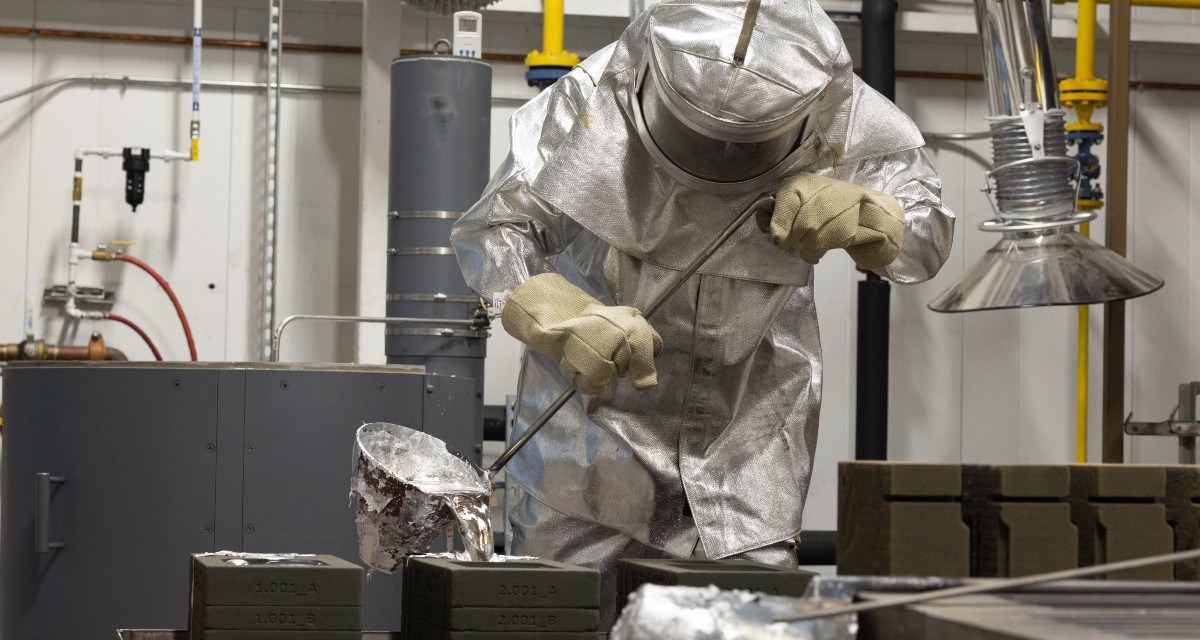
And yet aluminum is largely overlooked as a critical defense mineral, even though militaries are utterly dependent on a steady supply of it. It is a foundational material for aircraft, armored vehicles, naval systems, and munitions components. More broadly, it underpins the electrical infrastructure and industrial base that makes them all possible. This is why the Pentagon began directly investing in a domestic supplier that provided aluminum castings in 2024, acknowledging that these castings are essential for flight-critical structural components, rocket systems, and lightweight armor.
A 2025 US Geological Survey report revealed the scale of the vulnerability: a domestic smelter capacity of just 1.36 million tons, primary production of only 670,000 tons, and a net import reliance of 47 percent. That liability is now being exposed by the Iranian closure of the Strait of Hormuz, interrupting aluminum exports from a region the United States depends on for 22 percent of its imports.
This is why aluminum’s strategic role must be considered as a pillar of defense readiness. The strategic implications were made clear in a Department of Commerce Section 232 investigation in 2017, which identified aluminum as essential to US national security and concluded that maintaining domestic production capacity is a strategic imperative. And yet, the vulnerability has only deepened since then.
This aluminum vulnerability requires military planners and strategists to make the paradigm shift to prelogistics: assessing the upstream risk to the industrial ecosystem of smelters, refineries, and chemical plants. Failure begins with inputs consumed by energy-intensive facilities and transported through maritime chokepoints. The defense industrial base cannot respond to operational demand—or money thrown at it by policymakers—because it is constrained by the timelines of industrial physics.
The Hormuz Effect: Choking the Tradable Pool
The market’s reaction to the Iran war to date has been a relatively muted 10 percent surge in aluminum prices, which can look like a manageable problem. Gulf producers account for 9 percent of global aluminum output, but the true metric of strategic risk is not total world production; it is the far smaller, physically deliverable, and politically accessible pool of metal available to buyers on the margin. It is this tradable pool that is now being choked.
The newfound geopolitical shock reveals how much stability rested on a narrow band of accessible supply. Iranian strikes have damaged Emirates Global Aluminium in the UAE and Aluminium Bahrain, the region’s two biggest producers, pushing prices on the London Metal Exchange (LME) to $3,492 per metric ton, approaching a four-year high. The attack occurred as Aluminium Bahrain had already shut lines representing 19 percent of capacity, and inventories in LME-approved warehouses had fallen by about 60 percent since May to just 418,675 tons.
The Gulf’s disproportionate importance is less about its production volume, and more about its role as an export platform. The region exports around 75 percent of its output. For reference, Europe and the United States imported 1.2 million and 3.4 million tons respectively from the region last year. The Gulf’s role in the tradable, non-Chinese pool of supply is making aluminum an unexpected center of gravity.
China dominates global production at 60 percent, but consumes—and stockpiles—most of its own metal. Simultaneously, Western buyers have spent years reducing their exposure to Russian supply. This leaves a dangerously small pool of politically and commercially acceptable aluminum. So in effect, the closure of Hormuz threatens about a quarter of the non-Chinese aluminum supply.
This is why the Western position is so precarious. The United States and Europe both depend on imports for over half of their aluminum, with more than 20 percent of those imports coming from the Middle East. Europe’s aluminum crisis is made even worse by its own smelting base having been crippled by high energy prices.
More than five million metric tons of aluminum move through the Strait of Hormuz annually. When a market with low inventories and concentrated export hubs loses confidence in its access to the marginal ton, prices do not drift upward. They jump. And the upward pressure is not over; it will have longer-term risk implications for the market, like all the other commodities affected by the war.
From Aluminum to Prelogistics
The Pentagon does not abstractly buy interchangeable aluminum; it depends on a qualified supply chain of castings, rolled products, and specialty alloys. Soda companies can lightweight a can or a builder can delay a project. A defense manufacturer cannot improvise when it needs certified material for a mission-critical system. This is why the Pentagon’s 2024 investment in Constellium Muscle Shoals was a telling admission of the importance of achieving resilience for a critical metal needed for all of the US military.
For military planners and strategists, a mastery of contested logistics is irrelevant if the industrial base has already exhausted its limited stockpiles. When the tradable pool contracts, defense manufacturers cannot bid for metal on the same timeline as commercial buyers, because their material must be certified, qualified, and traceable through every step of processing. There will be nothing to load onto ships and planes in the American homeland. Smelting capacity, electricity costs, and import dependence are the prelogistics reality; they are core components of warfighting readiness.
Policymakers must also differentiate between primary smelting, recycling, and specialty processing. It is in this industrial middle, the cast houses and rolling mills, that strategic fragility often hides.
Aluminum lacks the policy allure of rare earths and semiconductors, which makes it easy to underestimate. But ubiquity is precisely what makes it a dangerous chokepoint.
The Iran shock is more than a commodity market event. It is a strategic warning. America’s arsenal depends on metal, electricity, processing capacity, and long lead times. That is not a problem solved by a logistician after a war has started. It is a prelogistics problem.
Morgan D. Bazilian is the director of the Payne Institute for Public Policy and professor at the Colorado School of Mines, with over thirty years of experience in global energy policy and investment. A former World Bank lead energy specialist and senior diplomat at the UN, he has held roles in the Irish government and advisory positions with the World Economic Forum and the International Energy Agency. A Fulbright fellow, he has published widely on energy security and international affairs.
Lt. Col. Jahara “Franky” Matisek (PhD) is a US Air Force command pilot, nonresident research fellow at the US Naval War College, and senior fellow at the Payne Institute for Public Policy, and a visiting scholar at Northwestern University. He is the most published active duty officer currently serving, with over 150 articles on industrial base issues, strategy, and warfare.
Macdonald Amoah is an independent researcher with interests across critical mineral supply chains, advanced manufacturing gaps, the industrial base, and geopolitical risks in the mining sector.
The views expressed are those of the authors and do not reflect the official position of the United States Military Academy, Department of the Army, or Department of Defense.
Image credit: Paul Shirk, US Defense Logistics Agency