The United States Army’s shift away from the counterinsurgency focus that dominated the early twenty-first century toward preparing for large-scale combat operations has been going on for nearly a decade. Discussion about that shift is dominated by a focus on technology and adoption of innovations, and it is already forcing a reimagination of a wide range of activities—from intelligence to communications to sustainment. But what about command of ground forces?
All four of us have served during a period that spans the Army’s transition from low-intensity conflict and stability operations to preparing for tomorrow’s major war. Our experiences, like those of a generation of officers, highlight fundamental differences in what is required to succeed as a ground force commander as conditions change. But they also highlight deep-seated, permanent truths. In effect, the character of command changes, but its underlying nature remains the same.
The Fundamental Responsibilities of Ground Force Command
To understand the enduring nature of the ground force commander’s role, we must first define it. The role combines two elements. First, being a commander vests a leader with the legal authority to execute mission orders in pursuit of a defined military objective. In all operations, the objective takes primacy, and the commander is the single authority responsible for its achievement. Second, commanding a ground force ties this authority to the tactical realities of land warfare. It anchors the commander to three specific and fundamental responsibilities required to succeed on the battlefield.
The first of these responsibilities is making timely decisions. The methods, tools, and cognitive frameworks ground force commanders employ must adapt to the new, modern, and technologically infused large-scale combat operations (LSCO) environment. In our experience during the post-9/11 wars in Iraq and Afghanistan, decision-making often occurred in a relatively permissive environment characterized by robust intelligence, surveillance, and reconnaissance assets. Ground force commanders frequently enjoyed the luxury of gathering extensive intelligence about a target over a long period before meticulously planning operations where a priority was given to minimizing collateral damage. The F3EAD (find, fix, finish, exploit, analyze, and disseminate) model was well suited for dismantling insurgent networks. In LSCO, the decision-making framework is radically different. The unblinking eye of persistent intelligence, surveillance, and reconnaissance is no longer guaranteed against peer adversaries who can contest all domains, creating a far more chaotic and destructive battlefield.
Consequently, LSCO will compel ground force commanders to make decisions faster, with less information, and under greater pressure. The linear and often centralized command structures of counterinsurgency must give way to more agile and decentralized approaches. Where ground force commanders in Afghanistan might have enjoyed hours or even days to approve a strike, their LSCO counterparts may only have minutes. Emphasis will shift from a zero-collateral-damage mindset to one of acceptable destruction, where the principle of proportionality is applied in a much more dynamic and uncertain context. The ground force commander must be comfortable making heavy decisions weighing risk to force and risk to mission to seize fleeting opportunities for tactical success.
The second core responsibility is setting conditions for success by synchronizing all available assets. This responsibility must also evolve. In the population-centric conflicts of yesterday, this involved a wide range of activities. In tomorrow’s large-scale combat, setting conditions is a far more focused and lethal endeavor. It revolves around synchronizing the effects of all warfighting functions to create and exploit windows of opportunity, almost certainly without air superiority. The ground force commander of the future must inherently think in terms of multidomain operations, orchestrating a symphony of lethal and nonlethal effects to achieve a decisive tactical advantage. The focus will shift toward dispersion, deception, and signature management. The ground force commander must understand how to leverage new tools, capabilities, and organizational structures to impose multiple dilemmas on the enemy.
Finally, the ground force commander is ultimately responsible for managing risk to both the force and the mission. In our past experiences, political sensitivity and the desire to avoid civilian casualties often led commanders to seek near certainty before acting. LSCO, by contrast, is an inherently high-risk endeavor where a thicker fog of war will envelop every action and encumber every decision. The ground force commander must be a master of calculations regarding risk to force versus risk to mission, often with little time for deliberation. In the Army’s counterinsurgency operations, strict rules of engagement restricted the use of force but also acted as a guide for leader decision-making. In LSCO, commanders will instead require a deep understanding of the law of armed conflict and commander’s intent to make decisions under stress.
The Same, But Different
Physical positioning, control, rehearsals, decisiveness, poise, and operational understanding—these are all fundamentals of effective command honed by our generation of officers in post-9/11 counterinsurgencies. They remain relevant in LSCO, but their application has changed. In fact, their importance is magnified by the speed, scale, and lethality of the future battlefield. If we take these in turn, we can see how.
A commander’s physical position on the battlefield is a constant balancing act. The ground force commander must be close enough to the action to maintain situational awareness and lead subordinate elements, yet not so close as to be decisively engaged. Positioning must facilitate communication with higher headquarters and supporting assets. This principle, which we learned through routine raids and close-quarters combat, becomes even more critical in LSCO. With the threat of advanced sensors and fires from long ranges, a commander’s physical and electromagnetic signature becomes a primary vulnerability. The ground force commander of the future must master not only a physical location but also a digital one, balancing the need to know with the need to survive.
To command effectively, one must be comfortable with at times relinquishing a significant degree of control. The speed with which decisions must be made increases proportionally with the speed of combat actions, all of which elevates the importance of true mission command. Effective commanders empower subordinates, managing their own bandwidth by using a few key touchpoints. A model regularly applied in the special operations community we serve in, for example, involved using a partner force commander to maneuver host nation troops, a senior noncommissioned officer to direct an assault force, and a joint terminal attack controller to control air assets. In LSCO, where communications will be contested and degraded, this decentralized approach moves from a best practice to necessity. Trust in subordinate leaders to execute according to the clear intent of the commander will be the very foundation of ground force maneuver when units are distributed and often isolated.
Next is the primacy of rehearsals and rigorous training. As the saying goes, in times of crisis soldiers do not rise to the level of their expectations but rather fall to the level of their training. Rehearsals make routine yet essential tasks automatic, freeing a commander’s cognitive capacity to focus on novel, complex problems. Repetition in training prevents mental overload in combat by minimizing the tunnel vision that chaos and stress create. In LSCO, the sheer complexity of synchronizing effects across multiple domains will instantly overwhelm an untrained unit and commander. Muscle memory built through repetitive, realistic training will be a critical factor in a unit’s ability to function under the immense pressure of peer conflict. Thus, a successful ground force commander is built well before the first shots are fired.
Command also requires decisiveness while simultaneously permitting the situation to further develop. Commanders often must make the best possible choice with the incomplete information available in a particular moment, as hesitation can be fatal. This fact does not contradict the need to take deliberate action to force an enemy reaction and generate clarity. The two concepts are complementary. Herein lies the art of command, which can only be gained through experience. In LSCO, windows of opportunity will be more fleeting and the stakes of each decision higher. Being decisive might mean risking more assets to develop the situation than was common in our past experiences, but the potential reward for seizing a momentary advantage may justify that risk.
Additionally, poise and composure are critical. Ground force commanders are an archway keystone, holding the entirety of battlefield chaos from collapsing onto their units. It is paramount that the commander remains poised and steady. Composure is a fountain of strength and confidence that reverberates across a formation. The scale of destruction and potential for mass casualties in LSCO will test future ground force commanders’ composure in ways unimaginable today. Maintaining external calm while processing immense stress and continuing to make sound decisions will be a core leadership task at the most decisive points of battle.
Finally, ground force commanders must fully understand their assigned missions and their superior commanders’ intent. This objective requires continuous interaction and clarification before operations commence. In a LSCO environment with degraded communications, that initial, deep understanding of the mission’s ultimate goal may be all a commander has to guide decisions and actions for extended periods. It is this understanding that allows the commander to make sound decisions about risk, cost, and opportunity, ensuring every action advances the mission.

As we prepare in our units and as our Army prepares for the next fight, LSCO will change how the fundamentals of ground force command are applied, but it will not change the fundamentals themselves. The commander’s core responsibilities of making decisions, setting conditions, and managing risk are timeless. However, successfully executing these duties under the immense pressure of modern warfare depends on a mastery of enduring principles of leadership. The poise, decisiveness, and trust in subordinates honed over decades of conflict are not just enduringly relevant; they are magnified in importance. The tools, tempo, and context may change, but the synthesis of fundamental responsibility and principled leadership will always be the foundation of victory on the battlefield.
Lieutenant Colonel Philip Swintek is a Special Forces officer and currently serves as a battalion commander in 10th Special Forces Group (Airborne).
Major Charlie Phelps is a Special Forces officer and currently serves as a company commander in 10th Special Forces Group (Airborne).
Major Rudy Weisz is a Special Forces officer and currently serves as a battalion executive officer in 10th Special Forces Group (Airborne).
Major Matt Linarelli is a Special Forces officer and currently serves as a battalion executive officer in 10th Special Forces Group (Airborne).
The views expressed are those of the authors and do not reflect the official position of the United States Military Academy, Department of the Army, or Department of Defense.
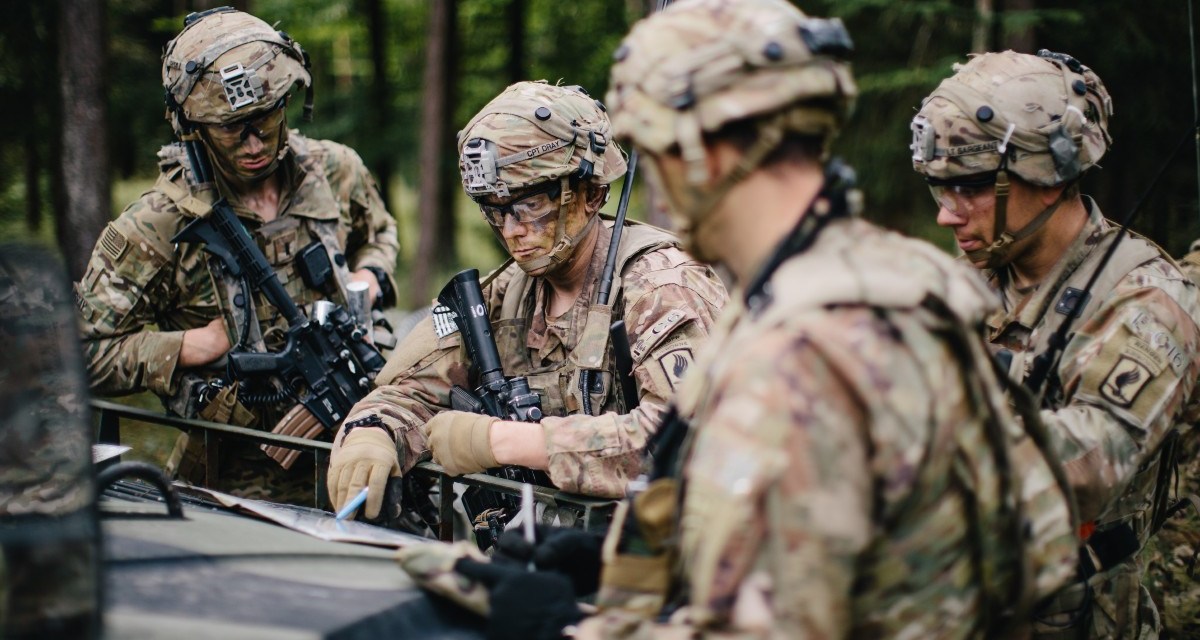
Image credit: Spc. Ryan Lucas, US Army