The crisis is upon us. An entire region has been pushed to the brink of major war. It is an event the US military has prepared for—yet almost immediately, the first signs of problems emerge. Messaging from US stakeholders is uneven; in some cases, it even contradicts itself. More consequentially, the combatant command is on its back foot, lacking the access, placement, and ongoing influence necessary to shape key audiences in ways that meet the demands of the emerging threat. Assumptions about how allies and partners will respond prove fragile or unfounded. Within hours, it becomes clear that influence activities—largely episodic and disconnected—have failed to shape the environment in advance of crisis and now scramble to gain traction during it. In the aftermath, these failures will be attributed to familiar explanations that blame interagency friction, political sensitivities, and the inherent difficulty of influence activities during competition. Yet the more important question is whether something different could have been done: whether influence campaigning was ever sufficiently prioritized, integrated, and aligned to the most consequential aspects of competition in the first place.
Strategic competition demands persistent influence campaigning at scale. Yet combatant commands continue to treat influence activities as bottom-up, disconnected capabilities rather than directing integrated theater-level campaigns. Theater plans contain broad influence objectives, but their scope routinely outpaces the scale of operations, activities, and investments (OAIs) aligned against them, rendering them largely unachievable. With subordinate commands independently choosing which OAIs to undertake, seldom are those OAIs tied to the most consequential aspects of competition. Coherent campaigning is essential to affect meaningful collaboration with interagency partners and gain approvals necessary to pursue combatant command objectives. Military activities outside of areas of ongoing hostilities require chief of mission concurrence. Military influence efforts therefore tend to reflect what is politically expedient rather than what is competitively decisive, as embassy country teams prioritize diplomatic risk management and bilateral relationships. The problem is less a lack of authorities than a failure to prioritize and integrate influence around achievable objectives supported by senior leader engagements. Short of that, embassies default to gatekeeping while forcing junior officers to negotiate permissions that should be settled by flag officers and politically appointed civilian leaders. Until combatant commands adopt a far more targeted and deliberate approach to influence campaigning against a finite set of prioritized influence requirements, interagency integration and operational permissions will remain a perpetual uphill struggle.
Normalizing Influence to Compete at Scale
Influence activities, discrete actions designed to shape foreign audience behavior, occupy a unique position within joint force capabilities. They entail specialized and often compartmented expertise, distinct approval processes, and varying levels of risk tolerance that can lead to organizational friction. The Department of Defense influence toolkit includes both cognitively focused capabilities and the dissemination means required to employ them. These capabilities vary in attribution, visibility, and risk. Absent deliberate campaign design, this complexity produces friction rather than complementary effects.
The department has a structurally fragmented approach to approvals, resourcing, and force management—treating influence capabilities as distinctly siloed. Combatant commands tend to plan influence activities at too high a degree of generality and without assigning mission lanes to subordinate units, further exacerbating the problem of divergent planning priorities, portfolios, and execution pathways. Subordinate service component commands develop influence activity concepts that fit broad guidance. However, in practice almost any proposed activity can be defended as supporting campaign objectives, regardless of priority. Gaining approval for influence activities is often difficult. When subordinate components plan for influence activities, they can easily gravitate toward near-term overt messaging—typically public affairs or key leader engagements—that require no additional authorities or resources and require less planning time. Their efforts align more readily on exercises and training events, which may be intensive but are only episodic. Furthermore, component commands often submit a singular capability request that serves only their own operations rather than supporting the joint force in theater more broadly.
Nevertheless, combatant commands remain the true locus of integration for plans, capabilities, and execution within the department. At that level, establishing the right priorities and an influence campaigning approach are essential. Without them, combatant commands inadvertently bleed efficiency, inhibit the potential effectiveness of overall operations, and drain finite global resources. Historically, combatant commands have viewed certain influence capabilities, such as psychological operations or military deception, as primarily within the purview of theater special operations commands. However, this paradigm is changing. While special operations forces remain essential, the modern need to compete at scale increasingly demands that conventional forces take a greater role in influence campaigning within clearly defined combatant command priorities, strategies, and mission lanes to guide them.
A Design Lens for Influence Campaigning
Influence campaigning is not simply about messaging—it is about shaping positional advantage and decision calculus in competition by blending physical and cognitive effects. To do so successfully, combatant commands must determine what matters most for influence campaigning with more granularity. Not all state adversary actions are inherently bad or counter to important US interests, nor do all malign activities rise to a level requiring US military attention or response. Prioritization is vital to effectively manage risk, resources, and effort. Just as the department must judiciously balance hard power and intelligence, surveillance, and reconnaissance assets around the globe, the same logic applies to influence activities. Combatant commands must align the precious few information forces available to them against the most important campaigning efforts—specifically, the most vital aspects of theater plans. Three interrelated and cross-cutting campaigning priorities undergirding the very purpose of theater plans are positional advantage, deterrence, and threats. Taken together, these priorities provide the combatant command with a logical design lens for aligning influence activities, authorities, and resources in competition.
First, influence is required to enable positional advantage, particularly access, basing, and overflight, as well as the posture necessary to execute theater plans. Second, influence activities should directly support deterrence against priority state adversaries. Third, influence activities must focus on threats for two bounded purposes: (1) countering state adversary campaigns deliberately designed to undermine US positional advantage and deterrence; and (2) countering foreign terrorist organizations that pose a direct threat to the homeland. These priorities are mutually reinforcing and must be undertaken through unified action, blending observable physical actions and influence activities, to produce operational effects. Achieving these outcomes requires combatant commander–directed campaigning for human, information, and physical advantages within the operational environment.
Deterrence is a central strategic organizing obligation for the joint force. Many theater plans are constructed primarily to deter threats to the homeland or contain regional threats. Accordingly, influence activities must be prioritized deliberately to shape adversary perceptions and decision-making in support of deterrence. Furthermore, many deterrent activities are predicated upon positional advantage as a precondition for effective employment. Deterrent activities, such as forward presence or pulsed operations, are conducted to alter an adversary’s decision-making calculus. Physical OAIs such as these, which punctuate periods of competition for deterrent effect, carry greater resonance when influence activities can amplify them to the right audiences in the right ways. Similarly, influence activities are more credible and effective when paired with observable physical OAIs that carry psychological weight and signal unambiguous intent, with purely deterrent actions being some of the starkest examples. This physical-information nexus, leveraged appropriately, reduces the likelihood of a fratricidal say/do gap emerging that could weaken or undermine combatant command narratives. To better plan for OAI amplification and resonance with key audiences, combatant commands should develop central narratives that place priority activities or high-impact OAIs in context and deliberately lay the groundwork for overt, nonpublic, and clandestine influence activities. To meaningfully operationalize this integration, combatant commands require a disciplined planning construct.
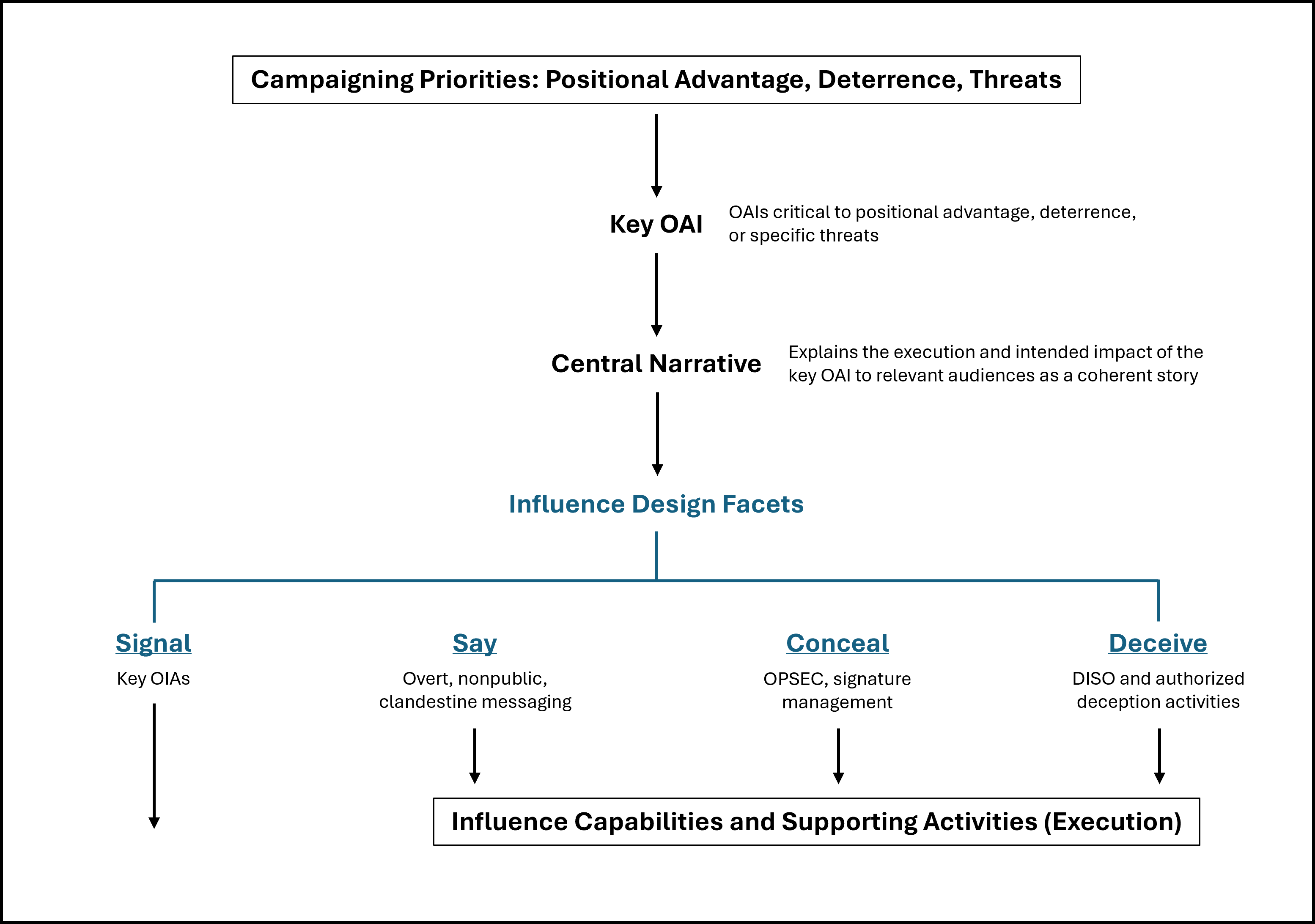
Planners should frame influence around four design facets—what they signal, say, conceal, and deceive—aligned to priority OAIs, respective narratives, and key audiences (Figure 1). Physical actions signal intent; inform and influence activities reinforce narrative coherence; concealment and deception preserve advantage and shape adversary decision-making. In an era of pervasive technical surveillance, effective campaigning requires deliberate sequencing—protecting capabilities through concealment, shaping perceptions through deception and operations security, and amplifying key actions at strategically decisive moments. Framing these facets around priority OAIs integrates physical and influence activities and strengthens their deterrent effect. While positional advantage and deterrence shape the competitive environment, influence must also confront active threats that undermine both.
Threats—both state and nonstate—exist in every region of the world. However, combatant commands must be discerning in determining those threats that warrant sustained military focus and those that do not. State adversaries actively challenge US positional advantage in ways that inhibit the joint force’s ability to set the theater and deploy, sustain, and execute lethal operations. Threat activities that directly erode US deterrence should receive priority influence support. Meanwhile, nonstate threats, primarily designated foreign terrorist organizations, will continue to absorb intelligence community attention and, at times, demand US military action to protect the homeland. Prioritizing the most dangerous of those groups remains essential. Taken together, these two threat categories constitute the third campaigning priority. Disrupting such threats is often best accomplished as part of broader irregular warfare approaches and may be more suitable for combatant commands to assign to theater special operations commands within the influence campaign. In such cases, influence activities should continue to leverage observable physical OAIs to the maximum extent possible, with joint force influence OAIs often shaping efforts to enable interagency or partner force prosecution of selected targets. Even when priorities are properly defined, the feasibility of influence campaigning in competition depends on external conditions that differ markedly from wartime environments.
Why Precision Beats Massed Activity in Competition
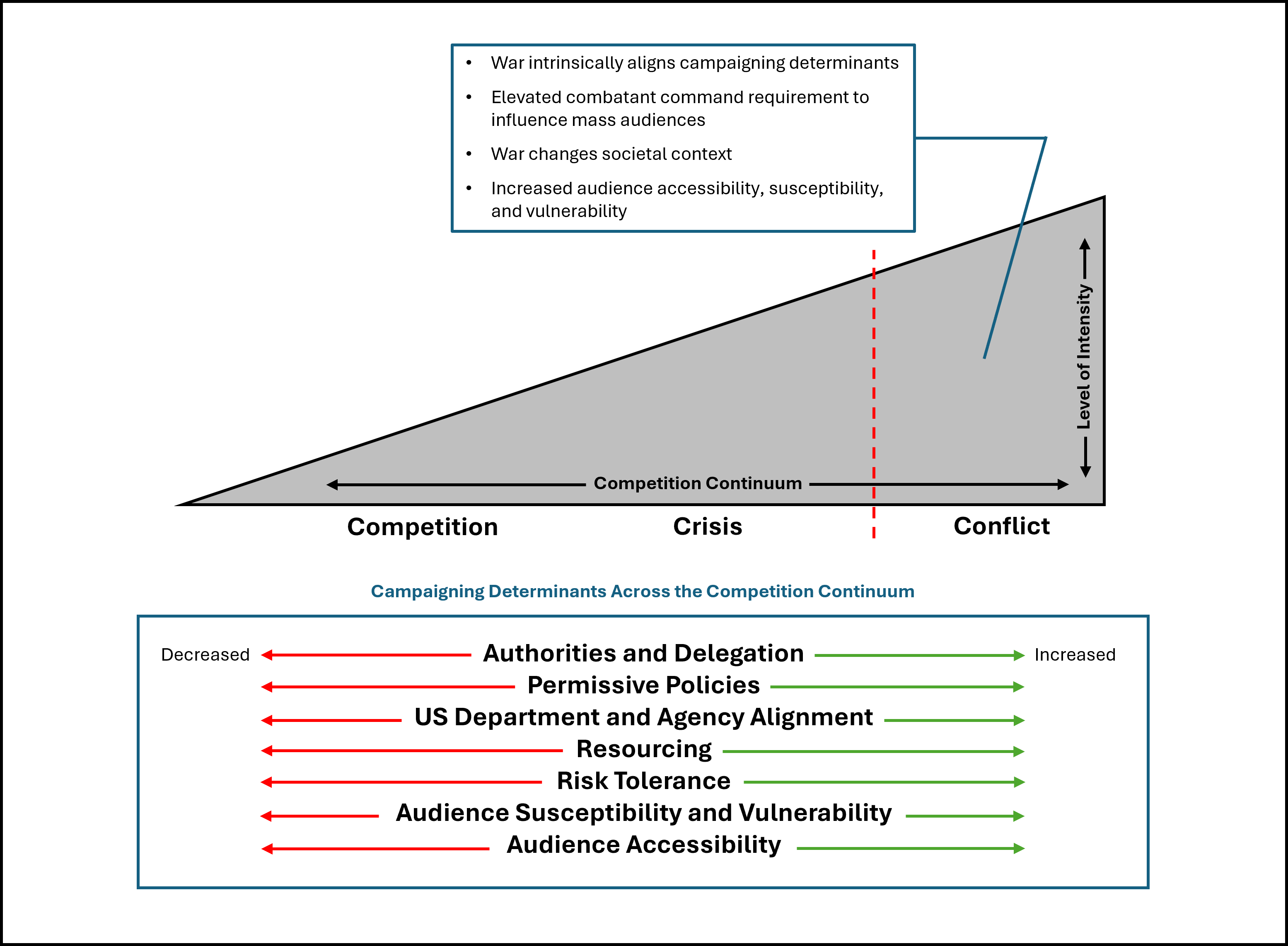
Influence activities frequently are the most difficult aspect of campaigning to plan and execute during competition. Interagency stakeholders commonly view them as more politically sensitive than training and exercise events, and sometimes more sensitive than deterrent physical OAIs themselves. Influence planning is governed by campaigning determinants: external conditions that shape feasibility and risk. For analytical purposes, these determinants can be grouped as institutional (policy, authorities, resourcing, risk tolerance) and audience-driven (accessibility, vulnerability, and susceptibility). In competition, they often function as constraints or outright barriers. While combatant commands do not control all determinants, they can shape how policy constraints and interagency equities are applied in practice through prioritization, campaign design, and senior-level engagement.
In war, departments align, authorities and risk tolerance expand, and the joint force gains access to higher-end capabilities that enable scale, including to mass audiences. In competition, the inverse is generally true: Permissions narrow, resources are spread across multiple combatant commands and reallocated during crises, and thresholds for employing sensitive means remain high. These realities do not make influence campaigning impracticable, but they fundamentally alter its logic. Under competitive conditions, advantage is created less through massed activity than through disciplined prioritization and precision in execution.
Behavioral change requires more than exposure to messages. It depends on audience accessibility, vulnerability, and susceptibility and on driving toward a tipping point into action. These factors are shaped by environmental conditions. War is a powerful generator of vulnerability, disrupting security and governance, while also imposing wide-ranging population consequences that require mass messaging. In competition, vulnerability and susceptibility are generally lower, and mass messaging alone is rarely sufficient to move audiences to action. Instead, influence must exploit existing vulnerabilities where they exist or deliberately shape conditions to increase vulnerability. While mass audience communication appropriately remains the domain of public affairs and embassy public diplomacy, effective influence campaigning during competition should shift toward finite, discrete decision-makers and groups whose choices directly affect positional advantage, deterrence, and threats. As a corollary, this approach also better supports assessment and measures of effectiveness—which is often little more than a chimera, more focused on measuring sentiment than observable behavior.
There are two planner-controlled aspects that also may introduce tensions into campaigning determinants—audience selection and attribution. Contemporary influence activities have suffered from an overemphasis on mass audience messaging during competition. A common example is broad counter-disinformation efforts aimed at mass audiences that are usually not tethered to physical OAIs and unlikely to produce durable behavioral effects in competitive environments. The question as to whether mass audience targeting is appropriate is consequential because it directly shapes whether campaigning determinants enable or constrain combatant command activities.
The second tension in influence campaigning concerns attribution. Attribution presents a tradeoff between credibility and political risk. While attributed messaging may carry greater credibility, it can elevate political sensitivity, incentivizing reliance on nonattributed means. Defaulting to nonattribution, however, often reflects pure risk avoidance rather than deliberate design grounded in more important considerations of effectiveness. These tensions become most evident when commands inevitably coordinate with embassies for concurrence to execute OAIs.
The Embassy as a Gatekeeper
Ambassadors bear personal responsibility for the entirety of US government activity in-country and must weigh host-nation sovereignty, bilateral relationships, domestic political sensitivities, strategic guidance, and congressional oversight when assessing risk. Influence activities outside areas of hostilities require chief of mission concurrence, making embassy engagement unavoidable and inherently political. Military personnel typically engage embassies during short rotations in a given country, placing them at a structural disadvantage and reinforcing embassy caution. Commands usually send company-grade or junior field-grade officers who must quickly learn the lay of the land, assess opportunities, and find somebody in the embassy who can shepherd them through country team bureaucracy. Eager to demonstrate progress and build credibility with the country team, officers often gravitate toward proposals that reflect the lowest common denominator between organizations. The expectation is that incremental cooperation will eventually unlock support for higher-priority efforts. In practice, however, this approach delays consideration of priority objectives and diverts limited resources toward peripheral activities.
A more effective approach to enabling influence campaigning is deliberate senior leader engagement at the general and flag officer level. Flag-level ownership signals seriousness to ambassadors and interagency partners. Without it, friction accumulates on the shoulders of junior officers and embassies understandably default to slower pace and more bureaucratic controls as they balance competing priorities. The responsibility for enabling senior leader engagements rests squarely with combatant command and service component staffs. Influence activities are seldom routine from an approval standpoint, and it is incumbent upon staffs to craft coherent guidance, prepare and arm senior leaders, and shape their engagements with embassies and interagency partners in support of practitioners.
Another key aspect of embassy engagement is that alignment and prioritization of influence activities must make sense from an embassy perspective. Ambassadors and embassy staff are rightfully cautious of Department of Defense activities, and combatant commands must anticipate embassy views on risk by planning priority OAIs that are scoped appropriately and mitigate that risk. Combatant commands should focus on influence campaigning priorities in competition (positional advantage, deterrence, and threats); be more targeted and integrated against definitive audiences; shape and exploit underlying audience conditions; and employ dissemination tools most appropriate for accessing those audiences. Though this approach is no panacea, activities planned in this manner and reinforced by flag-level engagement stand a far better chance of overcoming embassy apprehensions.
Disciplined Influence Campaigning to Compete at Scale
Combatant commands have both the responsibility and the leverage to campaign effectively for influence in competition, but doing so requires a deliberate shift in approach and role. They should focus on defining a limited set of narrow priority objectives, identifying the OAIs that anchor those priorities, and deliberately shaping the conditions that make audiences receptive to influence. To compete at scale, combatant commands must also direct and enable service component commands to execute persistent influence campaigning. While this approach does not solve all combatant command problems of scale in theater, it will better utilize time, unique capabilities, divisions of labor, resources, and integration toward fulfillment of objectives.
With priorities and mission lanes established at the combatant command level, the design burden shifts appropriately to subordinate components. Components should plan influence approaches tied to specific OAIs, identify relevant audiences, and determine the influence effects required to support theater objectives. They must also articulate the authorities, permissions, and resources necessary to execute those approaches. Combatant commands then assemble these requirements as interlocking pieces of a larger puzzle, seeking and sequencing authorities not as isolated line items but as a coherent set that enables the joint force to signal, say, conceal, and deceive in a coordinated manner around central narratives tied to priority OAIs. Clear mission lanes prevent the common pattern of components submitting isolated capability requests optimized for their own operations rather than the joint force’s campaigning requirements.
Influence effectiveness in competition derives less from permissiveness than from disciplined prioritization and deliberate alignment of authorities, access, and audience conditions around a finite set of priority OAIs. By focusing senior-level engagement on securing the right authorities for the right OAIs in support of the right priorities—and delegating detailed planning and execution to components—combatant commands can avoid dispersing limited influence capabilities across unconstrained ambitions. Campaigning for influence in competition therefore becomes an exercise in measured judgment: deciding where conditions are sufficiently favorable, aligning authorities accordingly, and enabling cumulative effect through direction, delegation, and coherence rather than volume.

Ultimately, the ability to wield influence in competition at scale will not come from expanding authorities, proliferating activities, or chasing mass audiences. It will come from disciplined influence campaigning, focusing on what matters most, aligning influence and physical actions through coherent narratives, and operating with a clear-eyed understanding of institutional and audience constraints.
The persistent friction surrounding influence campaigning is not a problem of permissions or process. Rather, it is the predictable result of incoherent priorities and ambiguous mission lanes. Combatant commands possess the perspective and authority to correct this. They must define narrow, defensible priorities, secure and delegate the authorities that matter, and empower components to execute persistent influence campaigning within those lanes. In an era of continuous competition, anything less risks advantaging adversaries who are already campaigning with purpose.
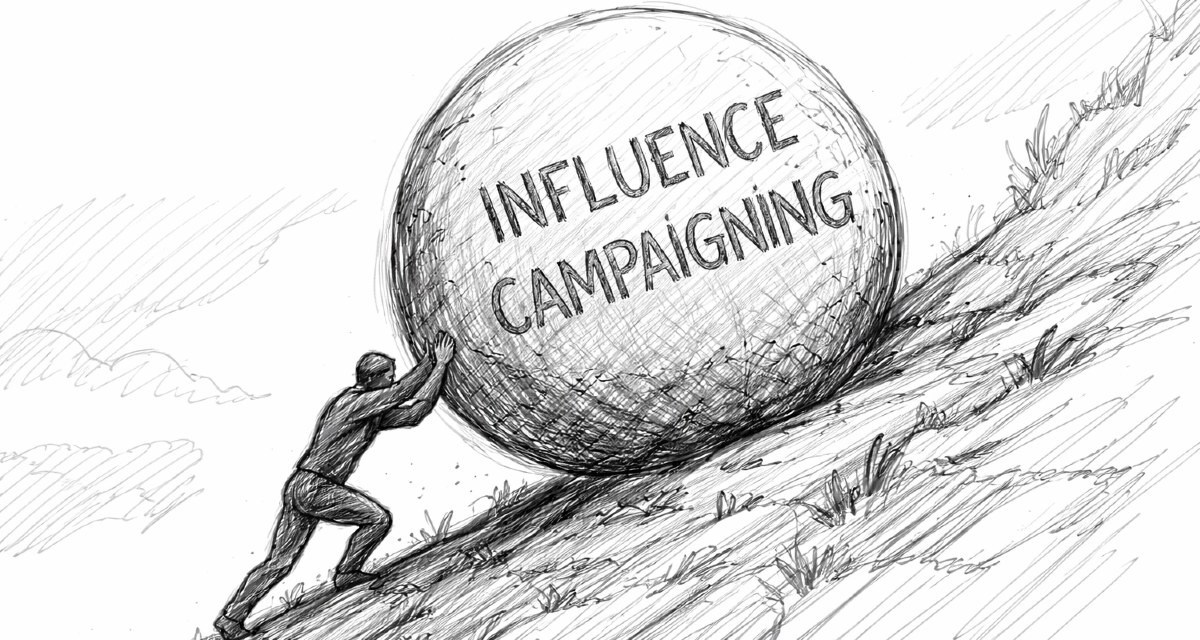
Competition demands a more selective model of influence campaigning—one that accepts constraint, favors coherence over volume, and measures success through cumulative effects rather than isolated outputs. By campaigning for the right objectives, against the right audiences, and through the means most feasible under competitive conditions, combatant commands can move beyond Sisyphean effort and reasonably shape the operational environment in advance of crisis and conflict.
Colonel Jeremy S. Mushtare, US Army, serves as a senior advisor for influence campaigning within the Office of the Secretary of War. He has commanded units in special operations and airborne formations and has served in interagency assignments at both US embassies and the Department of State. His experience spans tactical through strategic levels of war across multiple geographic combatant commands.
The views expressed are those of the author and do not reflect the official position of the United States Military Academy, Department of the Army, or Department of Defense.