At first glance, placing Army modernization of small unmanned aircraft systems—sUAS—under the leadership of the aviation branch seems reasonable. After all, sUAS fly and share battlefield airspace with crewed aircraft, so it is logical for the Army to charge the Aviation Center of Excellence to manage the modernization of all sUAS platforms (including Groups 1 and 2).
But beyond the fact that sUAS, like the crewed aircraft that belong to the aviation branch, fly, there is good reason for the Maneuver Center of Excellence (MCoE) to assume responsibility for the management of modernizing and integrating sUAS, which are inextricably linked to ground maneuver forces’ missions. These systems are fielded and employed almost exclusively at maneuver battalion formations and below, in both conventional and special operations units.
First, it’s important to scope the argument. The Army uses a five-tier taxonomy to categorize unmanned aircraft systems. The case for the maneuver community to own modernization is limited to Groups 1 and 2. To a much greater degree, larger systems in Groups 3 through 5 share characteristics with manned aircraft and fulfill similar missions. But the sUAS in Groups 1 and 2 routinely operate with maneuver forces at the tactical edge, and that will only increase as more systems are fielded.
Below is a table of Group 1 and 2 sUAS systems currently part of the Army’s UAS strategy.
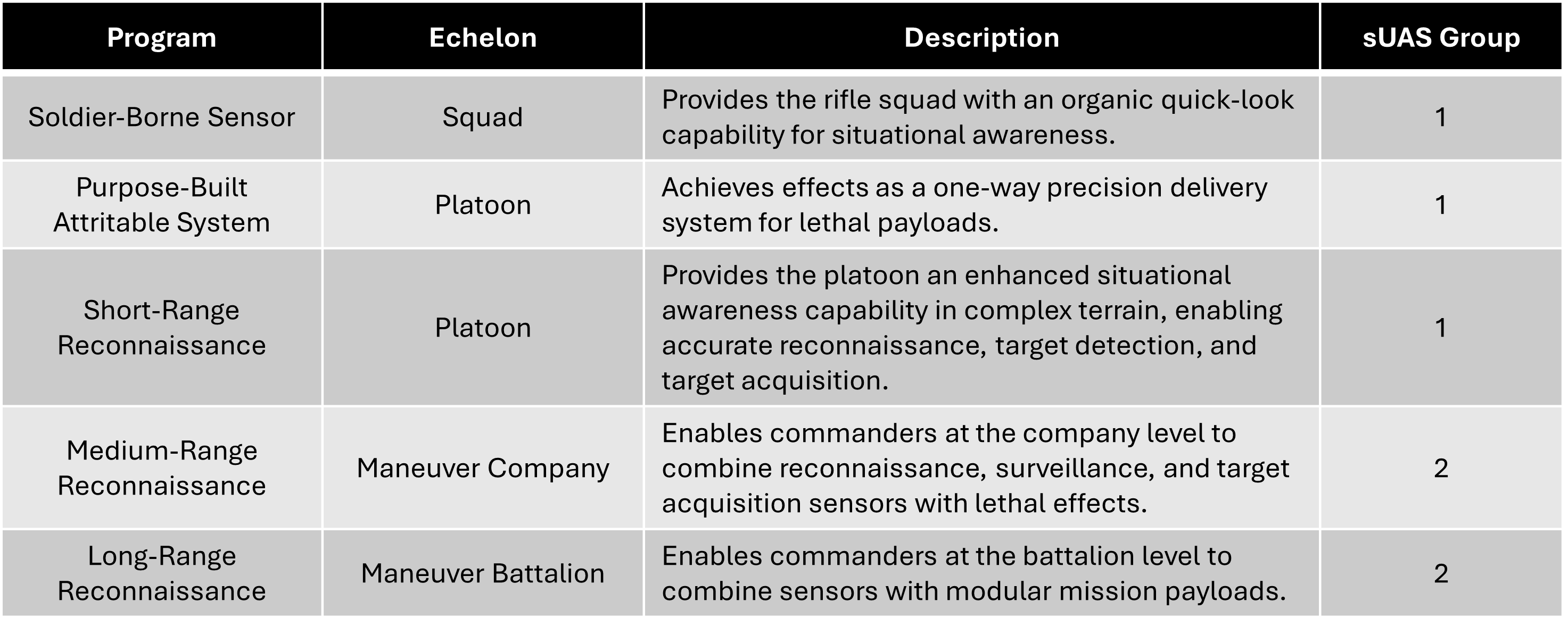
Given the intended use cases described in the strategy, assigning responsibility to the MCoE is logical. Four reasons in particular stand out.
Requirements Generation
Group 2 and below sUAS requirements are developed by the Maneuver Future Capability Directorate (MFCD), which is collocated with the MCoE at Fort Benning, Georgia. The directorate has a strong record of successful requirements generation and is primarily responsible for the writing and approval of the Joint sUAS Capability Development Document and its Army supporting annexes, including for programs for long-range reconnaissance, medium-range reconnaissance, and a purpose-built attritable system.
In addition, the MFCD generated the Company-level sUAS Directed Requirement, a program that has resulted in the fielding of specific Medium-Range Reconnaissance surrogates such as the Anduril Ghost-X and the Precision Drone Works C100. These systems have been fielded into the transformation-in-contact brigades and have a high acceptance rating with sUAS operators and units where they are fielded.
Requirements and Acquisition Partnership
The MFCD has a close partnership with the UAS Project Office at Redstone Arsenal, Alabama. Based on more than four years of repetitions in requirements generation teamwork, the collaborative relationship has a proven record of successful development and fielding of Group 1 and 2 sUAS. Examples include the proliferation of platoon short-range reconnaissance systems to the force, both initial and improved variants; fielding Company-level sUAS Directed Requirement systems to transformation-in-contact brigades, with an improved variant effort underway; and a maneuver battalion long-range reconnaissance program with systems fielded to and evaluated by the 25th Infantry Division.
Training, Doctrine, and Formation Integration
It should be unquestioned that the most sensible and efficient training base for sUAS is at the MCoE. The SUAS Master Trainer Course develops leaders that can support maneuver commanders in the field by training and certifying sUAS operators. Graduates are awarded the U2 additional skill identifier and serve as a unit commander’s key asset in maintaining a strong bench of operators and enhancing unit readiness. The MCoE also instructs graduates of infantry and armor one-station unit training in sUAS operation in preparation for follow-on training at their units of assignment. Future MCoE courses planned include an advanced sUAS operator course that will integrate lethality and a robotics leader course that will instruct maneuver officers and noncommissioned officers on the employment of robotics and autonomous systems.
Planning and employment of sUAS are also included in the curriculum at the Infantry and Armor Basic Office Leader Courses as well as the MCoE Noncommissioned Officer Academy. Fort Benning functional resident courses such as the Reconnaissance and Surveillance Leaders Course and the Army Ranger School also use sUAS as a critical training tool during the instruction of reconnaissance, surveillance, and small-unit infantry tasks.
In addition to the training dimension, doctrine also factors centrally in the discussion. The MCoE Doctrine Branch serves as lead in the development of the latest maneuver doctrine that employs sUAS. The branch is actively writing and staffing three publications that are directed at operators and crewmembers for the tactical employment of sUAS at each formation echelon. In addition, the branch is developing a sUAS crew gunnery circular to define lethal sUAS training and associated crew qualification.
And then there is the MCoE’s formation integration function. Fort Benning is the home of the transformation and lessons learned managers for the Army’s mobile, Stryker, and armored brigade combat teams, where the overwhelming majority of sUAS operators are assigned. And while operator development and training are important, formation integration and the employment of sUAS into combat unit missions and tasks are proving to be the most important facet of modernization. As the number of transformation-in-contact brigades increases, so do opportunities for sUAS development, fielding, and modernization. The transformation and lessons learned managers play a vital role by managing transformation efforts and sharing capability lessons learned with the modernization enterprise. In addition, they assist in requirements development by conducting rigorous analysis and integration studies based on lessons learned from their constant presence at the combat training centers and relevant operational feedback from the transformation-in-contact formations.
Key User Community
Finally, the MFCD develops all requirements in conjunction with the user community. One of the most important formations in that community is the 75th Ranger Regiment, located at Fort Benning. It houses the most advanced and skilled sUAS operators in the Army. In the last four years, operators from the regiment have been instrumental in the development and selection of every Army Groups 1 and 2 sUAS, from the rifle squad up to the maneuver battalion.

The Army’s center of gravity for sUAS modernization is located at Fort Benning. The MCoE is where the requirements are generated, where the soldiers and leaders are trained to operate and employ the systems, where the latest doctrine is written, and where the modernization enterprise studies and analyzes formations for operational lessons learned and sUAS integration. While coordination with the Aviation Center of Excellence should (and will) continue—especially, but not limited to, policy issues that will affect both sUAS and larger, Groups 3–5 systems—the sUAS requirements generation, doctrine and training development, and formation integration management must continue to occur at Fort Benning, under the leadership of the MCoE commander.
Unmanned systems are rapidly changing the character of warfare, with battlefield effects extending from the tactical to the strategic level. For those that Army maneuver forces at the tip of the spear will increasingly rely on—Groups 1 and 2 sUAS—the greatest potential for maximizing their battlefield advantage will come from assigning responsibility for their modernization to the Maneuver Center of Excellence.
John Dudas is a capability developer and requirements writer with the Maneuver Future Capability Directorate at Fort Benning, Georgia.
The views expressed are those of the author and do not reflect the official position of the United States Military Academy, Department of the Army, or Department of Defense.
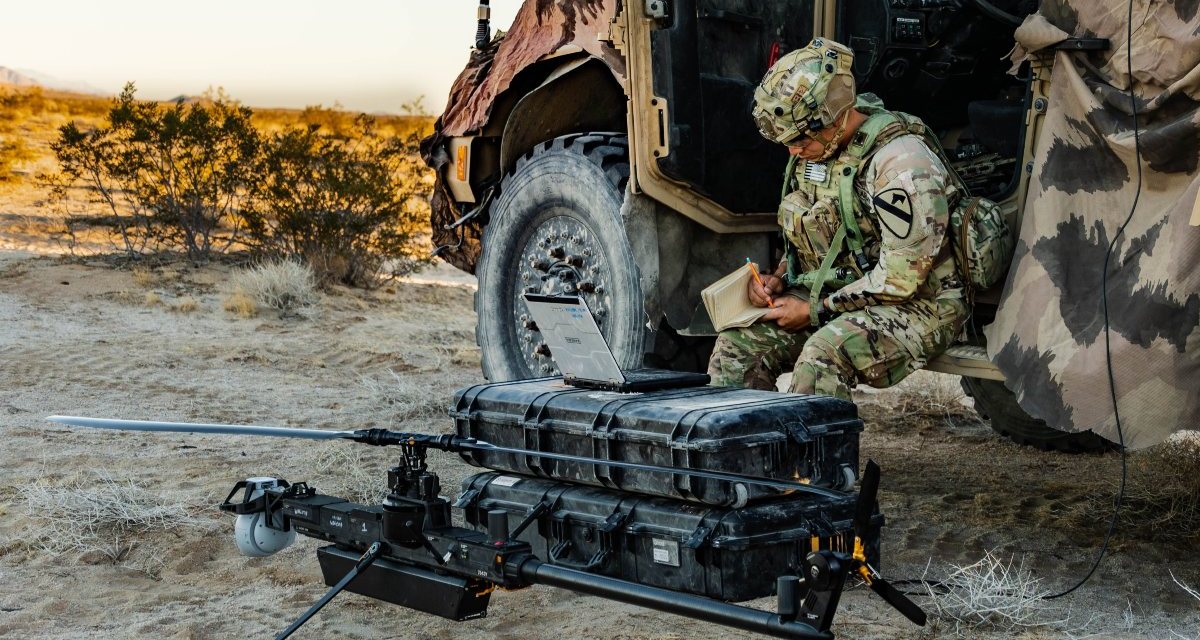
Image credit: Spc. Julian A. Winston, US Army