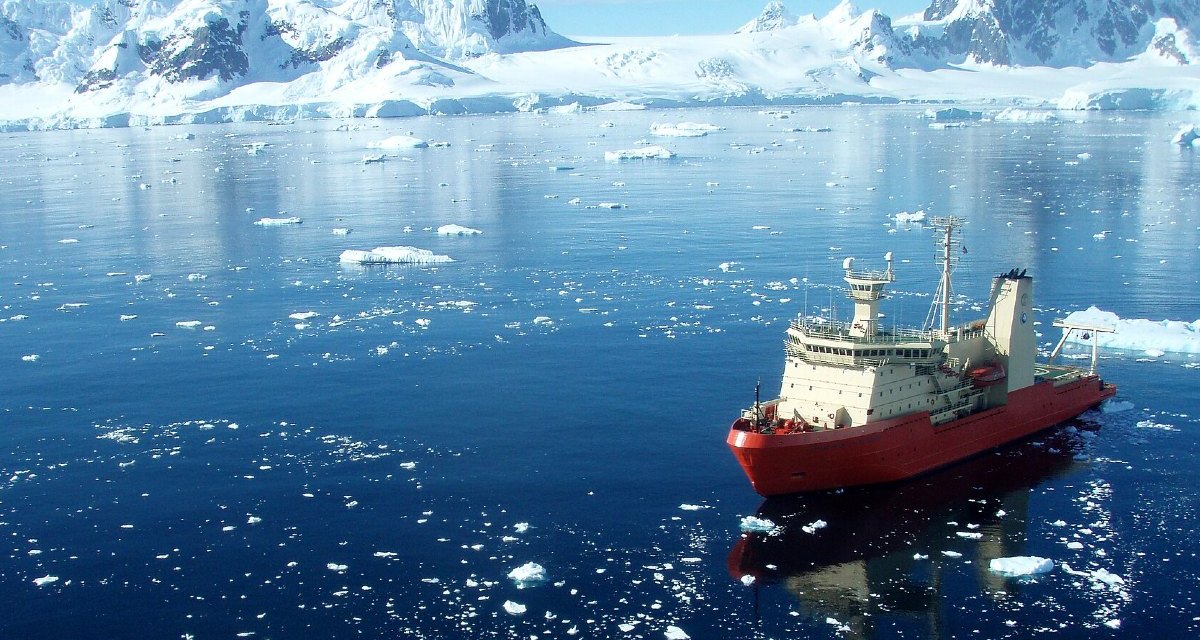
The December announcement that the United States would withdraw its last dedicated research ship from Antarctica marks the loss of America’s only independent maritime research capability in the southern polar region. This goes beyond science funding; it marks a strategic retreat in a remote region where influence is exercised through presence, data, and partnerships. At the same moment, the United States is building polar capability in the Arctic to counter China and Russia. This decision exposes a contradiction in US polar strategy: Washington recognizes that presence matters in remote but increasingly accessible environments—like the Arctic, as well as the space domain—yet is voluntarily reducing its ability to operate in Antarctica. That retreat will carry consequences in a region where competitors are quietly expanding. Antarctic research matters because it underwrites US climate intelligence, forecasting, and global commons governance. The risk is not militarization in the traditional sense, but dual-use infrastructure, future treaty stress, and loss of independent situational awareness. All of these bear on the United States’ strategic competition with rivals.
Under the Antarctic Treaty, the United States’ ability to deter militarization does not rest on force projection but on continuous access, independent data collection, and inspection capacity. Treaty parties retain the right to conduct unannounced inspections of stations, ships, and aircraft to verify compliance with demilitarization provisions, but those rights are meaningful only if states can physically reach Antarctic facilities on their own terms. The United States has conducted the most unannounced inspections of any country (sixteen since the treaty entered into force in 1961). The latest, in January 2026, saw the Department of State and an interagency group that included the National Science Foundation and Department of Defense complete a five-day inspection of Australian, Chinese, Indian, and Russian research stations. A former White House official noted the United States is concerned Beijing is using research stations for both civilian and military purposes, while a Chinese embassy spokesperson in Washington stated China’s activities are “consistent with the stipulations of the Antarctic Treaty System.” Inspections are thus an invaluable tool, and the loss of US-controlled maritime research and logistics platforms reduces American capacity to monitor expanding foreign infrastructure, verify dual-use activities, and independently assess changes in shipping patterns, air operations, and seabed activity in the Southern Ocean. Reduced access means greater reliance on foreign data and self-reporting in a system that relies on transparency to function. Moreover, Australia and New Zealand provided logistics for the most recent inspection trip, underscoring how diminished US access increasingly forces reliance on allied platforms—and goodwill—to exercise treaty rights that were historically supported by independent American polar capability.
The United States has maintained a coordinated Antarctic research and operational program since 1959, when the US Antarctic Program was founded following the International Geophysical Year. Managed by the National Science Foundation under a presidential mandate, the program operates three year-round stations (McMurdo, Amundsen-Scott South Pole, and Palmer Stations) and supports scientific expeditions as the principal expression of US policy in Antarctica. This sustained engagement, anchored in the Antarctic Treaty’s framework for peaceful scientific cooperation, reflects decades of strategic investment by successive administrations. There are seventy permanent research bases on the continent, representing twenty-nine countries and treaty signatories. Although remote, Antarctica plays an outsized role in our planet’s climate systems. The loss of dedicated maritime access constrains American scientists’ ability to study the Southern Ocean, a system that directly influences global sea levels, atmospheric circulation, and weather patterns that shape US agriculture, fisheries, and coastal resilience. And data collected in Antarctica underpins forecasting models relied upon not only by American farmers and coastal planners, but also by disaster-response agencies and the US military. This is not theoretical: Antarctica-based research has repeatedly reshaped global environmental policy and climate risk assessment. Antarctic research stations were where scientists first identified the ozone hole in the 1980s, catalyzing the 1987 Montreal Protocol and reshaping global environmental policy. Satellite measurements of rapidly retreating West Antarctic glaciers since the 2000s have driven revised global sea-level projections now used in coastal risk planning worldwide. And Antarctic and Southern Ocean measurements since the 2010s have shown that the region absorbs a disproportionate share of global ocean carbon, reshaping climate models and carbon budget estimates used in international policy. This is precisely why losing independent, ship-based access to and operational retreat from Antarctica carries consequences well beyond the continent itself. Today, National Science Foundation–supported Antarctic research is uniquely valuable because it sustains continuous, long-term datasets that directly inform US flood-risk maps, military installation resilience planning, insurance markets, and disaster response timelines. Interruptions in ice-sheet, ocean circulation, and atmospheric observations, particularly in systems like the Thwaites Glacier and the Southern Ocean, create permanent blind spots, as lost years of polar data cannot be reconstructed after the fact.
At the same time, the administration of President Donald Trump is authorizing new icebreaker construction to project US power in the Arctic. That investment reflects a clear recognition that sustained presence, access, and operational capability matter in polar regions with intensifying strategic competition. If Washington accepts that polar access is a strategic necessity in the Arctic, it should apply the same logic to Antarctica. In both places, the strategic truth is identical: Presence matters.
Antarctica does not have the same geopolitics as the Arctic. There are no active resource grabs or newly opened sea lanes; instead, influence is exercised through scientific presence, operational partnerships, and long-term cooperation. In this sense, Antarctica more closely resembles space than the Arctic—it is a region where sustained participation, not territorial control, will determine leadership. In March 2025, for example, Russia and China announced plans to construct new research stations near one another in Marie Byrd Land, an unclaimed territory in West Antarctica, underscoring how scientific infrastructure is increasingly used to anchor influence. Russia, China, India, and Australia already coordinate activities in the Larsemann Hills under an Antarctic Specially Managed Area. Cooperation itself is not the concern; rather, it is the long-term rebalancing of influence that occurs when the United States reduces its own operational presence while others deepen theirs.
China has publicly insisted that its Antarctic activities carry no geopolitical intent, cautioning against “overreading” Beijing’s Antarctic designs. However, US government assessments have taken a more measured view. A 2022 Department of Defense report concluded that China’s expanding Antarctic presence is likely intended to strengthen its position for potential future access to natural resources and strategic maritime routes and noted the deployment of dual-use technologies capable of supporting both scientific and military objectives. In a governance system built on transparency and trust, the ability to independently observe, verify, and participate matters; that capability is diminished when the United States reduces its own operational footprint.
The Antarctic Treaty System governs Antarctica through a delicate balance of frozen sovereignty claims, scientific cooperation, and mutual inspection rights—a system that remains stable only so long as major powers continue to actively engage with and invest in it. The system has endured for more than six decades because major powers have chosen sustained participation over withdrawal; its stability is not self-executing. Russia explicitly treats Antarctic presence as a component of its foreign policy, with official documents framing scientific activity as serving broader geopolitical and economic purposes, raising concerns that Moscow’s broader disregard for international law could eventually test treaty commitments banning commercial resource exploitation and militarization. While that scenario remains hypothetical, the ability to shape outcomes within the treaty system rests on active presence. Reducing US operational capacity in Antarctica weakens American leverage inside the system itself, not just beyond it.
Washington is rightly focused on building Arctic capability amid rising Chinese and Russian activity. That same strategic lens should apply to Antarctica.
Recent Antarctic campaigns indicate that the continent is no longer a distant scientific outpost but an increasingly active industrial and maritime space with strategic consequences. During the 2024–2025 season, Chile’s new icebreaker Almirante Viel completed its first Antarctic deployment; Argentina successfully landed a military Saab 340 transport aircraft for the first time on the newly constructed airstrip at Petrel Base; and Brazil’s icebreaker Almirante Maximiano reached waters south of the Antarctic Circle for the first time. These investments support not only science but sustained access to the Southern Ocean. The waters surrounding Antarctica sit astride the primary maritime routes connecting the Atlantic and Pacific via the Drake Passage and Southern Ocean; these are routes already crowded with fishing vessels and likely to see increased traffic as resource activity, tourism, and logistics expand. In a region with overlapping territorial claims by Argentina, Chile, and the United Kingdom, and a history of South Atlantic conflict, rising ship density and industrial activity elevate the risk of incidents at sea, coercive presence, and escalation. While the Antarctic Treaty has constrained overt militarization, expanding control over access, shipping lanes, and logistics infrastructure increasingly turns maritime presence into a strategic lever rather than neutral science.
This erosion has practical consequences for the US national security community. Antarctic data and access underpin DoD climate risk assessments, coastal installation planning, sealift forecasting, and Southern Ocean maritime domain awareness, even though these functions are often downstream of National Science Foundation operations. As US logistics capacity contracts, so does the government’s ability to independently validate foreign activity, anticipate climate-driven instability affecting US forces and allies, and plan for contingencies in a region that connects the Atlantic and Indo-Pacific theaters. This is not about deploying forces to Antarctica, but about preserving the access and data needed for credible planning elsewhere.
In May 2025, the White House proposed a 56 percent cut from $9 billion down to $3.9 billion for the National Science Foundation. In response, the foundation’s proposed fiscal year 2026 budget request reduced funding for the Office of Polar Programs from $559.8 million in fiscal year 2024 to $497.2 million in fiscal year 2026. Congress ultimately rejected most science cuts and enacted an $8.75 billion foundation budget, near prior levels, preserving polar funding above the request. The issue is not whether Antarctic science is valuable, but whether the United States will retain the access required to sustain Antarctic governance and verification. Erosion of National Science Foundation–supported operations will reduce the United States’ ability to independently observe activity, conduct treaty inspections, and validate compliance. Over time, this shifts influence toward states that maintain year-round access and logistics capacity, regardless of stated intent.
The United States does not face an imminent military confrontation in Antarctica. The risk is slower and structural: declining access, gaps in data continuity, and loss of independent verification across a continent that connects the Atlantic and Indo-Pacific and underpins global climate and maritime systems. Preventing that outcome does not require new doctrine or force posture, only sustained investment in the logistical and scientific infrastructure that has long served as the foundation of US presence.
DeLaine Mayer is a member of the New York University SPS Energy, Climate Justice and Sustainability Lab Advisory Board and professor at New York University’s Center for Global Affairs. She holds an MS in space resources from the Colorado School of Mines and an MS in global affairs from NYU. Her work explores the intersections of emerging technology, international relations, geopolitics, and frontier domains.
The views expressed are those of the author and do not reflect the official position of the United States Military Academy, Department of the Army, or Department of Defense.
Image credit: Adam Jenkins, National Science Foundation