Editor’s note: This article begins an eight-part series led by retired General James Mingus, the thirty-ninth vice chief of staff of the Army, on transforming the Army to meet the challenges of tomorrow’s battlefield.
When our nation was attacked on September 11, 2001, the US special operations community immediately began to plan for operations in Afghanistan. They quickly identified hundreds of information gaps, many of which were general and fundamental: Where exactly was Afghanistan? What languages do they speak? How tall are the mountains? How many rivers do they have? Information on the region was sparse and spread across multiple formats and sources, and teams spent days just gathering data, with no chance to even begin to address the more complex, nuanced understanding the mission required. We headed off to combat with only a rudimentary understanding of the operational environment. This experience highlights a critical challenge facing today’s military leaders—the tendency to become mired in raw data rather than ascending to higher levels of cognitive understanding. In an era of great power competition and rapidly evolving threats, this challenge has become existential. Residing in the data layer cedes initiative and decision space and could cost us the fight. Leaders must leverage new technology and artificial intelligence to automate foundational tasks to turn data into knowledge and quickly create shared understanding to achieve decision dominance.
The Need for Change: From Manual to Automated
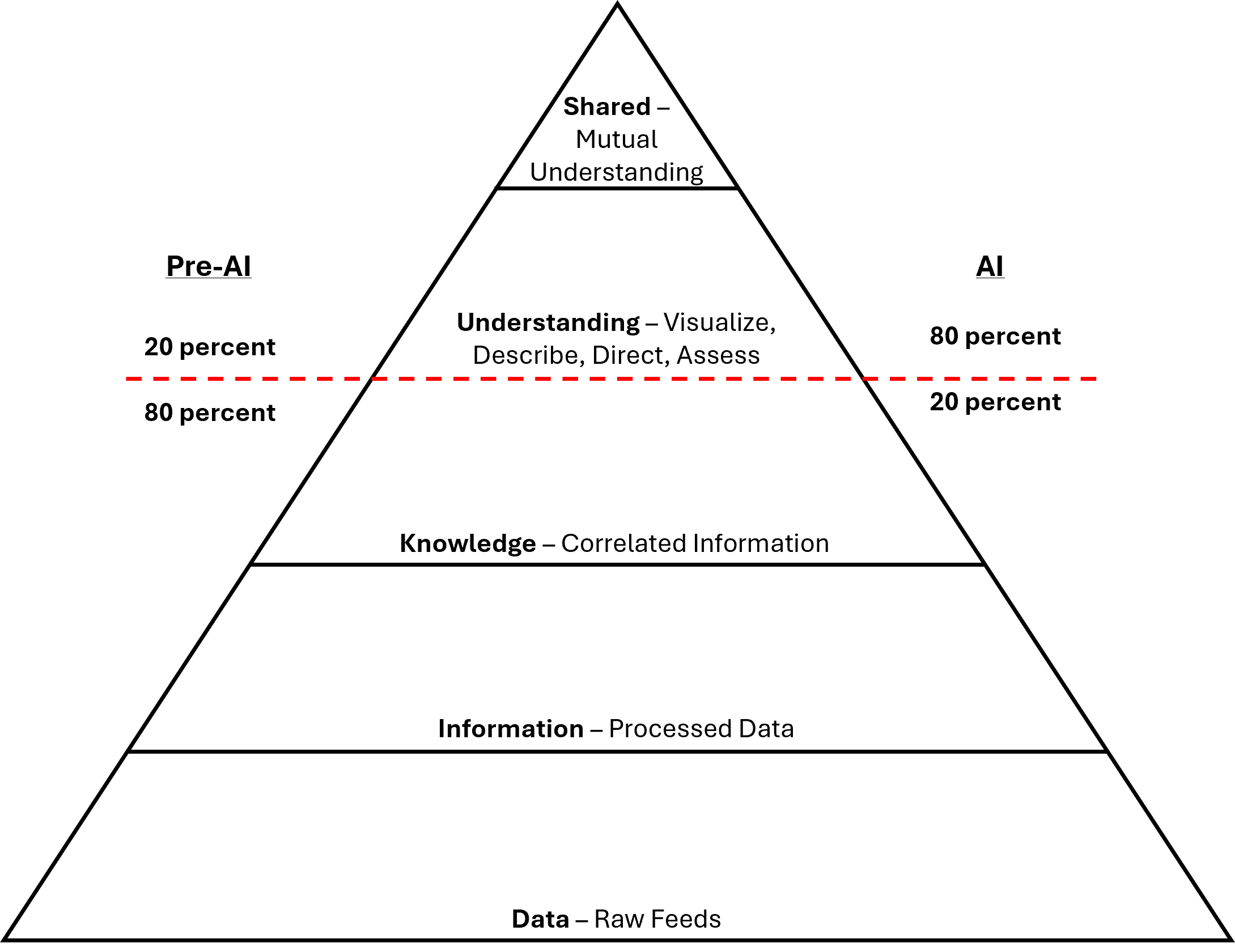
The way most leaders currently approach military decision-making relies heavily on manual data aggregation, leaving them bogged down in the lower tiers of the cognitive hierarchy (Figure 1). If you’re spending your time manually correlating data, you’re functioning as an analyst, not a commander or leader. This reactive posture is slow and unsustainable in the face of modern threats. Historically, leaders have spent most of their time—perhaps as much as 80 percent—on data and information processing. If as little as 20 percent of time is left for higher-order thinking, this asymmetry leaves us vulnerable to deception and information overload, intensifying the ever-present fog of war and forcing decisions downward into chaos.
Meanwhile, our principal adversaries have industrialized their approach to data processing, leveraging “informationized” warfare to gain a decisive edge. Their ability to process and exploit data at scale highlights the urgency for the Army to adapt. Remaining competitive requires us to leverage AI to invert this 80/20 paradigm: Automate the lower-tier cognitive tasks and redirect 80 percent of human effort toward deep understanding, thinking, and visualization. This shift allows us to prioritize and modulate tasks while retaining key terrain in the understanding layer. In this new cognitive battlespace, AI manages data like raw sensor feeds and research; parses it into information through natural language processing, pattern recognition, and correlation; and creates knowledge through predictive modeling and inference. Now leaders will be free to focus on the more challenging task of understanding—discerning intent, applying ethics, and crafting strategy.
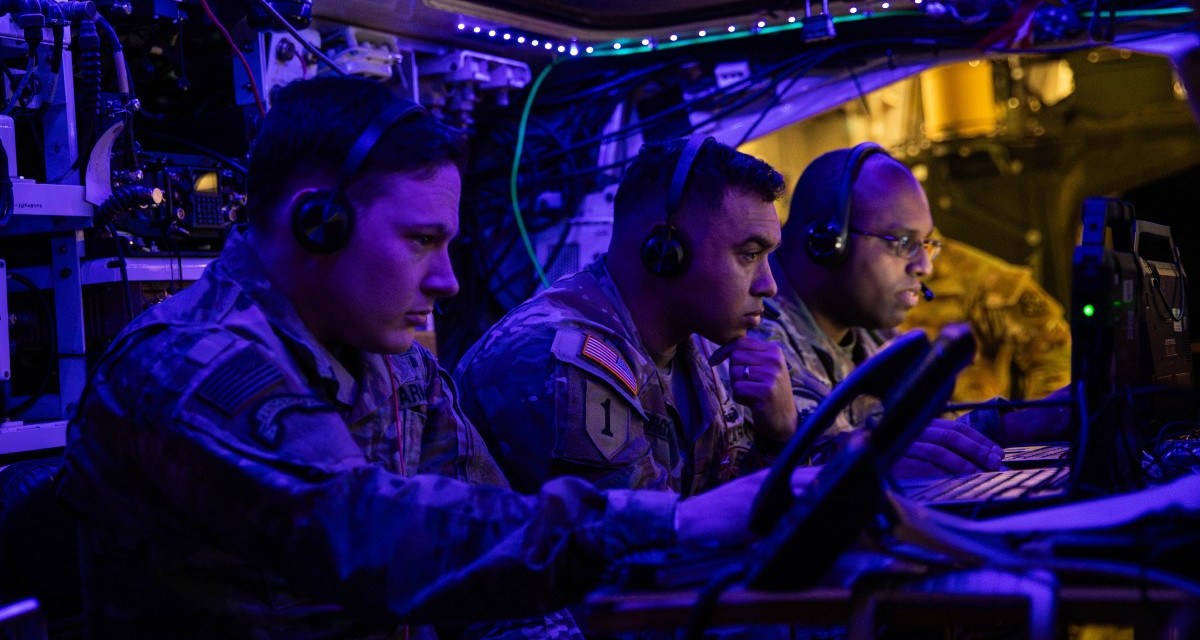
For instance, in intelligence preparation of the operational environment, AI can instantly fuse terrain analysis, enemy order of battle, and doctrinal templates to develop several threat courses of action (COAs). The S2 (intelligence) and S3 (operations) staff sections can add in the current enemy situation template as well as friendly operational plan and leverage AI to let the machine run and wargame hundreds of COAs. This human-machine teaming greatly reduces the time required for mission analysis and COA development, enabling compressed planning cycles and information superiority that places us inside the adversary’s decision timeline.
However, without the pervasive adoption of AI, this cognitive leap will remain out of reach. Our Army must sustain momentum in AI literacy through professional military education, incentivizing self-study programs, integrating proven industry tools into daily operations, and advancing cutting-edge initiatives such as the secretary of the Army’s Project ARIA (Army Rapid Implementation of AI). Programs already underway through continuous transformation that experiment with automated fusion, analytics, and decision-support tools demonstrate how commanders can leverage AI to change the force from one that sifts data, to one that shapes outcomes.
Risks: The Human-AI Balance
While AI offers transformative potential, it is not without risks. Blind spots such as hallucinations, cultural nuances, and the potential erosion of human intuition through overreliance can undermine decision-making if left unchecked. The Army must emphasize human-AI teaming to mitigate these risks. Remember, AI loads and aims; you assess and pull the trigger. Leaders must validate AI outputs, stress-test systems, and retain the ability to override automated processes when necessary.
Moreover, leaders must maintain mastery in our science of warfighting before they can exercise its art. AI literacy must be a cornerstone of professional development, ensuring leaders understand the technology’s mechanics, limitations, and failure modes to intervene decisively when AI crashes, hallucinates, or produces flawed outputs. At the end of the day, foundational human judgment will serve as the ultimate backstop for AI’s operational effectiveness.
Lead the Charge
Residing in the data layer saps momentum and invites defeat. Climbing out of that layer requires us to embrace AI as a force multiplier, automating basic tasks and focusing on understanding for decision advantage. Every soldier must assume ownership of this transformation. The Army’s relentless pursuit of AI excellence will enable leaders to better understand, visualize, describe, direct, and assess, ensuring that we deter, fight, and win in the battles of tomorrow.
The imperative is clear: Adapt or become irrelevant. Lead the way.
Retired General James Mingus served as the thirty-ninth vice chief of staff of the Army.
Major Zak Daker is an aviation officer and the AI advisor to the vice chief of staff of the Army.
The views expressed are those of the authors and do not reflect the official position of the United States Military Academy, Department of the Army, or Department of Defense.
Image credit: Spc. William Kuang, US Army